| |
|
Xiamen Oil Paintings, Wholesale Direct!
|
|
100% hand painted, 100% cotton canvas, 100% money back if not satisfaction. |
|
|
|
|
ART WORKS INDEX
A
B
C
D
E
F
G
H
I
J
K
L
M
N
O
P
Q
R
S
T
U
V
W
X
Y
Z
|
|
ARTISTS INDEX
A
B
C
D
E
F
G
H
I
J
K
L
M
N
O
P
Q
R
S
T
U
V
W
X
Y
Z
|
|
|
|
|
|
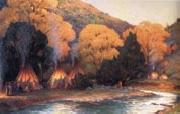 |
Sharp Joseph Henry
|
|
American Painter, 1859-1953
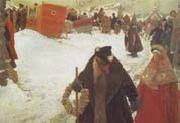
was a painter credited with influencing the creation of the Taos, New Mexico Society of Artists. Sharp may have been the first artist to discover Taos when he visited in 1883. He painted American Indian portraits and cultural life, and Western landscapes. As a youth he permanently damaged his hearing in a near-drowning accident, and gradually become totally deaf. His formal art training included Mckmicken School of Design (Cincinnati) and Antwerp (Belgium) Academy. He traveled and worked in Europe also. Harpers Magazine commissioned his illustrations of Taos Indian life. Some portraits were purchased by the Smithsonian Institution. President Theodore Roosevelt took an interest in him and had a cabin built for him at Little Big Horn to paint Indian life there.
|
|
|
|
 |
Shalva Kikodze
|
|
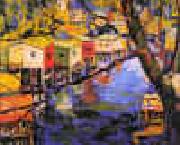
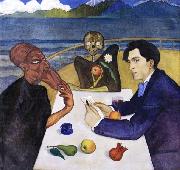
Shalva Kikodze (Georgian: შალვა ქიქოძე) (1894 - 1921) was a Georgian expressionist painter, graphic artist and theatre decorator. Together with Lado Gudiashvili and David Kakabadze, he is considered a key figure in Georgian art of the early 20th century.
He was born in a remote Georgian village Bakhvi, Guria, then part of the Russian Empire. From 1914 to 1918, he studied at Moscow School of Painting, Sculpture and Architecture. In 1916, he took part in an expedition to the Georgian village Nabakhtevi and made copies of the 15th-century murals from the local church. He stayed in his motherland for a short period of 1918-1920, and worked chiefly as a theater decorator for Jabadari Theater in Tbilisi. Afterwards he moved to Paris, where he, together with his fellow painters, Gudiashvili and Kakabadze, held an exhibition in 1921. He died in Freiburg, Germany, on November 7, 1921
|
|
 |
shah-u-gada
|
|
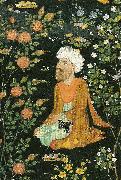
In Vishnudharmottara Purana, Kubera is described as the embodiment of both Artha ("wealth, prosperity, glory") and Arthashastras, treatises related to it and his iconography mirrors it. Kubera's complexion is described as that of lotus leaves. He rides a man - the state personified, adorned in golden clothes and ornaments, symbolizing his wealth. His left eye is yellow. He wears a armour and necklace upto his large belly. His face should be inclined to the left, sporting a beard and moustache and with two small tusks protruding from the ends of his mouth, representing his powers to punish and bestow favours. His wife Riddhi - representing the journey of life - is seated on his left lap, with her left hand on the back of Kubera and right holding a ratna-patra ("jewel-pot"). He should be four-armed, holding a gada (mace - symbol of dandaniti - administration of justice) and a shakti (power) in his left pair and standards bearing a lion - representing artha and a shibika (a club, the weapon of Kubera). The nidhi treasures Padma and Shankha stand besides him in human forms with their heads emerging from a lotus and a conch respectively. Agni Purana states that Kubera should be installed in temples as seated on a goat with club in his hand. Kubera's image is prescribed to be of gold with multi-coloured attributes
|
|
|
|
 |
Severin Roesen
|
|
1848-1871
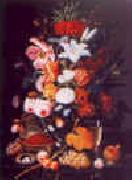
Severin Roesen (ca. 1815-1872) is a painter known for his abundant fruit and flower still lifes and is today recognized as one of the major American still-life painters of the mid-nineteenth century. Born in Cologne, in Germany, he emigrated to the United States in 1848.
While Roesen's paintings reveal a meticulous attention to detail in their precise arrangements and close brushwork, his subject matter, even down to specific motifs, did not change throughout his career. Sometimes he made near copies of paintings, but usually he merely rearranged and reassembled stock elements.
Numerous items in Fruit and Wine Glass, for example, also appear in other paintings. The footed desert plate full of strawberries is a common motif. The pilsner glass, sometimes accompanied by an open bottle of champagne, is interchangeable with a wine goblet filled with lemonade used elsewhere. The glass is nearly always placed at the lower left edge of the painting; a halved lemon often appears nearby. Branches full of grapes arranged from lower left to upper right provide the composition with a graceful S-curve and subtly lead the viewer's eye over the entire display. Here the composition is balanced by light and dark grapes at either side and filled in by scattered raspberries, cherries, peaches, apples, pears, and apricots. Many of these compositional elements, if not the items depicted, were derived from seventeenth-century Dutch still life paintings by such artists as Jan van Huysem.
|
|
 |
Severin Nilsson
|
|
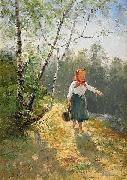
(1846 - 1918) was a Swedish painter and photographer.
He was born in Halland in the south of Sweden. He studied at the Royal Swedish Academy of Arts in Stockholm 1865 - 1871 and then under Leon Bonnat in Paris for three years.
Severin painted portraits, landscapes and genre pictures. A prolific artist, he participated in numerous exhibitions and left behind a large and diverse production of work. He was also one of the first Swedish documentary photographers. Inspired by Arthur Hazelius, he made photographic studies of public life, especially in the village Asige in Halland, where he was born
|
|
|
|
|
|
 |
SERODINE, Giovanni
|
|
Italian Baroque Era Painter, 1600-1630
Italian painter and stuccoist. His family moved from Ascona on Lake Maggiore to Rome, where his father is recorded in 1595. It is probable that Serodine was born there. His first work was probably done in association with his brother Giovanni Battista Serodine (1589/90-1630), a stuccoist active in Rome, where he carved a Virgin and Child (1614) for the fa?ade of S Francesca Romana, and in Ascona, where he restored the family home and decorated it with stucco (1620). The design and stucco decoration of the church of the Madonna della Fortuna on Monte Verit? (Ascona) are attributed to him, though it is probable that Giovanni (who is recorded in Ascona in 1620) collaborated in the work. The first of Giovanni's documented official commissions, however, was for the stucco decoration and apsidal paintings in the chuch of the Concezione at Spoleto, where he worked with Sante Ghezzi (Corradini; Toscano). These murals, painted in tempera and completed in July 1624, are sketchy and clumsily executed, quite distinct in their inferior quality and naive piety from the rest of Serodine's work. They are probably his first attempts at painting,
|
|
 |
Serhii Vasylkivsky
|
|
(October 19, 1854, Izium e October 7, 1917, Kharkiv) was one of the most prolific Ukrainian artists of the pre-revolutionary period and an expert on Ukrainian ornamentation and folk art.
Vasylkivsky grew up in an environment conducive to his development as an artist. He was born and spent his childhood in the picturesque surroundings of Izium, a city in the historical region of Sloboda Ukraine, and today's Kharkiv Oblast. The future painter had a chumak grandfather whose roots reached cossack ancestral lines. Vasylkivsky's father was a writer and taught his son the aesthetics of proper calligraphy. His mother, through her folk songs set the foundation which provided the inspiration for Vasylkivsky's art later in life.
When he was seven years old, his parents moved to Kharkiv, which at the time was a significant cultural center of Sloboda Ukraine. Vasylkivsky's first art lessons were given at the Kharkiv gymnasium by Dmytro Bezperchy, a student of Karl Briullov. During the years of his study, Vasylkivsky was able to use the extensive book collection of his relative and poet, V. Alexandrov. Among these were the works by Ivan Kotlyarevsky, Taras Shevchenko, and Nikolai Gogol, which made a strong impression on the young artist. After five years of education at the gymnasium and at the demand of his father, Vasylkivsky began studies at the Kharkiv Veterinary School. This lasted until 1873, when Vasylkivsky left veterinary studies due to his parents inability to pay for tuition. For a while, he worked as a civil servant in Kharkiv.
|
|
 |
Sergey Zaryanko
|
|
Sergey Konstantinovich Zaryanko (1818 - 1871) was a Russian painter, he was as a pupil of Venetzianov
|
|
|
|
|
|
|
|
 |
Sergei Sudeikin
|
|
Well-known Russian and emigre Symbolist painter, graphic artist, theater and film designer,1882-1946
was a Russian artist and set-designer associated with the Ballets Russes and the Metropolitan Opera. Having been banned from the Moscow School of Painting, Sculpture and Architecture for his "obscene drawings", Sudeikin joined the Mir Iskusstva movement. His close friends included the poet Mikhail Kuzmin and the impresario Serge Diaghilev, at whose invitation he came to Paris in 1906 for the Salon d'Automne Exhibition, where his work was first shown abroad. In 1907-1918, he was married to actress Olga Glebova (1885-1945), one of the famed beauties of St Petersburg and the closest friend of Anna Akhmatova. Glebova-Sudeikina is the principal character and addressee of Akhmatova's longest work, "The Poem Without Hero" (1940-65). Sudeikin designed the sets and costumes for Diaghilev's production of La trag??die de Salome by Florent Schmitt in 1913, and assisted in the execution of Nicholas Roerich's designs for Stravinsky's The Rite of Spring the same year. By the time of the October Revolution Sudeikin was among the foremost theatrical designers in Russia.
|
|
|
|
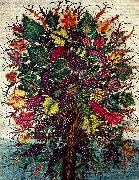 |
seraphine
|
|
Seraphine Louis, known as "Seraphine de Senlis" ("Seraphine of Senlis") (1864?C1942), was a French painter in the naïve style. Self-taught, she was inspired by her religious faith and by stained-glass church windows and other religious art. The intensity of her images, both in color and in replicative designs, are sometimes interpreted as a reflection of her own psyche, walking a tightrope between ecstasy and mental illness.
|
|
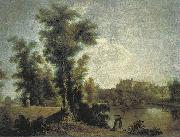 |
Semyon Shchedrin
|
|
(1745-1804) was a Russian landscape painter, the uncle and mentor of Sylvester Shchedrin.
He was born in St. Petersburg into the family of a life guard. In 1759, he entered the Academy of Arts in St. Petersburg, and in 1765 graduated with a gold medal and grants to study abroad. Shchedrin ventured to Paris, then to Rome. In Paris he studied the works of old and contemporary painters. Under the influence of Rousseau's idea that beauty exists not only in classic patterns of arts but also in everyday life and nature, Shchedrin worked much en plein-air, otherwise known as painting in outdoor environments. In Rome, however, he fell under the influence of classicism, the idea that art should reflect the works of antiquity and thus prolong their successes.
Shchedrin returned to St. Petersburg in 1776 and became a professor of landscape painting in the Academy of Arts. He was assigned to draw views of the palaces and parks of Catherine the Great, which brought into existence such works as View of the Large Pond Island in the Tsarskoselsky Gardens (1777), View of the Large Pond in the Tsarskoselsky Gardens (1777), View of the Farmyard in the Tsarskoye Selo (1777). After 1780, Shchedrin also participated in the restoration of pictures in the Hermitage, and in 1799 he headed a new class of landscape graphics.
The pinnacle of his art career came in the 1790s. The most famous of his works of the period are views of parks and palaces in Pavlovsk, Gatchina, and Petergof: The Mill and the Peel Tower at Pavlovsk (1792), View of the Gatchina Palace from the Silver Lake (1798), View of the Gatchina Palace from Long Island (1798), The Stone Bridge at Gatchina (1799-1801), View of the Kamennoostrovsky Palace through Bolshaya Nevka from the Stroganov Seashore (1803). The composition of all of his works is the same in accordance with the rules of academic classicism.
|
|
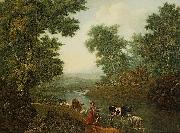 |
Semyon Fyodorovich Shchedrin
|
|
(1745-1804) was a Russian landscape painter, the uncle and mentor of Sylvester Shchedrin.
He was born in St. Petersburg into the family of a life guard. In 1759, he entered the Academy of Arts in St. Petersburg, and in 1765 graduated with a gold medal and grants to study abroad. Shchedrin ventured to Paris, then to Rome. In Paris he studied the works of old and contemporary painters. Under the influence of Rousseau's idea that beauty exists not only in classic patterns of arts but also in everyday life and nature, Shchedrin worked much en plein-air, otherwise known as painting in outdoor environments. In Rome, however, he fell under the influence of classicism, the idea that art should reflect the works of antiquity and thus prolong their successes.
Shchedrin returned to St. Petersburg in 1776 and became a professor of landscape painting in the Academy of Arts. He was assigned to draw views of the palaces and parks of Catherine the Great, which brought into existence such works as View of the Large Pond Island in the Tsarskoselsky Gardens (1777), View of the Large Pond in the Tsarskoselsky Gardens (1777), View of the Farmyard in the Tsarskoye Selo (1777). After 1780, Shchedrin also participated in the restoration of pictures in the Hermitage, and in 1799 he headed a new class of landscape graphics.
The pinnacle of his art career came in the 1790s. The most famous of his works of the period are views of parks and palaces in Pavlovsk, Gatchina, and Petergof: The Mill and the Peel Tower at Pavlovsk (1792), View of the Gatchina Palace from the Silver Lake (1798), View of the Gatchina Palace from Long Island (1798), The Stone Bridge at Gatchina (1799-1801), View of the Kamennoostrovsky Palace through Bolshaya Nevka from the Stroganov Seashore (1803).
|
|
|
|
|
|
 |
SEGHERS, Hercules
|
|
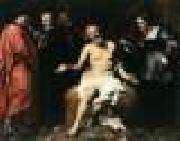
Dutch Baroque Era Painter and Printmaker, ca.1590-1638
Dutch landscape painter and etcher. Seghers's work greatly influenced early 17th-century Dutch landscape painting. He studied with the painter Coninxloo (1544C1607) and may have traveled to Italy and in the Alps. Some of the frenzy of his personal life can be seen in his rare paintings and his more numerous, masterly etchings. His landscapes consist of vast, often desolate, panoramas and powerful, smaller scenes rendered with drama and pathos. Rembrandt owned eight paintings by him, and his own landscape style was influenced by Seghers.
|
|
 |
SEGHERS, Gerard
|
|
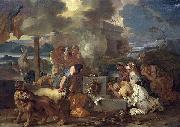
Flemish Baroque Era Painter, 1591-1651
Flemish painter, dealer and collector, active also in Italy and Spain. He grew up in Antwerp, a city that had only recently been liberated from the rebels by the Spanish troops. His father, a keeper of a wine tavern, originally had Calvinist sympathies but returned to the Catholic faith after 1585. Gerard possibly trained, as did afterwards his younger brother Jan Baptist Seghers, who later became a goldsmith, with Gaspar de Crayer (b 1551), the father of the well-known painter of the same name. At the age of 12 Seghers was listed as a pupil in the Guild of St Luke in Antwerp; the documents, unfortunately, fail to mention the name of his teacher. Florent Le Comte (1699) called him a pupil of Abraham Janssen
|
|
 |
Sebastien Bourdon
|
|
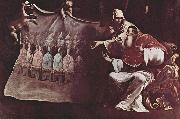
(2 February 1616 - 8 May 1671) was a French painter and engraver. His chef d'œuvre is The Crucifixion of St. Peter made for the church of Notre Dame.
The Finding of Moses, c. 1650 (National Gallery of Art, Washington)Bourdon was born in Montpellier, France, the son of a Protestant painter on glass. He was apprenticed to a painter in Paris. In spite of his poverty he managed to get to Rome in 1636; there he studied the paintings of Nicolas Poussin, Claude Lorrain and Caravaggio among his eclectic selection of models, until he was forced to flee in 1638, to escape denunciation by the Inquisition for his Protestant faith. Bourdon's facility rendered him adept at portraiture, whether in a dashing Rubens manner or in intimate, sympathetic bust-length or half-length portraits isolated against plain backgrounds that set a formula for middle-class portraiture for the rest of the century, landscapes in the manner of Gaspar Dughet or cappricci of ruins, mythological "history painting" like other members of Poussin's circle or the genre subjects of the Dutch Bamboccianti who were working in Rome. His eclectic range of styles have given art historians exercise in tracing his adaptation of his models, while the lack of an immediately recognizable "Bourdon style" has somewhat dampened public appreciation.
In 1652 Christina of Sweden made him her first court painter. Bourdon spent most of his working career outside France, where, though he was a founding member of the Academie de peinture et de sculpture (1648), he was for long largely dismissed as a pasticheur, a situation partly rebalanced by a comprehensive exhibition in 2000 of his work at the Musee Fabre, where the collection includes a fine Lamentation painted in the last years of his life.
His success required the establishment of an extensive atelier, where, among his other pupils worked Nicolas-Pierre Loir and Pierre Mosnier. He died in Paris in 1671.
|
|
 |
Sebastiano Ricci
|
|
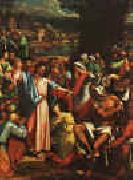
(1 August 1659 - 15 May 1734) was an Italian painter of the late Baroque school of Venice. About the same age as Piazzetta, and an elder contemporary of Tiepolo, he represents a late version of the vigorous and luminous Cortonesque style of grand manner fresco painting.
He was born in Belluno, son of Andreana and Livio Ricci. In 1671, he apprenticed to Federico Cerebri of Venice. Others claim Ricci's first master was Sebastiano Mazzoni. In 1678, a youthful indiscretion led to an unwanted pregnancy, and ultimately to a greater scandal, when Ricci was accused of attempting to poison the young pregnant woman to avoid marriage. Imprisoned, he gained release only after intervention of a nobleman, probably a Pisani family member. He married the pregnant mother in 1691, although this was a stormy union.
After his arrest, he moved to Bologna, where he domiciled near the Parish of San Michele del Mercato. His painting style there was apparently influenced by Giovanni Gioseffo dal Sole. On 28 September 1682 he was contracted by the "Fraternity of Saint John of Florence" to paint a Decapitation of John the Baptist for their Oratory. On 9 December 1685, the Count of San Segundo near Parma commissioned from Ricci the decoration of the Oratory of the Madonna of the Seraglio, which he completed in collaboration of Ferdinando Galli-Bibiena by October 1687, receiving a compensation of 4,482 Lira.
|
|
 |
Sebastiano del Piombo
|
|
1485-1547 Italian Sebastiano del Piombo Galleries
Italian painter. He was one of the most important artists in Italy in the first half of the 16th century, active in Venice and Rome. His early, Venetian, paintings are reminiscent of Giovanni Bellini and to a lesser extent of Giorgione. With his move to Rome in 1511 he came under the influence of Raphael and then of Michelangelo, who supplied him with drawings. After the death of Raphael (1520) he was the leading painter working in Rome and was particularly noted as a portrait painter. In his finest works, such as the Piete (1513; Viterbo, Mus. Civ.) and the Flagellation (1516-24; Rome, S Pietro in Montorio), there is a remarkable fusion of the Venetian use of colour and the grand manner of central Italian classicism.
|
|
 |
Sebastiano Conca
|
|
Italian Baroque Era Painter , 1680-1764
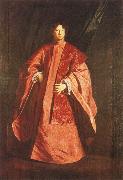
was an Italian painter. He was born at Gaeta, then part of the Kingdom of Naples, and apprenticed in Naples under Francesco Solimena. In 1706, along with his brother Giovanni, who acted as his assistant, he settled at Rome, where for several years he worked in chalk only, to improve his drawing. He was patronized by the Cardinal Ottoboni, who introduced him to Clement XI, who commissioned a well-received Jeremiah painted for the church of St. John Lateran. Conca was knighted by the pope. He collaborated with Carlo Maratta in the Coronation of Santa Cecilia in the namesake's church of Santa Cecilia in Trastevere (1721-24). He was elected in 1718 to the Accademia di San Luca and its director in 1729-1731 and 1739-1741. His painting was strongly influenced by the Baroque painter Luca Giordano. Among Conca's pupils were Pompeo Battoni, Andrea Casali, Placido Campoli, Corrado Giaquinto, Gaetano Lapis, Salvatore Monosilio, Literio Paladini, Drancesco Preziao, Rosalba Maria Salvioni, Gasparo Serenari, and Agostino Masucci, He received widespread official acclaim and patronage. He worked for a time for the Savoy family in Turin on the Oratory of San Filippo and Santa Teresa, in the Venaria (1721-1725), for Basilica di Superga (1726), and Royal Palace (1733). He painted frescoes of Probatica, or Pool of Siloam, in the Ospedale di Santa Maria della Scala (hospital) of Siena. In Genoa, he painted large allegorical canvases of the Palazzo Lomellini-Doria (1738-1740). In 1739, he published a guide to painting: Ammonimenti (or Admonishments), which blended moralistic advice with technique. He returned to Naples in 1752, and enjoyed the royal patronage of Charles III.
|
|
 |
Sebastiano Bombelli
|
|
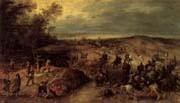
Italian, 1635-1719, Italian painter. He was perhaps the most influential Italian portrait painter of the later 17th century. His early style was formed by his father, Valentino Bombelli, a painter in Udine, and his godfather, the Mannerist artist Girolamo Lugaro. In the early 1660s he was in Venice (Boschini; Sansovino), where he responded passionately to the brilliant colour, painterly freedom and naturalism of 16th-century Venetian artists, particularly Veronese
|
|
 |
Sebastian Vrancx
|
|
Flemish Baroque Era Painter ,
b. 1573, Antwerpen, d. 1647, Antwerpen
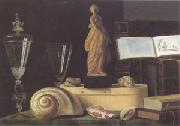
Antwerpen,was a Flemish Baroque painter and etcher of the Antwerp school. He was an apprentice in the workshop of Adam van Noort, who also trained many illustrious painters such as Peter Paul Rubens, Jacob Jordaens and Hendrik van Balen. He also visited the workshop of the Antwerp painter Paul Bril in Rome around 1600. He was esteemed as one of the main painters of battle scenes, and works by Vrancx were in the collection of Peter Paul Rubens. As a collaborator he worked at times with Jan Brueghel the Elder. and together with Rubens, Frans Francken the Younger, van Balen, Frans Snyders and Joos de Momper the Younger on the Allegory of the Senses, two works commissioned on the occasion of the archduke Albert of Austria's visit to Antwerp. His best-known student is Pieter Snayers. Most of his pictures represent biblical scenes or scenes of war, such as the sack of towns, cavalry combats, genre paintings and allegorical subjects. Though occasionally vigorous in drawing, his paintings are dull and heavy in tone. He was at the same time a writer of poetry, comedies and tragicomedies for the chamber of rhetoric De Violieren. He was served as dean of the Antwerp painters' Guild of St. Luke, and was a district head and captain of the militia. His works can be found in the Royal Museum of Fine Arts in Antwerp,
|
|
|
|
 |
Sebastian Stoskopff
|
|
Strasbourg 1597-Idstein 1657
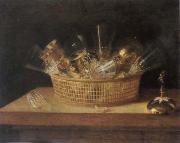
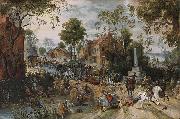
was an Alsatian painter. He is considered one of the most important German still life painters of his time. His works, which were rediscovered after 1930, portray goblets, cups and especially glasses. The reduction to a few objects, which is characteristic of early still life painting, can again be recognized in Stoskopff's painting. His chief works hang in Strasbourg and in Saarbr??cken. Sebastian Stoskopff was born in 1597 in Strasbourg. His father was employed by the city since 1590 and acted as a mounted courier or royal escort, driving a one-horse-carriage. In 1614, Stoskopff's father asked the Strasbourg council for help for his 17-year-old son. He wanted him to be able to learn the craft of painting, since Sebastian had already been extremely talented in drawing and painting since he was 15. The council agreed to provide their support and probably sent the young artist at first to the Strasbourg painter and copper engraver, Friedrich Brentel. However, he only learned how to further refine his drawing and was not, as hoped, introduced to the art of painting. In 1615, Stoskopff's father died and his widowed mother went to the Strasbourg council once again to ask for support for training from a recognized painter. Stoskopff was then sent to Daniel Soreau, a painter who was active in Hanau. In the beginning, Soreau was not very enthusiastic, since he usually chose his apprentices from among his relatives and close friends. However, he finally complied with the request of the council and assured them that would "make an Albrecht Derer of this apprentice". There is not a single definite picture by Daniel Soreau existing. It is only possible to draw conclusions about how well the master passed on his artistic skills to his students through the works of his sons, other apprentices of his workshop and through Stoskopff's works. After Soreau's death in 1619, Stoskopff took over his workshop with the apprentices, as well as his function as the master. One of the apprentices was Joachim von Sandrart, who later became a successful painter and who wrote the first important work on the history of art in the German language: "Teutsche Academie der Bau-, Bild,- und Malerey- Kenste". This work contains descriptions of the lives of earlier and contemporary artists, including descriptions of the time in Hanau with his master, Sebastian Stoskopff. After his attempt to get permission to settle in Frankfurt failed, Stoskopff went to Paris. He stayed there from about 1622 until 1639, which can be reconstructed from indirect reports and property inventories of Parisians. His first works in larger format were also created here, such as "Summer" or "Winter" (now both in Strasbourg).
|
|
 |
Sebastiaen Vrancx
|
|
(22 January 1573 - 19 May 1647) was a Flemish Baroque painter and etcher of the Antwerp school.
He was an apprentice in the workshop of Adam van Noort, who also trained many illustrious painters such as Peter Paul Rubens, Jacob Jordaens and Hendrik van Balen. He also visited the workshop of the Antwerp painter Paul Bril in Rome around 1600.
He was esteemed as one of the main painters of battle scenes, and works by Vranckx were in the collection of Peter Paul Rubens. As a collaborator he worked at times with Jan Brueghel the Elder. and together with Rubens, Frans Francken the Younger, van Balen, Frans Snyders and Joos de Momper the Younger on the Allegory of the Senses, two works commissioned on the occasion of the archduke Albert of Austria's visit to Antwerp. His best-known student is Pieter Snayers.
Most of his pictures represent biblical scenes or scenes of war, such as the sack of towns, cavalry combats, genre paintings and allegorical subjects. Though occasionally vigorous in drawing, his paintings are dull and heavy in tone.
He was at the same time a writer of poetry, comedies and tragicomedies for the chamber of rhetoric De Violieren. He was served as dean of the Antwerp painters' Guild of St. Luke, and was a district head and captain of the militia.
His works can be found in the Royal Museum of Fine Arts in Antwerp, Groeninge Museum in Bruges (both in Belgium) and the Noordbrabants museum in 's-Hertogenbosch and the Rijksmuseum in Amsterdam (the Netherlands). He is also represented with several drawings or paintings at the Hermitage in Saint Petersburg, the Harvard University Art Museums, the Louvre, Paris and several other museums.
|
|
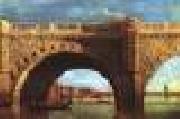 |
SCOTT, Samuel
|
|
English Painter, ca.1702-1772
English painter. In 1725 a sea-piece ascribed to Scott appeared at auction in London. In 1727 he was appointed Accomptant in the Stamp Office, Lincoln's Inn Square, London.
|
|
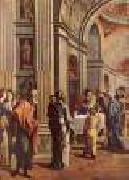 |
SCOREL, Jan van
|
|
Dutch Northern Renaissance Painter, 1495-1562
North Netherlandish painter and ecclesiastic. He was one of the first north Netherlandish artists to visit Italy, and his return to Utrecht in 1524 can be regarded as a turning-point in the history of painting in the northern Netherlands. The important role Scorel played in introducing Italian art in the north was recognized even by contemporary writers and was reiterated slightly later by van Mander
|
|
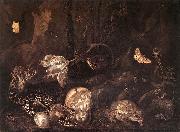 |
SCHRIECK, Otto Marseus van
|
|
Dutch Baroque Era Painter, 1619-1678
Dutch painter. According to Houbraken, he travelled to Italy and stayed in Rome and Florence with the painters Matthias Withoos and Willem van Aelst, the latter his pupil at the time. Among his patrons were Ferdinando II de' Medici, Grand Duke of Tuscany (reg 1621-70). Van Hoogstraten claimed that he met van Schrieck in Rome as late as 1652. In Rome, van Schrieck was a member of the Schildersbent. About 1657 he returned with van Aelst to Amsterdam, where he had a small property and got married on 25 April 1664. An inventory of the contents of his house was made in July 1678, shortly after his death, in which more than 300 paintings are listed. Besides his own paintings, there were works by Cornelis van Poelenburch, Simon de Vlieger, Ludolf Bakhuizen, Jan Wijnants, Lucas van Leyden
|
|
|
|
|
|
|
|
|
|
|
|
|
|
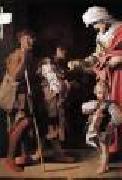 |
SCHEDONI, Bartolomeo
|
|
Italian painter, Emilian school (b. 1578, Modena, d. 1615, Parma)
Italian painter and draughtsman. He was the son of Giulio Schedoni, a mask-maker, who served the Este court in Modena and the Farnese in Parma; in 1598 Schedoni and his father are recorded as residing in Parma, both serving the court. In 1595 Ranuccio I, Duke of Parma, sent Bartolomeo to Rome, to train in the studio of Federico Zuccaro. Schedoni fell ill shortly after, however, and returned to Parma. His earliest surviving works show no evidence of Roman influence. The matter of Schedoni's training remains somewhat problematic. Carlo Cesare Malvasia claimed that he was a pupil of Annibale Carracci in Bologna, but there are reasons to doubt this. First, this would have been prior to Annibale's departure for Rome in 1595, a period when Schedoni was still apparently under his father's jurisdiction. Secondly, the early pictures indicate that initially his style was formed primarily by studying the work of Correggio in Parma. To a lesser degree he was influenced by the Parmesan culture of Parmigianino, Girolamo Mazzola Bedoli and Michelangelo Anselmi. As a boy in Parma he was also known to have frequented the studio of the Fleming Giovanni Sons (1547/8-1611).
|
|
 |
SCHAUFELEIN, Hans Leonhard
|
|
German Northern Renaissance Painter, ca.1480-1540
was a German painter, designer, and wood engraver. He was born in Nuremberg, probably studied under Wohlgemut, and then became the assistant of D??rer, whom he imitated. In 1512 he went to Augsburg and in 1515 removed to Nordlingen. He is a graceful narrator, and his types, though rarely accurately drawn, are attractive, but he lacks power and depth. Characteristic early paintings are the altarpiece at Ober Sankt Veit[1], near Vienna (1502), "Scenes from the Life of Christ" (Dresden Gallery), and "St. Jerome" (Germanic Museum, Nuremberg). To his Nordlingen period belong his masterpiece, the so-called "Ziegler Altar" for St. George's Church (1521), part of which is still in the church, part in the museum; "Scenes from the Story of Judith," in the town hall; and the illuminated Psalter for Count von Ottingen, now in the Berlin print room. His most important woodcuts are those for the Theuerdank of Emperor Maximilian.
|
|
 |
SCHALCKEN, Godfried
|
|
Dutch Baroque Era Painter, 1643-1706
Dutch painter and etcher, active also in England. He was the second son of Cornelis Schalcken from Heusden, a clergyman in Made, and Aletta Lydius, who came from a famous clerical family in Dordrecht. In 1654 the family moved to Dordrecht, where Cornelis was appointed headmaster of the Latin school. There Godfried was apprenticed to Samuel van Hoogstraten. He completed his training in Leiden with Gerrit Dou and by 1665 had returned to Dordrecht. Schalcken's earliest known works, for example the Doctor's Visit (1669; Germany, priv. col., on loan to Cologne, Wallraf-Richartz-Mus.), are dominated by the influence of Dou and the Leiden 'fine painters'. Like Dou, Schalcken painted small genre pieces with a wealth of painstakingly rendered detail, and his themes and frequent use of artificial lighting are strongly reminiscent of the Leiden master. The six prints known by him, including a portrait of Gerrit Dou and a few portraits after van Hoogstraten, must also originate from this period. Possibly under the influence of Caspar Netscher and Frans van Mieris, Schalcken soon afterwards adopted a freer touch with gentler transitions and a lighter palette and applied himself to painting genre pieces with elegant figures.
|
|
 |
Scarsellino
|
|
(1550 (or 1551) - 1620), was an Italian Late-Renaissance - Mannerist painter of the School of Ferrara. He was born and died in Ferrara; however, he traveled and worked extensively across Italy, encountering many influences. He was born to an artist father, the less-talented Sigismondo Scarsella. Apparently he lived in Venice for 4 years around 1570, though it is not known if he was affiliated to a particular studio. His early works show the influences of various contemporary styles and painters including the venetian schools and locally Dosso Dossi.
A number of his works now are at the Galleria Borghese in Rome, The Bathing Venus, Diana and Endymion and Venus and Adonis. Scarsellino worked alongside the brothers Carracci in the Palazzo dei Diamanti in Ferrara. However, unlike the Carracci, Scarsellino's paintings have a decorative quality, and lack monumentality. World War II bombing of Dresden destroyed two of his paintings: Flight into Egypt and Holy Family at Work.
|
|
 |
Sawrey Gilpin
|
|
1733-1807
English
Sawrey Gilpin Gallery
Gilpin was born 30 Oct 1733 in Cumbria, the son Captain John Bernard Gilpin, a soldier and amateur artist. His elder brother William Gilpin was a clergyman, schoolmaster, and author of several influential works on picturesque scenery.
Apprenticed to the marine painter Samuel Scott of Covent Garden, Sawrey came to specialise in painting animals, particularly horses and dogs, which he sometimes added to backgrounds by other artists, including Philip Reinagle, George Barret and J. M. W. Turner. He was patronised by Prince William Augustus, Duke of Cumberland. Gilpin was Director and President of the Society of Artists, and a member of the Royal Academy from 1796.
Sawrey Gilpin married Elizabeth Broom; their son William Sawrey Gilpin also became an artist, and in later life a landscape gardener.
He died at Broughton, Northamptonshire, England in 1807.
Works by Sawrey Gilpin are in the collections of the Courtauld Institute of Art , Tate Britain [3], and the Royal Academy in London and the Fitzwilliam Museum, Cambridge.
|
|
|
|
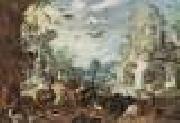 |
SAVERY, Roelandt
|
|
Flemish Northern Renaissance Painter, 1576-1639
Flemish Northern Renaissance Painter, 1576-1639.Painter, draughtsman and etcher, brother of (1) Jacob Savery I. The subject and miniaturist precision of his earliest dated work, Birds by a Pond (1600; St Petersburg, Hermitage), reflect the influence of Jacob, his presumed teacher. The strong Flemish current in Amsterdam c. 1600 is apparent in the Village Edge
|
|
|
|
|
|
|
|
|
| Wholesale China Oil Painting Wholesale Oil Painting China Xiamen Portrait Reproduction on canvas Chinese Oil Painting Wholesale USA Oil Painting |
|
|
|
|
|