| |
|
Xiamen Oil Paintings, Wholesale Direct!
|
|
100% hand painted, 100% cotton canvas, 100% money back if not satisfaction. |
|
|
|
|
ART WORKS INDEX
A
B
C
D
E
F
G
H
I
J
K
L
M
N
O
P
Q
R
S
T
U
V
W
X
Y
Z
|
|
ARTISTS INDEX
A
B
C
D
E
F
G
H
I
J
K
L
M
N
O
P
Q
R
S
T
U
V
W
X
Y
Z
|
|
|
|
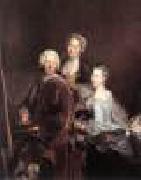 |
PESNE, Antoine
|
|
French painter (1683-1757)
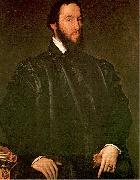
French painter active in Prussia. He studied with his father, the portrait painter Thomas Pesne (1653-1727), and with his maternal great-uncle, Charles de La Fosse. In 1703, as a pupil at the Academie Royale, he would have won the Prix de Rome with his Moses and the Daughters of Jethro (untraced), had not Jules Hardouin Mansart, adviser to the Academie, deemed all entries that year unworthy. Nevertheless Pesne left for Italy, making the acquaintance of Jean Raoux in Venice and being allowed the use of a studio in Rome by Charles Porson, Director of the Academie de France. While in Venice, Pesne painted the portrait of Friedrich Ernst von Knyphausen
|
|
|
|
|
|
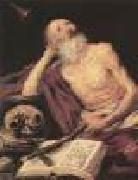 |
PEREDA, Antonio de
|
|
Spanish Baroque Era Painter, ca.1611-1678
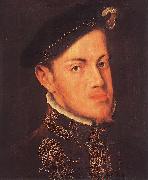
Spanish painter. He was the son of a minor painter of the same name (d 1622) and, after his father died, about 1627 he moved to Madrid with his mother. There he entered the studio of Pedro de las Cuevas, and his fellow pupils included such artists as Juan Carreeo de Miranda, Francisco Camilo, Jusepe Leonardo and Antonio Arias Fernendez. He must also have known and studied the work of many masters esteemed at court, particularly Vicente Carducho, echoes of whose work can be found in the former's early paintings. Pereda received protection early on from a member of the Royal Council, Francisco de Tejada, and later from Giovanni Battista Crescenzi, a painter and patron who was in Spain from 1617. Pereda probably completed his training through contact with Crescenzi's collection and eventually he lived in Crescenzi's house. In 1634 Pereda executed Aid to Genoa (Madrid, Prado) for the decoration of the Salen de Reinos in the Casen Buen Retiro, Madrid, a project involving all the leading artists of Madrid, including Carducho, Velezquez, Zurbaren and Jose Leonardo. The death of Crescenzi in 1635 deprived Pereda of further court commissions and seems to have stopped him painting any further secular works other than still-lifes. Also in 1635 he began a well-documented career as a religious painter, producing large altar paintings and many other medium-sized works, probably for private worship. Outstanding among these is the Immaculate Conception (1637) in the Convento de los Felipenses, Alcale de Henares (Madrid). The important allegorical painting Vanitas
|
|
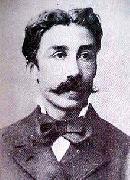 |
Pedro Americo
|
|
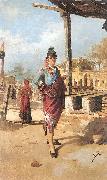
de Figueiredo e Melo (Areia, Brazil, 29 April 1843 - Florence, Italy, 7 October 1905) was one of the most important academic painters of Brazil. He was also a writer and a teacher.
He moved to Rio de Janeiro in 1854, where he was granted a scholarship to study in the Academia Imperial de Belas Artes (Imperial Academy of Fine Arts). Later he furthered his studies in Europe, at the École des Beaux-Arts in Paris, being a pupil of Jean-Auguste-Dominique Ingres, Hippolyte Flandrin and Carle-Horace Vernet, winning much praise for his paintings, and achieving the Doctorate in Sciences at the University of Brussels, in 1868.
Returning to Brazil, he produced a great series of masterpieces, including one of the most well known works of art in Brazil: Independence or Death!, depicting the moment when Prince Peter declared the country independent from Portugal, a work that has illustrated History books for elementary schools in Brazil for decades. Living mostly in Florence, Italy but traveling extensively back and forth from Rio de Janeiro, Pedro Am??rico managed to work also as a lecturer and an art historian.
He married Carlota de Ara??jo Porto-alegre (1844?C1918), daughter of painter and diplomat Manuel de Ara??jo Porto-alegre, and they had children. Knighted by the German Crown he was also Great Knight of the Order of the Holy Sepulchre. With the proclamation of the Republic in Brazil in 1889, he was elected a deputy of the National Assembly.
|
|
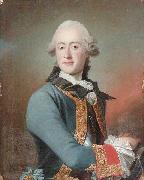 |
Peder Als
|
|
Peder Als, a Danish historical and portrait painter, born at Copenhagen in 1725, studied for some time under C. G. Pile. After gaining the first great prize given by the academy at Copenhagen in 1755, he went to Rome and entered the school of Mengs. He occupied himself chiefly in copying the pictures of Raphael and Andrea del Sarto, which it is said that he did with great accuracy. He also copied Correggio and Titian. On his return to his own country he painted some good portraits; but his colouring was too sombre to give a pleasing effect to his pictures of females, and his work was frequently so laboured as to be deprived of all animation. Copies of the works of the old masters by Als are to be seen in Denmark. He died in 1775.
|
|
|
|
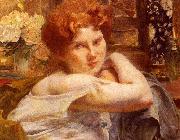 |
Paul-Albert Besnard
|
|
(2 June 1849 --4 December 1934) was a French painter and printmaker.
He was born in Paris and studied at the École des Beaux-Arts, studied with Jean Bremond and was influenced by Alexandre Cabanel. He won the Prix de Rome in 1874 with the painting Death of Timophanes
Until about 1880 he followed the academic tradition, but then broke away completely, and devoted himself to the study of colour and light as conceived by the Impressionists. The realism of this group never appealed to his bold imagination, but he applied their technical method to ideological and decorative works on a large scale, such as his frescoes at the Sorbonne, the Ecole de Pharmacie, the ceiling of the Comedie-Française (main theatre in Paris), the Salle des Sciences at the Hôtel de Ville, the mairie of the Ier arrondissement, and the chapel of Berck hospital, for which he painted twelve Stations of the Cross in an entirely modern spirit.
A great virtuoso, he achieved brilliant successes alike in watercolour, pastel, oil and etching, both in portraiture, in landscape and in decoration. His close analysis of light can be studied in his picture La femme qui se chauffe at the Luxembourg in Paris, one of a large group of nude studies of which a later example is Une Nymphe au bord de la mer; and in the work produced during and after a visit to India in 1911. A large panel, Peace by Arbitration, was completed seven days before the outbreak of war in 1914.
|
|
|
|
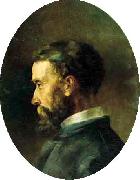 |
Paul Emile Chabas
|
|
(March 7,1869 ?C May 10,1937) was a French painter and illustrator and member of the Acad??mie des Beaux-Arts.
Paul Chabas's September Morn, 1912, oil on canvas, Metropolitan Museum of Art, New YorkHe was born in Nantes, and had his artistic training under William-Adolphe Bouguereau and Tony Robert-Fleury. He first exhibited at the Salon in 1890. He was awarded a gold medal at the Exposition Universelle of 1900 and in 1912 received the M??daille d??honneur. His preferred subject was a nude young girl in a natural setting. His most famous painting, September Morn (1912), became a "Succ??s de scandale" in the United States in May, 1913, when Anthony Comstock, head of the New York Society for the Suppression of Vice, protested against the painting as supposedly immoral. There was much publicity, and reproductions of the painting sold briskly for years afterwards. September Morn has often been cited as an example of kitsch.
|
|
|
|
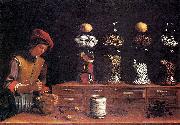 |
Paolo Antonio Barbieri
|
|
(1603-1649) was an Italian painter who was the brother of Guercino. He was born at Cento, a village near Bologna. The subjects of his pictures are flowers, fruit, and game, but he particularly excelled in painting fish
|
|
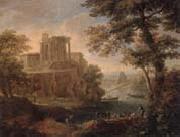 |
Paolo Anesi
|
|
Italian ,
Romer 1697-1773
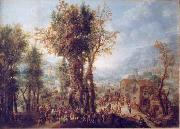
Italian painter, draughtsman and engraver. He was the son of Pietro Anesi, a silk weaver from Venice. Paolo studied figure painting with Giuseppe Chiari and, in 1715, landscape painting with Bernardino Fergioni (1674-?1738), who was also teaching Andrea Locatelli at that time. Sebastiano Conca was another of Anesi's teachers. In 1723 Anesi married the daughter of the architect Giuseppe Sardi. His earliest known work is a drawing (1719; Florence, Uffizi), but he made his reputation with the only known example of his engraved work: Varie vedute inventate ed intagliate, dedicated to Cardinal Giuseppe Renato Imperiali and published in Rome in 1725.
|
|
 |
Paolo Alboni
|
|
(1671-1734), also called Paolo Antonio Alboni, was an Italian painter of the late-Baroque period. He was born and trained in Bologna, where he became a landscape painter. After practicing some time in Rome and Naples, he went in 1710 to Vienna, where he remained nearly thirteen years, but being deprived of the use of his right side by a stroke, he returned to Bologna; he subsequently painted with his left hand. His daughter, Luigia Maria Rosa, was also a landscape painter. She died in 1759.
|
|
|
|
 |
ottilia adelborg
|
|
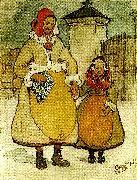
Eva Ottilia Adelborg, född 6 december 1855 i Karlskrona, död 19 mars 1936, var en svensk akvarellkonstnär. Hon var dotter till kommendörkapten Bror Jacob Adelborg och hans hustru Hedvig Catharina af Uhr samt syster till Gertrud Adelborg.
Adelborg var "bilderbokskonstnärinna" enligt äldre benämning. Hon benämns idag barnboksillustratör, men illustrerade även böcker för vuxna, komponerade tapetmönster och skrev böcker och kan därför benämnas författare. Bosatt i Gagnef i Dalarna från juli 1903, då hon startade en skola för knyppling. Museum över hennes liv och verksamhet finns i Gagnefs gamla prostgård. Känd för bland annat affischen "Prinsarnes blomsteralfabet" (1892). Det litterära Ottilia Adelborg-priset instiftades år 2000 av Gagnefs kommun.
|
|
 |
Oswald achenbach
|
|
German Painter, 1827-1905
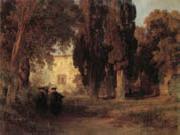
was a German landscape painter. Born in Desseldorf, he received his art education from his brother, Andreas Achenbach. His landscapes generally dwell on the rich and glowing effects of color which drew him to the Bay of Naples and the neighborhood of Rome. From 1863 to 1872 he was Professor of Landscape Painting at the Desseldorf Academy. He died in Desseldorf of an inflammation of the lungs.
|
|
 |
Ostade, Adriaen van
|
|
Dutch Baroque Era Painter, 1610-1685
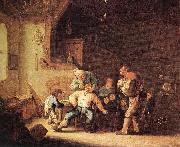
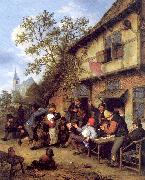
Painter, draughtsman and etcher. According to Houbraken's rather unreliable biography, he was a pupil concurrently with Adriaen Brouwer of Frans Hals in Haarlem. Hals influenced him very little, whereas Brouwer, who was described as 'known far and wide' as early as 1627, had a decisive influence on the evolution of Adriaen van Ostade's always idiosyncratic portrayal of peasant life. The first documentary mention of Adriaen van Ostade as a painter is in 1632 (Schnackenburg, 1970). Most of his paintings are signed and dated, the earliest firmly dated example being the Peasants Playing Cards (1633; St Petersburg, Hermitage).
|
|
|
|
 |
Osbert, Alphonse
|
|
French Symbolist Painter, 1857-1939
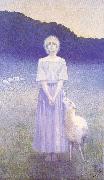
French painter. He studied at the Ecole des Beaux-Arts and in the studios of Henri Lehmann, Fernand Cormon and L?on Bonnat. His Salon entry in 1880, Portrait of M. O. (untraced), reflected his early attraction to the realist tradition of Spanish 17th-century painting. The impact of Impressionism encouraged him to lighten his palette and paint landscapes en plein air, such as In the Fields of Eragny (1888; Paris, Y. Osbert priv. col.). By the end of the 1880s he had cultivated the friendship of several Symbolist poets and the painter Puvis de Chavannes, which caused him to forsake his naturalistic approach and to adopt the aesthetic idealism of poetic painting. Abandoning subjects drawn from daily life, Osbert aimed to convey inner visions and developed a set of pictorial symbols. Inspired by Puvis, he simplified landscape forms, which served as backgrounds for static, isolated figures dissolved in mysterious light. A pointillist technique, borrowed from Seurat, a friend from Lehmann's studio, dematerialized forms and added luminosity. However, Osbert eschewed the Divisionists' full range of hues in his choice of blues, violets, yellows and silvery green. Osbert's mysticism is seen in his large painting Vision
|
|
 |
Olof Arenius
|
|
a Swedish portrait painter, and son of a minister in Upland, was born in 1701. He studied under David von Krafft, and afterwards went to the Netherlands to study the old masters. His portraits and miniatures in oil are much esteemed, and are to be found in all the public galleries, as well as in the best private collections, in Sweden. Many of them have been engraved. He died at Stockholm in 1766.
|
|
 |
Nuzi, Allegretto
|
|
Italian, 1320-1373
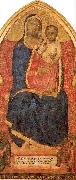
.Italian painter. He was probably trained in Fabriano by local masters who introduced him indirectly to Giottesque and Sienese influences. Familiarity with the work of an anonymous artist responsible for the frescoes (Urbino, Pal. Ducale) from S Biagio in Caprile also contributed to his early style. Nuzi's first signed and dated work is a Maest? of 1345, believed to have been painted for S Domenico (formerly S Lucia) in Fabriano. This altarpiece is a close contemporary of two frescoes in the sacristy of the same church, which have been ascribed to his hand following their restoration in the mid-1970s (Donnini, 1975).
|
|
|
|
|
|
 |
Nicolas-Andre Monsiau
|
|
(1754 -- 31 May 1837) was a French history painter and a refined draughtsman who turned to book illustration to supplement his income when the French Revolution disrupted patronage. His cool Poussiniste drawing style and coloring marked his conservative art in the age of Neoclassicism.
His training at the school of the Academie royale de peinture et de sculpture, Paris, was under the direction of Jean-François-Pierre Peyron. An early patron, the marquis de Corberon, paid for a sojourn at Rome, where he studied at the French Academy in Rome from 1776. On his return to Paris, he was unable to exhibit in the annual Paris salons, which were closed to all but those who had been received by the Academie or were members, under the Ancien Regime. Instead he found an outlet in the smaller Salon de la correspondance, where in 1782 he showed a tenebrist Piquant effect of the light of a lamp.
Two years later he was received at the Academie with a historical subject, Alexander taming Bucephalus and was made a member 3 October 1787, his second attempt, on the strength of The Death of Agis. The influence of Jacques-Louis David, an acquaintance from Monsiau's days in Rome, is most vividly represented by Monsiau's Ulysses, after returning to his palace and slaying Penelope's suitors, orders the women to remove the corpses (1791 Salon), where the action is played out in a shallow frieze-like space defined by a colonnade parallel to the picture plane.
In his best-known painting, Zeuxis choosing among the most beautiful girls of Crotona, shown at the Salon of 1791,Monsiau illustrates an anecdote of the painter Zeuxis, recorded in Pliny's Natural History, that exemplifies an essential aspect of the Classical approach to artistic creation, in the artist's refining an ideal Art by selecting from among the lesser beauties of Nature.
Monsiau's great public commission was a commemoration of the occasion on 26 January 1802, at which Napoleon delivered an authoritarian constitution to the Cisalpine Republic at a convocation of notables (the consulta) at Lyon. François Gerard had turned down the commission, preferring to continue his series of individual portraits of the Bonapartes. Monsiau received the commission in 1806; the finished painting was exhibited at the Salon of 1808 and was installed at the Tuileries the following year.
Monsiau was among the first history painters to depict scenes from modern history that were not commemorations of battles. He showed Moliere reading Tartuffe at the house of Ninon de Lenclos at the Salon of 1802. It was engraved by Jean-Lous Anselin. His painting of Louis XVI giving instructions to the sea captain-explorer La Perouse before his attempted circumnavigation was exhibited at the Salon of 1817 and was purchased for the recently restored Louis XVIII.
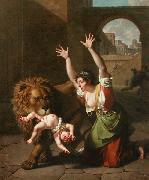
His portrayal of a sensational episode in which an escaped lion from the Grand Ducal menagerie in Florence had dropped a child it had picked up, without harming it, was exhibited at the Salon of 1801 and is conserved in the Louvre.
Among his pupils was the portrait draughtsman Louis Letronne (1790--1842), whose pencil portrait of Ludwig van Beethoven is iconic.
|
|
 |
Nicolai Abildgaard
|
|
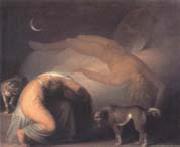
1743-1809 Romanticism,Danish,Danish painter, designer and architect. His paintings reveal both Neo-classical and Romantic interests and include history paintings as well as literary and mythological works. The variety of his subject-matter reflects his wide learning, a feature further evidenced by the broad range of his creative output. In addition to painting, he produced decorative work, sculpture and furniture designs, as well as being engaged as an architect.
|
|
|
|
 |
NEER, Aert van der
|
|
Dutch Baroque Era Painter, ca.1603-1677
Dutch landscape painter. Working mostly in Amsterdam, he excelled in painting unusual light effects, such as moonlight, sunsets, conflagrations, and glimmering light on snow and ice. His winter landscapes are among the best in Dutch art. He is well represented in many European galleries. The Metropolitan Museum has his Sunset, The Farrier, and Landscape. His son and pupil, Eglon Hendrik van der Neer, 1634C1703, was a genre, landscape, and portrait painter. He was court painter to the elector palatine in Desseldorf. He excelled in painting luxurious interiors, hunting scenes, and mythological or biblical subjects in Dutch settings.
|
|
|
|
|
|
 |
Morbelli, Angelo
|
|
Italian, 1853-1919
Italian painter. He received his first lessons in drawing in Alessandria, and in 1867 he travelled on a local study grant to Milan, where he was based for the rest of his life. He enrolled at the Accademia di Brera and from 1867 to 1876 studied drawing and painting there under Raffaele Casnedi and Giuseppe Bertini, whose influence is seen in both the subject-matter and technique of his early works. These include perspectival views, anecdotal genre scenes and history paintings. In the Dying Goethe (1880; Alessandria, Pin. Civ.) the theatrical setting, enriched by a sophisticated execution and a well-modulated use of colour, derives from the teaching of Casnedi and Bertini, while the historic-romantic quality of this painting also recalls the style of Francesco Hayez. In the years that followed, Morbelli began to concentrate more on themes such as labour and the life of the poor, influenced perhaps by Realist painters of the 1880s such as Achille D'Orsi, Francesco Paolo Michetti and Teofilo Patini. Morbelli's Return to the Stable
|
|
|
|
|
|
 |
Moore, Albert Joseph
|
|
English Classicist Painter, 1841-1893
He showed precocious artistic talent as a child and entered the Royal Academy Schools in London in 1858. His early work shows a Pre-Raphaelite influence common to his generation. The watercolour Study of an Ash Trunk (1857; Oxford, Ashmolean) is very Ruskinian in its precise handling of naturalistic detail. Moore made two visits abroad: in 1859 to France with the architect William Eden Nesfield and in the winter of 1862-3 to Rome with his brother John Collingham Moore. Elijah's Sacrifice (1863; exh. RA 1865; Bury St Edmunds, A.G.), one of Moore's earliest large-scale oil paintings, was executed while he was in Rome. Its biblical subject and sombre tone are typical of his output in the early 1860s and relate to the work of Ford Madox Brown and Edward Armitage.
|
|
 |
Monticelli, Adolphe-Joseph
|
|
French, 1824-1886
French painter. In 1846, after studying at the Ecole d'Art in Marseille, Monticelli left Provence to study in Paris with Paul Delaroche. Although he had been trained to work in a Neo-classical style by his teachers in Marseille, in Paris he admired the Troubadour pictures of such artists as Pierre R?voil and Fleury Richard and the bold colours and rich surface impasto of Delacroix's oil sketches. He also copied many of the Old Masters in the Louvre. When he returned to Marseille in 1847 Emile Loubon (1809-63), newly appointed director of the Ecole de Dessin in Marseille and a friend of many realist landscape painters in Paris, encouraged him and another local painter, Paul Guigou
|
|
|
|
|
|
 |
Miller, Alfred Jacob
|
|
American Painter, 1810-1874
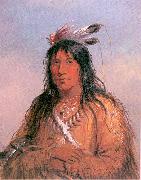
American painter. From 1831-2 he studied with the portrait painter Thomas Sully in Philadelphia, PA. In 1832 he went to France, where he studied in Paris at the Ecole des Beaux-Arts. He also visited Rome before returning to Baltimore, to open a portrait studio in 1834. Three years later Miller moved to New Orleans, LA, and was engaged by Captain William Drummond Stewart to accompany an expedition to the Rocky Mountains. The journey brought Miller into close contact with the American Indians, whose hunting and social customs he depicted in 200 watercolour sketches, and with the Far West fur trappers at their annual trading gatherings. He was one of the first artists to leave a detailed visual account of the life of the American mountain men (see WILD WEST AND FRONTIER ART). Miller's Rocky Mountain paintings are among the most romantic images of the American West ever created. His works are often panoramic and dramatic, yet he was equally adept at depicting charming, intimate scenes. His free, vigorous painting style brings to life both the American Indian and the rugged pioneer. Such paintings as the Lost Greenhorn
|
|
 |
Mikolas Ales
|
|
(November 18, 1852 in Mirotice near Pisek - July 10, 1913 in Prague) was a Czech painter.
Ales was born in 1852 in Mirotice into a relatively rich family that was in debt at the time. He was taught history by his brother Frantisek until his death in 1865; he expressed interest in painting at an early age. In 1879 he got married to Marina Kailova and moved to Italy where he continued his career in painting. He moved back to Prague working on the new artwork at the Prague National Theatre; he died in Prague at the age of 60.
Ales is estimated to have had over 5,000 published pictures, he has painted for everything from magazines to playing cards to textbooks. His paintings were not publicized too widely outside Bohemia, but many of them are still available, and Mikolas Ales is certainly regarded as one of the country's best painters
|
|
 |
MIGNON, Abraham
|
|
Dutch Baroque Era Painter, 1640-1679
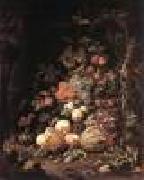
Dutch painter, was born at Frankfurt. His father, a merchant, placed him under the still-life painter Jacob Marrel, by whom he was taken to the Netherlands about 1660. He then worked under Jan Davidszoon de Heem at Utrecht, where in 1675 he married the daughter of the painter Cornelis Willaerts. Sibylle Merian (1647-1717), daughter of the engraver Matthew Merian, became his pupil and achieved distinction as a flower painter. He died at Utrecht. Mignon devoted himself almost exclusively to flowers, fruit, birds and other still-life, though at times he also attempted portraiture. His flower pieces are marked by careful finish and delicate handling. His favourite scheme was to introduce red or white roses in the centre of the canvas and to set the whole group of flowers against a dark background. Nowhere can his work be seen to better advantage than at the Dresden Gallery, which contains fifteen of his paintings, twelve of which are signed. Six of his pictures are at the Louvre, four at the Hermitage, and other examples are to be found at the museums of Amsterdam,
|
|
 |
Michel-Ange Houasse
|
|
1680-1730
French
Michel Ange Houasse Gallery
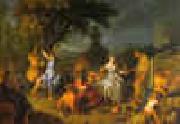
Son of Rene-Antoine Houasse. He trained in his father's circle, becoming familiar with the academic teaching methods then fashionable in France and also in Italy, where he went with his father. In 1706 he joined the Acad?mie Royale de Peinture et de Sculpture in Paris, obtaining the rank of Academician in 1707 with the painting Hercules and Lichas (Tours, Mus. B.-A.). In Rome he probably became acquainted with the Marquis d'Aubigny, secretary to the powerful Princess Orsini, who was close to Philip V of Spain. The Spanish King already had the painter Henri de Favanne in his service in Madrid; Michel-Ange was recommended for work at the Spanish court by Count Jean Orry (1652-1719), the King's French finance minister, and arrived there in 1715. He had contact with the French artists at court and married the daughter of the French architect Rene Carlier.
|
|
 |
michael angelo rooker
|
|
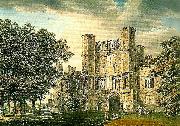
Michael, Angelo, Rooker (1746 - 3 Mar 1801) was an English oil and watercolour painter of architecture and landscapes, illustrator and engraver. He was also the principal scene painter at the Haymarket Theatre.
|
|
 |
Michael Ancher
|
|
Danish Painter, 1849-1927
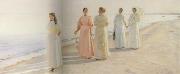
He studied at the Kongelige Akademi for de Sk?nne Kunster, Copenhagen (1871-5), where his teachers Wilhelm Marstrand and Frederik Vermehren encouraged his interest in genre painting. He first visited Skagen in 1874 and settled there in 1880, having found that subject-matter drawn from local scenery was conducive to his artistic temperament. In Will he Manage to Weather the Point? (1880; Copenhagen, Kon. Saml.) several fishermen stand on the shore, evidently watching a boat come in. The firmly handled composition focuses on the group of men (the boat itself is invisible); each figure is an individual portrait that captures a response to the moment. Ancher's skill at grouping large numbers of figures with heroic monumentality compensates for his lacklustre colour sense. A change in his use of colour is noticeable in the works produced after an influential visit to Vienna in 1882; he was deeply impressed by the Dutch Old Masters at the Kunsthistorisches Museum, especially the Vermeers. Their effect on his painting can be seen in the Sick Girl (1883),
|
|
 |
MEULEN, Adam Frans van der
|
|
Flemish painter (b. 1632, Bruxelles, d. 1690, Paris).
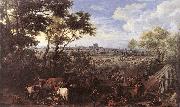
Flemish painter and draughtsman, active also in France. He was the eldest son of the seven children of Pieter van der Meulen and his second wife Marie van Steen Wegen. He went to study with Pieter Snayers, court painter in Brussels, on 18 May 1646, and in 1651 he became a master in the Brussels painters' guild. Probably soon after he married Catherina Huseweel. During the first 15 years of his career, the so-called Brussels period, he painted small-scale genre and history scenes with political and military events in the Baroque style of Sebastiaen Vrancx, Pieter Snayers and Jan Breughel the elder. Typical examples are a Cavalry Battle (1653; Geneva, Mus. A. & Hist.), a Ceremonial Entry into Brussels (1659; Kassel, Gemeldegal.), a General on Campaign (1660; Madrid, Prado) and a Hunting Scene
|
|
 |
MENGS, Anton Raphael
|
|
German Neoclassical Painter, 1728-1779
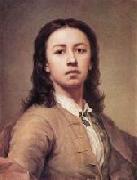
Painter and writer, brother of Theresia Concordia Mengs. His early career was at the Dresden court; thereafter he worked principally in Rome and Madrid, notably on the frescoes at the Villa Albani and the Palacio Real respectively. As an early exponent of Neo-classicism he produced some impressive classical and religious scenes, though he was most accomplished as a portrait painter. Under the influence of Johann Joachim Winckelmann he also wrote some theoretical works, of which the most important is the Gedanken ber die Schenheit und ber den Geschmack in der Malerey (1762). Although acclaimed during his lifetime
|
|
|
|
|
|
|
|
|
|
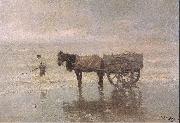 |
Mauve, Anton
|
|
Dutch, 1838-1888
Dutch painter. He came from a large family of clergymen in the province of North Holland. At the age of 16 he was apprenticed to the animal painter Pieter Frederik van Os (1808-92): animals (especially sheep, but also cows and horses) became Mauve's preferred theme. He then trained for a few months with Wouterus Verschuur, who gave him his love of horses, in the style, at least, of Paulus Potter and Philips Wouwerman.
|
|
|
|
|
|
|
|
|
| Wholesale China Oil Painting Wholesale Oil Painting China Xiamen Portrait Reproduction on canvas Chinese Oil Painting Wholesale USA Oil Painting |
|
|
|
|
|