| |
|
Xiamen Oil Paintings, Wholesale Direct!
|
|
100% hand painted, 100% cotton canvas, 100% money back if not satisfaction. |
|
|
|
|
ART WORKS INDEX
A
B
C
D
E
F
G
H
I
J
K
L
M
N
O
P
Q
R
S
T
U
V
W
X
Y
Z
|
|
ARTISTS INDEX
A
B
C
D
E
F
G
H
I
J
K
L
M
N
O
P
Q
R
S
T
U
V
W
X
Y
Z
|
|
|
|
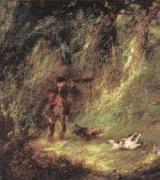 |
George Armfield
|
|
British, born circa 1808-1893
He was born in Wales
His father was a painter, who for some time had a studio at 54, Pall Mall, London and from his father, George Armfield obtained any artistic tuition he may have received.
|
|
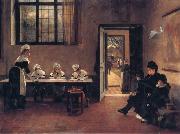 |
George Adolphus Storey
|
|
(1834-1919), Painter
was an English portrait painter, genre painter and illustrator. Storey was born in London, but educated in Paris. When he returned to London, he worked briefly for an architect before studying under J. M. Leigh and J.L. Dulong. Though not a pupil he was also encouraged by William Behnes the sculptor, whose studio he visited. He exhibited at the Royal Academy from 1852 and studied at the Royal Academy schools from 1854. He was strongly incluenced by the Pre-Raphaelites but gave them up under influence of Charles Robert Leslie. Storey worked in North London, establishing a reputation as a genre and portrait painter, and also as an illustrator. He drew elegant pictures of middle class people for love stories and the like. Storey became ARA in 1875 and was a member of the Arts Club from 1874-95. He exhibited at the British Institution, the Royal Society of British Artists in Suffolk Street and the New Watercolour Society. He also published his autobiography in 1899, containing valuable information about the St John's Wood Clique, of which he was a member until he moved to Hampstead. From 1900, he was also the Professor of Perspective at the Royal Academy, and became RA in 1914.
|
|
|
|
|
|
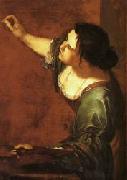 |
GENTILESCHI, Artemisia
|
|
Italian Baroque Era Painter, 1593-1652
Tuscan painter, daughter and pupil of Orazio Gentileschi, b. Rome. She studied under Agostino Tassi, her father's collaborator, who was convicted of raping the teen-age Artemisia in 1612. Over the years, she has been portrayed as a strumpet, a feminist victim or heroine, and an independent woman of her era and her life has been fictionalized in several novels and plays. In purely artistic terms, she achieved renown for her spirited execution and admirable use of chiaroscuro in the style of Caravaggio, and during her life she achieved both success and fame. In 1616 she became the first woman admitted to the Academy of Design in Florence. About 1638 she visited England, where she was in great demand as a portraitist. Among her works are Judith and Holofernes (Uffizi);
|
|
|
|
 |
Garneray Ambroise
|
|
French Artist ,
Paris 1783-1857
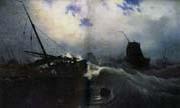
French corsair, painter and writer. He served under Robert Surcouf and Jean-Marie Dutertre, and was held prisoner by the British for eight years. Garneray was born in Paris (on Rue Saint-Andre-des-arts, in the Latin Quarter) on February 9, 1783. He was the elder son of Jean-Francois Garneray (1755 - 1837), painter of the king, who was pupil of Jacques-Louis David. At thirteen, he joined the Navy as a seaman, encouraged by his cousin, Beaulieu-Leloup, commander of the frigate Forte ("the Stout one"). Garneray sailed from Rochefort to the Indian Ocean with the frigate division under Sercey, to which the Forte belonged. Garneray took part in the various campaigns of Sercey division and witnessed the hardship it met in the battle against Arrogant and Victorious. He then served in 1798 on the corvette Brule Gueule ("Mouth burner"), which patrolled with the frigate Preneuse ("the Taker"). Returning from this campaign, the Brule Gueule and Preneuse were chased by a British squadron comprising two ships of the line, one frigate and one corvette; the French flew into a creek near Black River whose shallow waters prevented the British from pursuing. The next day, the British squadron attacked; the French had established strong defensive positions by installing the unusable batteries of their ships ashore, and repelled the British squadron. In 1799,
|
|
 |
Gabriel Jacques de Saint-Aubin
|
|
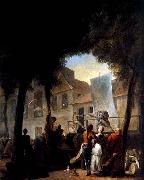
French Painter, 1724-1780,Draughtsman, etcher and painter, brother of (1) Charles-Germain de Saint-Aubin. He studied with the painters Etienne Jeaurat and Hyacinthe Colin de Vermont, but failed three times to win the Prix de Rome (competition paintings, 1752-4; Paris, Louvre). He broke with the Academie Royale, preferring to support and exhibit at the Academie de St Luc. Although he continued to paint such pictures as a Street Show in Paris (c. 1760; London, N.G.; other examples in Rouen, Mus. B.-A.), he is best known as a draughtsman and etcher. He was a passionate and unconventional observer of the sights of the Paris streets and of the social scene. Dacier saw him as the 'man who drew at all times and in all places', and his contemporary Jean-Baptiste Greuze spoke of his 'priapism of draughtsmanship'. In his many drawings he combined pencil, black and red chalk, bistre, ink and watercolour to create dazzling spontaneous effects. He drew incidents that struck him as he wandered the streets, or entertainments that he attended. He recorded them, noting dates and times, in sketchbooks (e.g. Paris, Louvre and Stockholm, Nmus.) or sometimes in the margins and blank pages of printed books that he was carrying (such as a volume of the poems of Jean-Michel Sedaine, in the Mus. Cond?, Chantilly). These drawings of contemporary incidents include the Fire at the Foire Saint-Germain on the Night of 16-17 May 1762 (ex-David Weill priv. col.) and the Crowning of Voltaire at the Theetre-Franeais in 1778 (Paris, Louvre; see fig.). He went regularly to the Salon of the Academie Royale and to art sales, covering the margins and flyleaves of his sale catalogues and Salon livrets with tiny sketches of works of art and the passing scene. One hundred of these illustrated catalogues were among his effects when he died, and of these about a third survive. These include the livrets for the Salons of 1761, 1769 and 1777 (all Paris, Bib. N.), as well as the catalogues of the sales of Louis-Michel van Loo in 1772 and Charles Natoire in 1778 (both Paris, Bib. N.), and that of Pierre-Jean Mariette in 1775 (Boston, MA, Mus. F.A.). Together with his etchings and large watercolours (e.g. Paris, Louvre) of the Louvre's Salon Carre at the time of the exhibitions of 1753, 1767 and 1769,
|
|
 |
Friedrich von Amerling
|
|
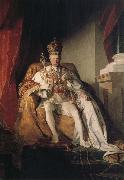
Austrian Academic Painter, 1803-1887,Austrian painter. He came from a family of craftsmen and studied (1815-24) at the Akademie der bildenden Kenste, Vienna, where one of his teachers was the conservative history painter Hubert Maurer (1738-1818). From 1824 to 1826 he attended the Academy in Prague, where he was taught by Josef Bergler. In 1827 and 1828 Amerling stayed in London, and he met the portrait painter Sir Thomas Lawrence, whose work was to be a strong influence on Amerling's painting during the next two decades. Amerling also travelled to Paris and Rome but was recalled to Vienna on an official commission to paint a life-size portrait of the emperor Francis I of Austria (Vienna, Ksthist. Mus.). With this work,
|
|
 |
Friedrich August von Kaulbach
|
|
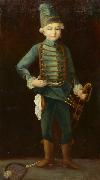
(2 June 1850, Hannover - 26 July 1920, Munich, Germany) was a German portraitist and historical painter. He was the son of Theodor Friedrich Wilhelm Christian Kaulbach (1822 - 1903), the court painter at Hannover, and the great nephew of Wilhelm Kaulbach, another prominent member of the Kaulbach family of artists. He learned to paint from his father, and later was a student of August von Kreling at Nuremberg. He sought to emulate the artist Hans Holbein.
|
|
|
|
 |
Frederick Walker,ARA,RWS
|
|
1840-1875
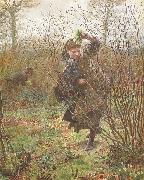
English painter and illustrator. He acquired his training in drawing and painting through study in the British Museum (where he copied heavily from the Antique), a short period spent in an architect's office, life classes at Leigh's school, a studentship at the Royal Academy and three years' employment as a draughtsman on wood with the commercial engraver Josiah Wood Whymper (1813-1903).
|
|
 |
Frederick goodall,R.A.
|
|
1822-1904
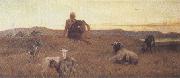
son of Edward Goodall. He was taught by his father and first exhibited at the Royal Academy in 1838. His earliest subjects were rural genre scenes and landscapes, many derived from sketching trips made between 1838 and 1857 in Normandy, Brittany, Wales, Ireland, Scotland and Venice. In the 1850s he also painted subjects from British history. More significant for his subsequent career was his visit to Egypt from September 1858 to April 1859. In Cairo he lived in a house in the Coptic quarter with Carl Haag. Together the two artists went on expeditions to Giza to draw the Nile, the Sphinx and Pyramids, and to Suez and across the Red Sea to the Wells of Moses at 'Uyen Mesa. Goodall also made rapid sketches in the crowded streets of Cairo. 'My sole object in paying my first visit to Egypt', he wrote, 'was to paint Scriptural subjects'. The first of these, Early Morning in the Wilderness of Shur (London, Guildhall A.G.), was exhibited at the Royal Academy in 1860 and won him critical and popular acclaim. In 1864 he was elected RA. Much of the rest of Goodall's long career was devoted to painting similar scenes of Egyptian life with biblical associations, for which he made reference to his sketches and to Egyptian artefacts and clothing. Their success prompted a second visit to Egypt in 1870-71.
|
|
 |
Frederick Arthur Bridgman
|
|
American Painter, 1847-1928
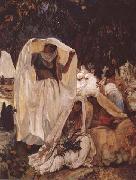
was an American artist, born in Tuskegee, Alabama. An American Southerner, born in Tuskeegee, Alabama, the son of a physician, Bridgman would become one of the United States' most well-known and well-regarded painters and become known as one of the world's most talented "Orientalist" painters. He began as a draughtsman in New York City, for the American Bank Note Company in 1864-1865, and studied art in the same years at the Brooklyn Art Association and at the National Academy of Design; but he went to Paris in 1866 and became a pupil of Jean-Leon Gerôme. Paris then became his headquarters. A trip to Egypt in 1873-1874 resulted in pictures of the East that attracted immediate attention, and his large and important composition, The Funeral Procession of a Mummy on the Nile, in the Paris Salon (1877), bought by James Gordon Bennett, brought him the Cross of the Legion of Honor. Other paintings by him were An American Circus in Normandy, Procession of the Bull Apis (now in the Corcoran Gallery of Art, Washington, D.C.), and a Rumanian Lady (in the Temple collection, Philadelphia, Pennsylvania). In 1867, Bridgman entered the studio of the noted academic painter Jean-Leon Gerôme (1824-1904), where he was deeply influenced by Gerôme's precise draftsmanship, smooth finishes, and concern for Middle-Eastern themes. (Bridgman would even become known as "the American Gerôme.") No mere imitator, however, Bridgman would later adopt a more naturalistic aesthetic, emphasizing bright colors and painterly brushwork. Bridgman made his first trip to North Africa between 1872 and 1874, dividing his time between Algeria and Egypt. There he executed approximately three hundred sketches, which became the source material for several later oil paintings. Additional visits to the region throughout the 1870s and 1880s allowed him to amass a collection of costumes, architectural pieces, and objets d'art, which often appear in his paintings. (Amusingly, John Singer Sargent noted that Bridgman's overstuffed studio, along with the Eiffel Tower, were Paris's must-see attractions.) Though Bridgman maintained a lifelong connection to France, his popularity in America never waned. Indeed, in 1890, the artist had a one-man show of over 400 pictures in New York's 5th Avenue galleries. When the show moved to Chicago's Art Institute, it contained only 300 works - testimony to the high number of sales Bridgman had made.
|
|
 |
Frederic Auguste Bartholdi
|
|
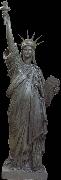
French Sculptor, 1834-1904,was a French sculptor. He is also known as Amilcar Hasenfratz, a pseudonym used for his paintings of Egyptian subjects, apparently because of concern that his work in another medium would distract from his sculpture. Born in Colmar, Alsace, Bartholdi went to Paris to further his studies in architecture as well as painting. Then he made a long trip to Egypt and Yemen, where he heard about the Suez project. He came back to his native city to become an architect. Bartholdi was a freemason, he was initiated on October 14, 1875 in the lodge LeAlsace-Lorraine, Grand Orient of France.
|
|
 |
Franz Anton Maulbertsch
|
|
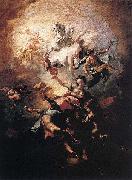
(June 7, 1724 -- August 8, 1796) was an Austrian painter and engraver, one of the most renowned exponents of roccoco painting in the German region.
Maulbertsch was born in Langenargen and studied in the Academy of Vienna. Through the knowledge of Paul Troger, he was influenced by the Venetian painters Piazzetta and Giovanni Battista Pittoni. He also studied the frescoes by Sebastiano Ricci in the Schönbrunn Palace in Vienna, and frequented Giambattista Tiepolo, who was active in Werzburg starting from 1750.
An appreciated frescoer, he received numerous commissions, mostly of ecclesiastical theme. He produced art for churches in Bicske, Kalocsa, Vienna's Michaelerkirche and Piaristenkirche Maria Treu. He also decorated the Porta Coeli in Moravia, the Kromeř Archbishop's Palace and the villa of Halbturn.
He also painted a portrait of Narcissus of Jerusalem
|
|
|
|
 |
Francois-Auguste Biard
|
|
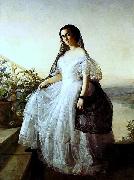
(June 30, 1799 - June 20, 1882) was a French genre painter.
Born at Lyon, he traveled around the world, sketching on the way. He was particularly successful in rendering burlesque groups.
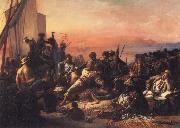
His painting, Scenes on the Coast of Africa, depicted on the right, was the inspiration behind Isaac Julien's short film The Attendant (1993). Biard was a known abolitionist against the Atlantic slave trade.
Wikimedia Commons has media related to: Auguste François Biard
This article incorporates text from the public domain 1907 edition of The Nuttall Encyclopædia.
|
|
 |
Francois-Andre Vincent
|
|
(December 30, 1746 - August 4, 1816) was a French neoclassical painter.
He was the son of the miniaturist François-Elie Vincent and studied under Joseph-Marie Vien. He travelled to Rome, where he won the Prix de Rome in 1768. From 1771 to 1775 he studied there at the Academie de France.
In 1790 Vincent was appointed master of drawings to Louis XVI of France, and in 1792 he became a professor at the Academie royale de peinture et de sculpture in Paris. In 1800 he married the painter Adelaïde Labille-Guiard.
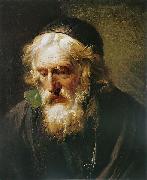
Belisarius by François-Andre Vincent, painted 1776. He was a leader of the neoclassical and historical movement in French art, along with his rival Jacques-Louis David, another pupil of Vien. He was influenced by the art of classical antiquity, by the masters of the Italian High Renaissance, especially Raphael, and among his contemporaries, Jean-Honore Fragonard.
He was one of the founder members of the Academie des beaux-arts part of the Institut de France and the successor to the Academie royale in 1795.
|
|
|
|
|
|
 |
Francisco Pedro do Amaral
|
|
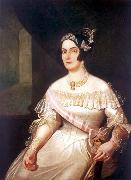
Amaral, Francisco Pedro do (1790 - 1831)
painted Portrait of Domitila de Castro Canto e Melo, Marquise of Santos in 19th century
|
|
|
|
|
|
|
|
|
|
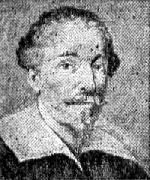 |
Francesco Albani
|
|
(March 17 or August 17, 1578 COctober 4, 1660) was an Italian Baroque painter.
Born at Bologna, his father was a silk merchant who intended to instruct his son in the same trade; but by age twelve, Albani became an apprentice under the competent mannerist painter Denis Calvaert, where he met Guido Reni. Soon he followed Reni to the so-called "Academy" run by the Carracci family: Annibale, Agostino, and Ludovico. This studio fostered the careers of many painters of the Bolognese school, including Domenichino, Massari, Viola, Lanfranco, Giovanni Francesco Grimaldi, Pietro Faccini, Remigio Cantagallina, and Reni.
In the year 1600, Albani moved to Rome to work in the fresco decoration of the gallery of the Palazzo Farnese, being completed by the studio of Annibale Carracci. Rome, under Clement VIII Aldobrandini (1592-1605) was exhibiting some degree of administrative stability and renewed artistic patronage. While pope Clement was born from a Florentine family residing in Urbino, his family was allied by marriage to the Emilia-Romagna and the Farnese, since Ranuccio I Farnese, Duke of Parma had married Margherita Aldobrandini. Parma, like Bologna, are part of the Region of Emilia-Romagna. Thus it was not surprise that Cardinal Odoarde Farnese, Ranuccio's brother, chose the Carraccis from Bologna for patronage, thereby establishing Bolognese predominance of Roman fresco painting for nearly two decades.
|
|
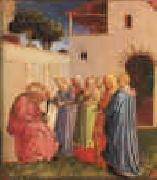 |
Fra Angelico
|
|
Fra Angelico Galleries
b.c. 1400, Vicchio, Florence
d.Feb. 18, 1455, Rome
Fra Angelico (c. 1395 ?C February 18, 1455), born Guido di Pietro, was an Early Italian Renaissance painter, referred to in Vasari's Lives of the Artists as having "a rare and perfect talent".
Known in Italy as il Beato Angelico, he was known to his contemporaries as Fra Giovanni da Fiesole (Brother John from Fiesole). In Giorgio Vasari's Lives of the Artists, written prior to 1555, he was already known as Fra Giovanni Angelico (Brother Giovanni the Angelic One).
Within his lifetime or shortly thereafter he was also called Il Beato (the Blessed), in reference to his skills in painting religious subjects. In 1982 Pope John Paul II conferred beatification, thereby making this title official. Fiesole is sometimes misinterpreted as being part of his formal name, but it was merely the name of the town where he took his vows, used by contemporaries to separate him from other Fra Giovannis. He is listed in the Roman Martyrology as Beatus Ioannes Faesulanus, cognomento Angelicus??"Blessed Giovanni of Fiesole, nicknamed Angelico".
Fra Angelico was working at a time when the style of painting was in a state of change. This process of change had begun a hundred years previous with the works of Giotto and several of his contemporaries, notably Giusto de' Menabuoi, both of whom had created their major works in Padua, although Giotto was trained in Florence by the great Gothic artist, Cimabue, and painted a fresco cycle of St Francis in the Bardi Chapel in Santa Croce. Giotto had many enthusiastic followers, who imitated his style in fresco, some of them, notably the Lorenzetti, achieving great success.
|
|
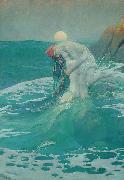 |
Floris Arntzenius
|
|
(9 June 1864 - 16 February 1925) was a Dutch painter, water-colourist, illustrator and printmaker. He is considered a representative of the younger generation of the Hague School.
Arntzenius was born in Surabaya on the island of Java where his father served in the Royal Dutch East Indies Army. In 1875, at the age of 11, he was sent to the Netherlands to Amsterdam to live with his aunt and uncle in order to complete his education.
In 1882 he became a student of Frederik Nachtweh, under Nachtweh's supervision he gained admission to the Rijksacademie van Beeldende Kunsten. During his time at the Rijksacademie, from 1883 to 1888, his teachers included August Allebe and Barend Wijnveld, and amongst his fellow students were Isaac Israëls, George Breitner, Willem Witsen and Jan Veth. After his studies in Amsterdam he spent another two years at the Koninklijke Academie voor Schone Kunsten in Antwerp, studying under Charles Verlat.
Back in Amsterdam, Arntzenuis became a member of the artist's societies Arte et Amicitiae (1890) and St. Lucas (1891), and he had a studio at the Sarphatistraat. In 1892 his mother became widowed and moved to The Hague and Arntzenuis also moved there to keep her company. Around the same time his former fellow students Isaac Israëls and George Breitner left The Hague for Amsterdam to be a part of the capital's more vibrant artistic climate. At The Hague the established painters of the first generation of the Hague School dominated artistic life.
Spuistraat, 1919, Haags Historisch MuseumArntzenius became a member of the artist's society Pulchri Studio in The Hague in 1892. From 1893 to 1895 he shared Bernard Blommers' former studio with Cornelis Antonie van Waning. He also contributed illustrations to Elsevier Geïllustreerd Maandschrift from 1892 to 1894. In 1896 he was admitted to the Hollandsche Teeken Maatschappij, a society that promoted the medium of watercolours among its members. He got married in 1900, to Lide Doorman, a talented painter of floral still lives, who lived in the house opposite of Arntzenius' mother, together they had four daughters, who he frequently painted.
|
|
|
|
|
|
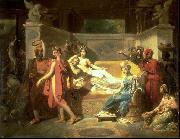 |
Felix Auvray
|
|
a French historical painter, was born at Cambrai in 1800. He was a pupil of Momal in Valenciennes, and afterwards of Gros in Paris. He exhibited in 1824, 'St. Louis a Prisoner,' and in 1827, 'Gautier de Châtillon defending St. Louis against the Saracens,' now in the Museum of Cambrai; 'St. Paul at Athens,' &c. He died in 1833, in his native city.
|
|
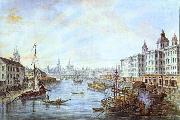 |
Fedor Alekseev
|
|
(c. 1753 ?C November 23, 1824) was an early Russian painter of landscape art.
After training in the Saint Petersburg Imperial Academy of Arts, he spent three years in Venice studying the works of famous French and Italian landscape painters.
Returning to Saint Petersburg to work, his popularity grew over time. In 1800, Emperor Paul of Russia commissioned a series of paintings of Moscow from him.
|
|
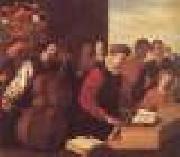 |
FALCONE, Aniello
|
|
Italian painter, Naples school (b. 1607, Napoli, d. 1656, Napoli).
Italian painter and draughtsman. He trained briefly with Jusepe de Ribera, the Caravaggesque Spanish painter. He quickly won fame as a specialist in scenes of battle, and his contemporaries nicknamed him the 'oracle' of this genre. Falcone created the 'battle scene without a hero' (Saxl): he showed the battle as a brutal, confused struggle between anonymous troops, without heroes, without defeats and without particular historical incidents. The Battle between Turks and Christians (1621; Paris, Louvre; see fig.) is one of the earliest. The frieze-like composition is elaborately structured, yet the picture is rich in intensely naturalistic, vividly coloured details of armour and weapons and precisely observed expressions of anger and pain. The famous dealer and collector Gaspar Roomer and other Neapolitan collectors commissioned many battle pictures from him, and these were soon introduced throughout Europe. He was especially favoured by Ferrante Spinelli, Prince of Tarsia, who gave Falcone a residence in his palace after 1651.
|
|
|
|
|
|
|
|
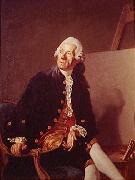 |
Etienne Aubry
|
|
Etienne Aubry, who was born at Versailles in 1746, studied under J. A. Silvestre and Joseph Vien, and soon became noted for his portraits and genre subjects. He exhibited several works of great merit at the Salon; but his life was cut short in its prime in 1781, in which year he had exhibited the 'Parting of Coriolanus from his Wife.'
|
|
|
|
 |
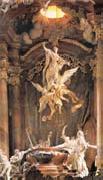
ELSHEIMER, Adam
|
|
German Baroque Era Painter, 1578-1610
German painter, printmaker and draughtsman, active in Italy. His small paintings on copper established him after his brief life as the most singular and influential German artist to follow D?rer. Their grand conception in terms of monumental figures and poetic landscape and their meticulous, miniature-like execution were admired by Rubens and came to influence many 17th-century artists, including Rembrandt. Most were produced in Rome after 1600:
|
|
|
|
 |
Egid Quirin Asam
|
|
German Baroque Era Sculptor, 1692-1750,was a German plasterer and sculptor active during the period of the Late Baroque. Born in Tegernsee, Bavaria, Asam worked mainly together with his brother, the architect and painter Cosmas Damian Asam. Because of this, their common work is often attributed to the Asam Brothers. Asam died in Mannheim.
|
|
 |
EERTVELT, Andries van
|
|
Flemish painter (b. 1590, Antwerpen, d. 1652, ?)
Flemish painter. He enrolled as a member of Antwerp's Guild of St Luke in 1609. In 1615 he married Catherine Vlieger (d 1627), after whose death he went to Genoa, where he worked for Cornelis de Wael. By c. 1630 he was back in Antwerp, where he had his portrait painted by Anthony van Dyck (1632; Augsburg, Schaezlerpal.). In 1633 Eertvelt married Elisabeth Boots, probably a daughter of the Antwerp painter Jan Boots (b before 1620). Eertvelt is regarded as the first Flemish marine painter. Over the years his palette and style changed. His first paintings, mostly of ships in storms (e.g. Sea Battle in a Storm; Schwerin, Staatl. Mus.), were painted in greenish-black and brown tones, often using white to highlight the rigging against the dark sea. After his tour of Italy he favoured views of southern harbours, with calm seas painted in soft tones (e.g. Spanish Ships Leaving a Port; Vienna, Ksthist. Mus.). In his day Eertvelt was a man of distinction whose artistic qualities were praised by the poet Cornelis de Bie and whose marine paintings were appreciated abroad, some being exported as far as Seville and Lisbon.
|
|
 |
Edwin Austin Abbey
|
|
1852-1911
Edwin Austin Abbey Gallery
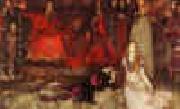
Edwin Austin Abbey (April 1, 1852 ?C August 1, 1911) was an American artist, illustrator, and painter. He flourished at the beginning of what is now referred to as the "golden age" of illustration, and is best known for his drawings and paintings of Shakespearean and Victorian subjects. His most famous work, The Quest of the Holy Grail, resides in the Boston Public Library.
Abbey was born in Philadelphia, Pennsylvania in 1852. He studied art at the Pennsylvania Academy of the Fine Arts under Christian Schuessele. Abbey began as an illustrator, producing numerous illustrations and sketches for such magazines as Harper's Weekly and Scribner's Magazine. His illustrations began appearing in Harper's Weekly at an early age: before Abbey was twenty years old. Abbey was an illustrator with Harper's Weekly from 1871-1874. He moved to England in 1878 where he was made a full member of the Royal Academy in 1898. In 1902 he was chosen to paint the coronation of King Edward VII. It was the official painting of the occasion and, hence, resides at Buckingham Palace. In 1907 he declined an offer of knighthood in order to retain his U.S. citizenship. Friendly with other expatriate American artists, he summered at Broadway, Worcestershire, England, where he painted and vacationed alongside John Singer Sargent at the home of Francis Davis Millet.
He completed murals for the Boston Public Library in the 1890s. The frieze for the Library was titled "The Quest for the Holy Grail." It took Abbey eleven years to complete this series of murals in his England studio. In 1908-1909, Abbey painted a number of murals and other artworks for the rotunda of the new Pennsylvania State Capitol in Harrisburg, Pennsylvania. His works in that building include allegorical medallions representing Science, Art, Justice, and Religion in the Capitol Rotunda, large lunette murals underneath the Capitol dome, and a number of works in the House Chamber. Unfortunately, Abbey became ill with cancer in 1911 slowing his work. At the time, he was working on the "Reading of the Declaration of Independence Mural" which was later installed in the House Chamber. Abbey was so ill, that his studio assistant, Ernest Board completed the work with little supervision from Abbey. Later in 1911, Abbey died, leaving his commission for the State Capitol of Pennsylvania unfinished. John Singer Sargent, a friend and neighbor of Abbey, and studio assistant Board completed the "Reading of the Declaration of Independence Mural." Abbey's works were installed in the Rotunda and House Chamber. Two rooms from Abbey's commission were left undone, and the remainder of the commission was given to Violet Oakley. Oakley completed the works from start to finish using her own designs.
Abbey was elected to the National Academy of Design and The American Academy of Arts and Letters. In 1937 Yale University became the home for a sizable collection of Abbey's works, the result of a bequest from Abbey's widow.
|
|
|
|
|
|
|
|
 |
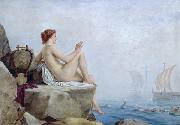
Edward Arthur Walton
|
|
British Painter, 1860-1922
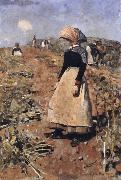
He trained at the Staatliche Kunstakademie in Desseldorf (1876-7) and Glasgow School of Art. One of the GLASGOW BOYS, he painted outdoors in the Trossachs and at Crowland, Lincs, with James Guthrie, Joseph Crawhall and George Henry. He also painted in W. Y. Macgregor's life studio in Glasgow. He joined the New English Art Club in 1887 and developed an atmospheric landscape style influenced by plein-air painting and by James McNeill Whistler with whom he was friendly during his stay in London (1894-1904); Autumn Sunshine (1884; U. Glasgow, Hunterian A.G.) is characteristic. Walton was a regular exhibitor from 1880 in both Glasgow, at the Institute of the Fine Arts, and Edinburgh, at the Royal Scottish Academy. He was elected an Associate of the Academy in 1889 and a full member in 1905, taking an active role in its affairs after moving to Edinburgh in 1904. He concentrated after c. 1885 on pastel and on watercolour, which he used notably in his Helensburgh and Kensington scenes of contemporary life. From 1915 he served as President of the Royal Scottish Water Colour Society. Oil was reserved largely for portraits in a Whistlerian style, such as the Artist's Mother.
|
|
 |
Edward Armitage
|
|
(May 20, 1817 - May 24, 1896) was an English Victorian era painter whose work focussed on historical, classical and biblical subjects.
Armitage was born in London to a family of wealthy Yorkshire industrialists, the eldest of seven sons of James Armitage (1793 - 1872) and Anne Elizabeth Armitage nee Rhodes (1788 - 1833), of Farnley Hall, just south of Leeds, Yorkshire. His great-grandfather James (1730 - 1803) bought Farnley Hall from Sir Thomas Danby in 1799 and in 1844 four Armitage brothers, including his father James, founded the Farnley Ironworks, utilising the coal, iron and fireclay on their estate. His brother Thomas Rhodes Armitage (1824 - 1890) founded the Royal National Institute of the Blind.
Armitage was the uncle of Robert Armitage (MP), the great-uncle of Robert Selby Armitage, and first cousin twice removed of Edward Leathley Armitage.
|
|
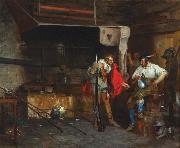 |
Eduardo Zamacois Y Zabala
|
|
Eduardo Zamacois y Zabala (ca. 1841 - 14 January 1871) was a Spanish academic painter who was born in Bilbao, Spain in 1841 or 1842. He moved to Madrid in 1859, where he enrolled in the Real Academia de Bellas Artes de San Fernando and studied with Federico de Madrazo. In 1860, he studied in Paris with Jean-Louis-Ernest Meissonier (1815-1891). He achieved success at the Paris Salon of 1867 with Buffon au 16e siecle.
Zamacois y Zabala is associated with both classicism and anti-clerical art. He is known to have employed the Swiss painter Edouard Castres (1838-1902) as his assistant. He died in Madrid in 1871 at the age of 29.
|
|
|
|
|
|
|
|
|
| Wholesale China Oil Painting Wholesale Oil Painting China Xiamen Portrait Reproduction on canvas Chinese Oil Painting Wholesale USA Oil Painting |
|
|
|
|
|