| |
|
Xiamen Oil Paintings, Wholesale Direct!
|
|
100% hand painted, 100% cotton canvas, 100% money back if not satisfaction. |
|
|
|
|
ART WORKS INDEX
A
B
C
D
E
F
G
H
I
J
K
L
M
N
O
P
Q
R
S
T
U
V
W
X
Y
Z
|
|
ARTISTS INDEX
A
B
C
D
E
F
G
H
I
J
K
L
M
N
O
P
Q
R
S
T
U
V
W
X
Y
Z
|
|
|
|
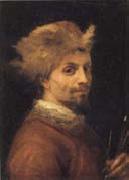 |
Ludovico Cigoli
|
|
Italian Baroque Era Painter ,
1559-1613
was an Italian painter and architect of the late Mannerist and early Baroque period, trained and active in his early career in Florence, and spending the last nine years of his life in Rome. Lodovico Cardi was born at Villa Castelvecchio di Cigoli, in Tuscany, whence the name by which he is commonly known. Initially, Cigoli trained in Florence under the fervid mannerist Alessandro Allori. Later, influenced by the most prominent of the Contra-Maniera painters, Santi di Tito, as well as by Barocci, Cigoli shed the shackles of mannerism and infused his later paintings with an expressionism often lacking from 16th century Florentine painting. For example, for the Roman patron, Massimo Massimi, he painted an Ecce Homo (now in Palazzo Pitti). Supposedly unbenknownst to any of the painters, two other prominent contemporary painters, Passignano and Caravaggio, had been requested canvases on the same theme. It is unclear if they are completely independent. Cigoli's painting seems to have been made with knowledge of Caravaggio's canvas; however, while Cigoli's work lacks the power of Caravaggio's naturalism, the background shade and sparse foreground shows how much he was moving away from crowded Florentine historical paintings. This work was afterwards taken by Bonaparte to the Louvre, and was restored to Florence in 1815. One of his early paintings was of Cain slaying Abel.
|
|
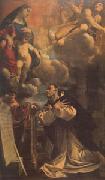 |
Ludovico Carracci
|
|
(Bologna 1555-1619)
Painter, draughtsman and etcher. His father, Vincenzo Carracci, was a butcher, whose profession may be alluded to in Ludovico's nickname 'il Bue', though this might also be a reference to the artist's own slowness. Ludovico's style was less classical than that of his younger cousins Agostino and Annibale, perhaps because of a mystical turn of mind that gave his figures a sense of other-worldliness. Like his cousins, he espoused the direct study of nature, especially through figure drawing, and was inspired by the paintings of Correggio and the Venetians. However, there survives in his work, more than in that of his cousins, a residue of the Mannerist style that had dominated Bolognese painting for most of the mid-16th century. Ludovico maintained a balance between this Mannerist matrix, his innate religious piety and the naturalism of the work of his cousins. With the exception of some travels during his training and a brief visit to Rome in 1602, Ludovico's career was spent almost entirely in Bologna.
|
|
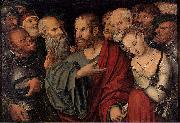 |
Lucas Cranach the Younger
|
|
(October 4, 1515 ?C January 25, 1586) was a German Renaissance artist, known for his woodcuts and paintings.
He was a son of Lucas Cranach the Elder who began his career as an apprentice in his father's workshop. Henceforth, his own reputation and fame grew. After his father's death, he assumed control over the workshop.
The style of their paintings can be so similar that there have been some difficulties in attribution of their works.
|
|
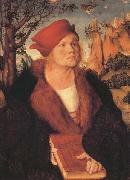 |
Lucas Cranach the Elder
|
|
b. 1472, Kronach, d. 1553, Weimar. German painter and printmaker. He took his name from the town of his birth. Little is known about his early life or training. In Vienna (c. 1501 ?C 04) he painted some notable portraits and landscapes characteristic of the Danube school. From 1505 to 1550 he was court painter in Wittenberg, where he achieved great success and wealth painting portraits, mythological subjects, and altarpieces for Protestant and Catholic churches. He attracted so many young artists to Wittenberg that the town became an art centre. A friend of Martin Luther, Cranach became known as the chief pictorial propagandist of the Protestant cause in Germany. He produced numerous engravings and more than 100 woodcuts, notably for the first German edition of the New Testament (1522). After his death, his style was perpetuated by his son, Lucas the Younger (1515 C 86).
|
|
 |
Lucas Cranach
|
|
Kronach 1472-Weimar 1553
German painter and engraver. The son of a painter, he settled in Wittenberg c.1504 and was court painter successively under three electors of Saxony. There he maintained a flourishing workshop and was twice burgomaster. Cranach was a close friend of Martin Luther, whose doctrine he upheld in numerous paintings and woodcuts, and he has been called the painter of the Reformation. He was a rapid and prolific painter, and the work turned out by his studio is uneven in quality. Naïve and fanciful, often awkward in draftsmanship, it has, nonetheless, freshness and originality and a warm, rich palette. His portraits are particularly successful. Among his best-known works are Repose in Egypt (Gemäldgalerie, Staatliche Mus., Berlin-Dahlem); Judgment of Paris (Staatliche Kunsthalle, Karlsruhe); Adam and Eve (Courtauld Inst., London); and Crucifixion (Weimar). The latter contains figures of Luther and Cranach. His many famous protraits include those of Elector John Frederick and Self-Portrait (Uffizi). Cranach was also an accomplished miniaturist. He produced a few copperplates and designs for woodcuts. His son and pupil Lucas Cranach, the Younger,
|
|
|
|
 |
Lucas Cranach
|
|
1472-1553
German
Lucas Cranach Locations
Lucas Cranach the Elder was born at Kronach, Franconia. He was apparently trained by his father, Hans, a painter, and from 1495 to 1498 undertook work at Kronach for Coburg and Gotha. There is evidence that Cranach resided in Vienna between about 1500 and 1504. In 1504 he married Barbara Brengbier of Gotha; they had three daughters and two sons, Hans (died 1537) and Lucas the Younger (1515-1586), both of whom were painters.
In 1505 Cranach established residence at Wittenberg, where he was court painter to three successive electors: Frederick the Wise, John the Constant, and John Frederick the Magnanimous. Cranach was a prosperous and respected citizen. He owned several houses and land, held the office of councilor, and was a burgomaster. He also worked for other princely patrons and was a follower and lifelong friend of Martin Luther.
In 1550 Cranach followed John Frederick the Magnanimous to Augsburg, where the elector was in exile, and in 1552 accompanied him to Weimar. Cranach died in Weimar on Oct. 16, 1553.
|
|
 |
Luca Carlevaris
|
|
1665-1731
Italian
Luca Carlevaris Location
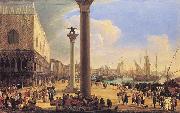
Luca Carlevarijs or Carlevaris (1663 - 1730) was an Italian painter of landscapes (vedutista).
Carlevarijs was born in Udine, but worked mostly in Venice. His veduta of Venice are among the earliest Baroque depictions of the city. He was influenced by the Dutch painter active in Rome, Caspar van Wittel (often called Vanvitelli). The painters Canaletto and Antonio Visentini are said to have been highly influenced by or pupils of his. Johan Richter did work with him.
|
|
 |
Luca Carlevarijs
|
|
Luca Carlevarijs or Carlevaris (20 January 1663 - 12 February 1730) was an Italian painter and engraver of landscapes (vedutista).
Carlevarijs was born in Udine, but worked mostly in Venice. His vedute of Venice are among the earliest Baroque depictions of the city. He was influenced by the Dutch painter active in Rome, Caspar van Wittel (often called Vanvitelli). The painters Canaletto and Antonio Visentini are said to have been highly influenced by or pupils of his. Johan Richter did work with him. Also called Luca Casanobrio or Luca di Ca Zenobri, for his patronage by the latter family.
He painted landscapes, sea-pieces, and perspective views. He completed over a hundred etchings of views in Venice, which give an exact representation of the principal places in that city. He died in Venice.
|
|
 |
Luca Cambiaso
|
|
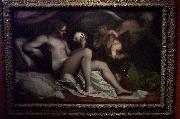
Luca Cambiasi (surname also written Cambiaso or Cangiagio; 1527 - 1585) was an Italian painter and draftsman, familiarly known as Lucchetto da Genova.
|
|
 |
Lovis Corinth
|
|
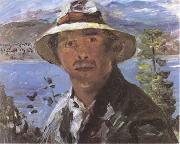
German Painter, 1858-1925
German painter and writer. He grew up on his family's farm and tannery. As a child he showed interest in art, taking informal lessons in drawing from a local carpenter and caricaturing his primary school teachers. Corinth's father sent him to secondary school in the nearby city of K?nigsberg (now Kaliningrad), where he lived with his widowed aunt. A superstitious woman fond of story-telling, she possessed what Corinth later described as a coarse temperament and an unrestrained, 'demonic' humour. These qualities and his aunt's bohemian acquaintances, including fortune-tellers and soothsayers, fascinated the young Corinth, accustomed to his more reserved parents.
|
|
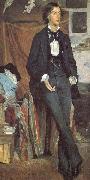 |
Louise-Catherine Breslau
|
|
(6 December 1856 - 12 May 1927) was a German/Swiss artist.
Born Maria Luise Katharina Breslau in Munich, Germany, she spent her childhood in Zurich, Switzerland and as an adult made Paris, France her home. Suffering from asthma all her life, Breslau turned to drawing as a child to help pass the time while confined to her bed. Although she became one of the most sought after portraitists of her time, after her death she and her work were all but forgotten. It has only been in the past few years that interest in Breslau and her works has been growing.
Breslau was born into a prosperous bourgeois family; her father was a well-respected physician specializing in obstetrics and gynecology. When Breslau was two years old, her father accepted the position of professor and head physician of Obstetrics and Gynecology at the University of Zurich; Switzerland became home to the Breslau family.
|
|
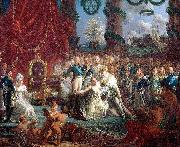 |
Louis-Philippe Crepin
|
|
(1772-1851) was a French naval painter, one of the first Peintres de la Marine.
Crepin was notably a pupil of Joseph Vernet and Hubert Robert.
His Combat de la Bayonnaise contre l'Ambuscade, 1798, depicting the Action of 14 December 1798, is one of the main exhibits of the Musee national de la Marine.
|
|
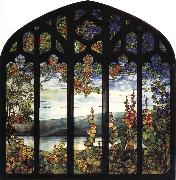 |
Louis Comfort Tiffany
|
|
American Art Nouveau Stained Glass Artist, 1848-1933
was an American artist and designer who worked in the decorative arts and is best known for his work in stained glass and is the American artist most associated with the Art Nouveau and Aesthetic movements. Tiffany was affiliated with a prestigious collaborative of designers known as the Associated Artists which included Lockwood de Forest, Candace Wheeler, and Samuel Colman. Tiffany designed stained glass windows and lamps, glass mosaics, blown glass, ceramics, jewelry, enamels and metalwork Louis was the son of Charles Lewis Tiffany, founder of Tiffany and Company; and Harriet Olivia Avery Young. Louis married Mary Woodbridge Goddard (c1850-1884) on May 15, 1872 in Norwich, Connecticut and had the following children: Mary Woodbridge Tiffany (1873-1963) who married Graham Lusk; Charles Louis Tiffany I (1874-1874); Charles Louis Tiffany II (1878-1947); and Hilda Goddard Tiffany (1879-1908). After the death of his wife, he married Louise Wakeman Knox (1851-1904) on November 9, 1886. They had the following children: Louise Comfort Tiffany (1887-1974); Julia DeForest Tiffany (1887-1973) who married Gurdon S. Parker then married Francis Minot Weld; Annie Olivia Tiffany (1888-1892); and Dorothy Trimble Tiffany (1891-1979). Many of Tiffany's descendants are active in the arts, politics, and the sciences. Only one descendant is working in glass today- Dr. Rodman Gilder Miller of Seattle, WA,
|
|
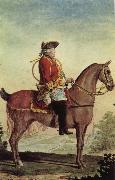 |
Louis Carrogis Carmontelle
|
|
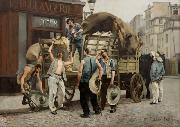
August 15, 1717?CDecember 26, 1806,was a French dramatist, painter and architect; author of little pieces under the name of Proverbes.
|
|
 |
Louis Carrier-Belleuse
|
|
(1848-1913) was a French painter and sculptor.
He was son and pupil of Albert-Ernest Carrier-Belleuse. He designed the patterns of the Faïencerie (earthenware factory) from Choisy-le-Roi, where he was artistic director. He was also the sculptor of the Equestrian monument to General Manuel Belgrano
|
|
 |
Louis Caravaque
|
|
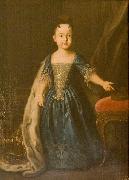
Louis Caravaque, a French portrait painter, was a native of Gascony. He went to Russia, and in 1716 painted at Astrakhan the portrait of Peter the Great, which has been engraved by Massard and by Langlois. He again painted the Czar in 1723, and subsequently the Empresses Anne and Elizabeth. He died in Russia in 1752.
|
|
 |
Lorenzo Costa
|
|
Bologna 1460-Mantua 1535
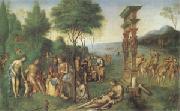
was an Italian painter of the Renaissance. He was born at Ferrara, but moved to Bologna by the his early twenties, and would be more influential to the Bolognese school of painting. However, many artists worked in both nearby cities, and thus others consider him a product of the School of Ferrara. There are claims that he trained with Cosimo Tura. In 1483 he painted his famous Madonna and Child with the Bentivoglio family, and other frescoes, on the walls of the Bentivoglio chapel in San Giacomo Maggiore, and he followed this with many other works. He was a great friend of Francesco Francia, who was much influenced by him. In 1509 he went to Mantua, where his patron was the Marquis Francesco Gonzaga, and he eventually died there. His Madonna and Child enthroned is in the National Gallery, London, but his chief works are at Bologna. His sons, Ippolito and Girolamo, were also painters, and so was Girolamo's son, Lorenzo the younger (1537-1583).
|
|
 |
Lorenzo Costa
|
|
1460-1535
Italian
Lorenzo Costa Locations
Italian painter of the Ferrarese and Bolognese schools. Trained in the manner of such painters as Tura and Cossa, he modified the strident Ferrarese style when he became a partner of Francia. Among his paintings are the Madonna and Child with the Bentivoglio Family and the Triumphs of Petrarch in San Giacomo Maggiore, the Madonna with Saints in San Petronio, and the Madonna in San Giovanni in Monte, all in Bologna. His Three Saints is in the Metropolitan Museum.
|
|
|
|
|
|
 |
Lodovico Carracci
|
|
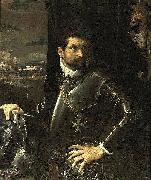
(21 April 1555 - 13 November 1619) was an Italian, early-Baroque painter, etcher, and printmaker born in Bologna.
Ludovico himself apprenticed under Prospero Fontana in Bologna and traveled to Florence, Parma, and Venice, before returning to his hometown. Along with his cousins Annibale and Agostino Carracci, Ludovico in 1585 was a founder and director (caposindaco) of the so-called Eclectic Academy of painting (also called the Accademia degli Incamminati), which in reality was a studio with apprenticed assistants. This studio however propelled a number of Emilian artists to pre-eminence in Rome and elsewhere, and singularly helped encourage the so-called Bolognese School) of the late 16th century, which included Albani, Guercino, Sacchi, Reni, Lanfranco and Domenichino. The Carracci had their apprentice draw studies focused on observation of nature and natural poses, and use a bold scale in drawing figures. Ludovico specifically helped train Giacomo Cavedone. The Carracci are credited with reinvigorating Italian art, especially fresco art, which was subsumed with formalistic Mannerism.
Carracci's own works are characterized by a strong mood invoked by broad gestures and flickering light that create spiritual emotion.
Ludovico Carracci died in Bologna in 1619.
|
|
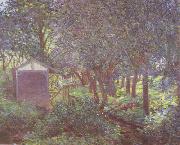 |
Lilla Cabot Perry
|
|
American Impressionist Painter, 1848-1933
was an American artist who worked in the Impressionist style, rendering portraits and landscapes in the free form manner of her mentor, Claude Monet. Perry was an early advocate of the French Impressionist style and contributed to its reception in the United States. Perry's early work was shaped by her exposure to the Boston school of artists and her travels in Europe and Japan. She was also greatly influenced by Ralph Waldo Emerson's philosophies and her friendship with Camille Pissarro. Although it was not until the age of thirty-six that Perry received formal training, her work with artists of the Impressionist, Realist, Symbolist, and German Social Realist movements greatly affected the style of her oeuvre. Boston native Lilla Cabot Perry was born on January 13, 1848 to Dr. Samuel Cabot, a distinguished surgeon, and Hannah Lowell Jackson Cabot. What is known of her early life reveals a childhood that allowed her the freedom of exploring her interests and creativity. Perry studied literature, language, poetry, and music. There are a few references to Perry having informal sketching sessions with her friends however she had no formal training in the arts before 1884. As a child she additionally enjoyed reading books and playing sports outdoors. Because of her family's prominence in Boston society,
|
|
|
|
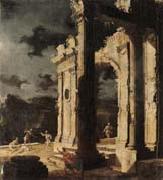 |
Leonardo Coccorante
|
|
Italian, 1680-1750 , Active in Naples during the frist half of the 18th Century
Active in Naples during the frist half of the 18th Century .was an Italian painter who was born in Naples, Italy. He studied with Jan Frans van Bloemen (1662-1749), Angelo Maria Costa (1670-1721), and finally with Gabriele Ricciardelli (active between 1741 and 1777). From 1737 to 1739, he was employed decorating the royal palace of Naples. Coccorante died in Naples in 1750. He is best known for his large highly detailed landscapes with imaginary classical architectural ruins. He often included small figures in the foreground to emphasize the expansiveness of the ruins. Coccorante is classified as a veduta (or vista) painter. The Honolulu Academy of Arts, the Louvre, the Lowe Art Museum (Coral Gables, Florida.), Mus??e d??partemental de l'Oise (Beauvais, France), Mus??e de Grenoble (Grenoble, France), Museo Regionale Agostino Pepoli (Trapani, Italy), and Pinacoteca del Castello Sforzesco (Milan, Italy)
|
|
|
|
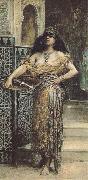 |
Leon Comerre
|
|
Leon François Comerre French. 1850 - 1934
|
|
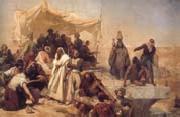 |
Leon Cogniet
|
|
French Academic Painter, 1794-1880,was a French painter. Cogniet was born in Paris. In 1812, he entered the Ecole des Beaux-Arts in Paris, where he studied under Pierre-Narcisse Guerin at the same time as Delacroix and Gericault. He was a resident at the Villa Medici, in Rome, from 1817 to 1822. A romantic painter, his main subjects were history and portraits, and in 1817 he won the Prix de Rome. He died in Paris in 1880.
|
|
|
|
 |
LE BRUN, Charles
|
|
French painter (b. 1619, Paris, d. 1690, Paris)
French painter and designer. He dominated 17th-century French painting as no other artist; it was not until over a century later, during the predominance of Jacques-Louis David, that artistic authority was again so concentrated in one man. Under the protection of a succession of important political figures, including Chancellor Pierre S?guier, Cardinal Richelieu and Nicolas Fouquet, Le Brun created a series of masterpieces of history and religious painting. For Louis XIV and his chief minister Jean-Baptiste Colbert he executed his greatest work, the royal palace of Versailles: an almost perfect ensemble of architecture, decoration and landscape. After Colbert's death in 1683, he was no longer able to count on prestigious commissions
|
|
 |
Laurens Craen
|
|
Laurens Craen (c. 1620, The Hague - c.1670, Middelburg ), was a Dutch Golden Age painter.
|
|
 |
LA FOSSE, Charles de
|
|
French Baroque Era Painter, 1636-1716
French painter and draughtsman. He was the most important decorative painter in France in the generation after Charles Le Brun and in this capacity contributed to many of the major official and private building projects from the 1670s to the 1710s, including the D?me des Invalides in Paris and the chapel at the ch?teau of Versailles. His colourist's temperament, his early study of the Venetian painters of the 16th century and his interest in the work of Peter Paul Rubens contributed to the triumph of the party that championed colour over line and put him in the vanguard of the new tendency in French painting in the later 17th century. His work, with its rich and changing colours, combines the strength of the 17th century
|
|
 |
KETEL, Cornelis
|
|
Dutch painter (b. 1548, Gouda, d. 1616, Amsterdam).
Dutch painter, draughtsman and sculptor, active also in France and England. He was one of the most important portrait and narrative painters of the Dutch Mannerist school of the late 16th century and the early 17th. He received his earliest training in Gouda from his uncle Cornelis Jacobsz. Ketel (d c. 1568) and studied for a year with the painter Anthonie Blocklandt in Delft c. 1565. Ketel then travelled to France and lived in Paris and Fontainebleau.
|
|
|
|
|
|
|
|
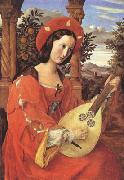 |
Julius Schnorr von Carolsfeld
|
|
1794-1872
Painter and draughtsman, brother of Ludwig Ferdinand Schnorr von Carolsfeld. He was taught engraving by his father and then trained under Heinrich Feger at the Akademie in Vienna (1811-15). Though not particularly excited by the curriculum, he was inspired by his friendship with Ferdinand Olivier and Joseph Anton Koch and the circle around A. W. Schlegel to an interest in both landscape sketching and in old German and Netherlandish art, as reflected in the style of the detailed pen drawing of the Prodigal Son (1816; Dresden, Kupferstichkab.). From 1815 to 1818 he lived in the house of Ferdinand Olivier, whose step-daughter, Marie Heller, he later married. A painting of 1817, St Roch Distributing Alms
|
|
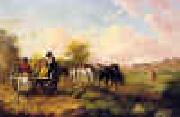 |
Julius Caesar Ibbetson
|
|
1759-1817
British
In 1785, Ibbetson began exhibiting at the Royal Academy with View of North Fleet. Mitchell calls George Biggin (1783), which is one of Ibbetson's earliest known works, "an accomplished full-length portrait in the Gainsborough tradition, [which] should be considered as a milestone in the development of an artist who was entirely self-taught". Through the efforts of Captain William Baillie in 1787, Ibbetson was made draughtsman to Colonel Charles Cathcart on the first British embassy to Peking (Beijing); he made many watercolor drawings of the animals and plants on the journey. While he was away, his Ascent of George Biggin, esq. from St. George's Fields, June 29th 1785 was exhibited at the Royal Academy to great critical and popular acclaim.
In 1789, Ibbetson went to visit the Viscount Mountstuart at Cardiff Castle in Wales. He spent decades drawing the scenery there and, according to Mitchell, "[h]is detailed watercolours of iron furnaces, coal staithes, and copper mines foreshadow the work of Joseph Wright of Derby and J. M. W. Turner and constitute an important record of the early industrial developments in that region, but are less well known than his more numerous scenes of folk life and picturesque scenery." After a visit to the Isle of Wight in 1790, he began painting shipwrecks and smugglers. David Murray, 2nd Earl of Mansfield, and his wife commissioned Ibbetson to decorate Kenwood House, in 1794. This distracted him from the death of his wife and caring for their three children. Her death had "provoked a minor nervous breakdown, exacerbated by near destitution", but the Kenwood project relieved that stress. Four years later, he moved to Liverpool to work for Thomas Vernon. In 1801 he married his second wife, Bella Thompson, and moved to Ambleside.
Ibbetson acquired several generous patrons in Liverpool and in Edinburgh: William Roscoe, Sir Henry Nelthorpe, and the Countess of Balcarress. The last prompted him to write and publish his instruction manual An Accidence, or Gamut, of Painting in Oil (1803). In 1803, he met the Yorkshire philanthropist William Danby and in 1805 moved to Masham to be near him. The next 14 years of his life were the most settled of his life.
Ibbetson died on 13 October 1817 and was buried in the churchyard of St Mary's, Masham.
Benjamin West described Ibbetson as the "Berchem of England" in recognition of his debt to the Dutch 17th century landscape painters. According to Mitchell, "[h]is watercolours are prized for their delicacy and sureness of line". Many were engraved for projects such as John Church's A Cabinet of Quadrupeds and John Boydell's Shakespeare Gallery.
|
|
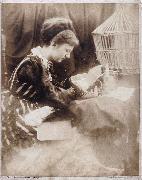 |
Julia Margaret Cameron
|
|
British Photographer, 1815-1879,English pioneer photographer, b. Calcutta (now Kolkata). Born and married into the high ranks of the British civil service, Cameron became an intimate of many of the most famous people of her day. In 1864 she became an ardent amateur photographer, demanding long, arduous sittings from her illustrious friends. She sought to illuminate the inner person of her subject, and her celebrated portraits, including those of Tennyson, Carlyle, Ellen Terry, Browning, Darwin, and Longfellow, are remarkably spontaneous. She also pioneered the use of closeups,
|
|
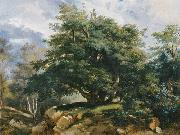 |
Jules Coignet
|
|
was born in Paris in 1798 and died there in 1860. He was a noted landscape painter who had studied under Jean-Victor Bertin. He travelled a good deal in his own country as well as elsewhere in Europe and the East, and produced a considerable number of views. A regular exhibitor at the Paris Salon exhibitions, he was awarded a gold medal there in 1824 and was given state recognition by being made a Chevalier of the Legion of Honour in 1836.
As a painter, Coignet holds a middle place between the Idealists and the Realists, and his work is remarkable for the combination of vigour and delicacy in the effects of light and shade, for poetical feeling, for a firm brush, and occasionally for grandeur of conception. This is particularly evident in "The Ruins of the Temple of Paestum", now in Munich's Neue Pinakothek.There are times too when his paintings have an atmospheric, almost Impressionist effect. One example is the coastal sunset in the Louvre; another is the pastel "Grey weather over the sea" (1848) in the Dijon museum.
Following the 1824 exhibition in Paris of John Constable's paintings, Coignet began painting outside in the forest of Fontainbleau and encouraged his students to do the same. One of his specialities was painting tree 'portraits', of which there are many examples, both as finished paintings and as sketches in oil paint.
|
|
 |
Jules Cheret
|
|
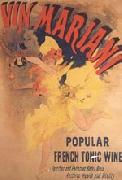
French Printmaker , 1836 - 1932 Paris
was a French painter and lithographer who became a master of poster art. Often called the father of the modern poster. Born in Paris to a poor but creative family of artisans, a lack of finances meant Jules Cheret had a very limited education. At age thirteen, he began a three-year apprenticeship with a lithographer and then his interest in painting led him to take an art course at the Ecole Nationale de Dessin. Like most other fledgling artists, Cheret studied the techniques of various artists, past and present, by visiting Paris museums. He was trained in lithography in London, England, from 1859 and 1866, and there he was strongly influenced by the British approach to poster design and printing. On returning to France, influenced by the scenes of frivolity depicted in the works of Jean-Honore Fragonard and other Rococo artists such as Antoine Watteau, Cheret created vivid poster ads for the cabarets, music halls, and theaters such as the Eldorado, the Olympia, the Folies Berg??res, Theatre de l'Opera, the Alcazar d'Ete and the Moulin Rouge. So much in demand was he, that he expanded his business to providing advertisements for the plays of touring troupes, municipal festivals, and then for beverages and liquors, perfumes, soaps, cosmetics and pharmaceutical products. Eventually he became a major advertising force, adding the railroad companies and a number of manufacturing businesses to his client list. As his work became more popular and his large posters displaying modestly free-spirited females found a larger audience, pundits began calling him the "father of the women's liberation." Females had previously been depicted in art as prostitutes or puritans. The women of Cheret's posters, joyous, elegant and lively - 'Cherettes', as they were popularly called ?? were neither. It was freeing for the women of Paris, and lead to a noticeably more open atmosphere in Paris where women were able to engage in formerly taboo activities, such as wearing low-cut bodices and smoking in public.
|
|
 |
Juan Sanchez-Cotan
|
|
Spanish
1561-1627
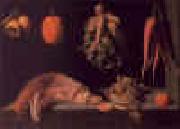
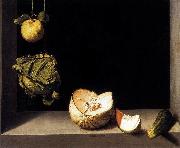
S??nchez Cot??n was born in the town of Orgaz, near Toledo. He was a friend and perhaps pupil of Blas de Prado, an artist famous for his still lifes whose mannerist style with touches of realism, the disciple developed further. Cot??n began by painting altar pieces and religious works. For approximately twenty years, he pursued a successful career in Toledo as an artist, patronized by the city??s aristocracy, painting religious scenes, portraits and still lifes. These paintings found a receptive audience among the educated intellectuals of Toledo society. S??nchez Cot??n executed his notable still lifes around the turn of the seventeenth century, before the end of his secular life. An example (seen above) is Quince, Cabbage, Melon and Cucumber (1602, in the San Diego Museum of Art).
On August 10, 1603, Juan Sanchez Cotan, then in his forties, closed up his workshop at Toledo to renounce the world and enter the Carthusian monastery Santa Maria de El Paular. He continued his career painting religious works with singular mysticism. In 1612 he was sent to the Granada Charterhouse, he decided to become a monk, and in the following year he entered the Carthusian monastery at Granada as a laybrother. The reasons for this are not clear, though such action was not unusual in Cot??n??s day.
Cotan was a prolific religious painter whose work, carried out exclusively for his monastery, reached its peak about 1617 in the cycle of eight great narrative paintings which he painted for the cloister of the Granada Monastery. These depict the foundation of the order of St. Bruno, and the prosecution of the monks in England by the Protestants.
Although the painter??s religious works have an archaic air, they also reveal a keen interest in the treatment of light and volumes, and in some respect are comparable with certain works by the Italian Luca Cambiaso whom Cotan knew at the Escorial. While Cotan's religious works are unexceptional, as a still-life painter he ranks with the great names of European painting.
In spite of his retreat from the world, Cotan??s influence remained strong. His concern with the relationships among objects and with achieving the illusion of reality through the use of light and shadow was a major influence on the work of later Spanish painters such as Juan van der Hamen, Felipe Ramirez, the brothers Vincenzo and Bartolomeo Carducci and, notably, Francisco de Zurbaran. Sanchez Cotan ended his days universally loved and regarded as a saint. He died in 1627 in Granada.
|
|
 |
Juan Sanchez Cotan
|
|
(June 25, 1560 - September 8, 1627) was a Spanish Baroque painter, a pioneer of realism in Spain. His still lifes, also called bodegones were painted in a strikingly austere style, especially when compared to similar works in Netherlands and Italy.
Senchez Coten was born in the town of Orgaz, near Toledo, Spain. He was a friend and perhaps pupil of Blas de Prado, an artist famous for his still lifes whose mannerist style with touches of realism, the disciple developed further. Cotan began by painting altar pieces and religious works. For approximately twenty years, he pursued a successful career in Toledo as an artist, patronized by the city's aristocracy, painting religious scenes, portraits and still lifes. These paintings found a receptive audience among the educated intellectuals of Toledo society. Senchez Cotan executed his notable still lifes around the turn of the seventeenth century, before the end of his secular life. An example (seen above) is Quince, Cabbage, Melon and Cucumber (1602, in the San Diego Museum of Art).
On August 10, 1603, Juan Sanchez Cotan, then in his forties, closed up his workshop at Toledo to renounce the world and enter the Carthusian monastery Santa Maria de El Paular. He continued his career painting religious works with singular mysticism. In 1612 he was sent to the Granada Charterhouse, he decided to become a monk, and in the following year he entered the Carthusian monastery at Granada as a laybrother. The reasons for this are not clear, though such action was not unusual in Cotan's day.
|
|
 |
Juan Pantoja de la Cruz
|
|
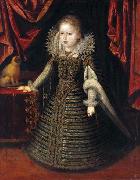
(Valladolid, 1553 - 26 October 1608, Madrid) Spanish painter, one of the best representatives of the Spanish school of court painters. He worked for Philip II and Philip III. The Museo del Prado contains examples of his severe portraiture style.
Juan Pantoja de La Cruz was, born 1553 in Valladolid. Very little is known of his formative years as a painter. He was a pupil of the court painter Alonso Senchez Coello in Madrid and he must have assisted his master in complying with his duties as painter of the Spanish King, Philip II. Pantoja probably continued to work in his master studio after completing his training. He married in 1585 beginning to paint for the court around that time. After Sanchez Coello's death in 1588, Pantoja took over his master workshop and became court painter to Philip II of Spain.
Pantoja kept working for the court and the nobility, painting portraits of Prince Philip, the future Philip III, in 1592 and 1594. Among his most well known works is the portrait of Philip II wearing a cape and hat all in black, painted around 1594 for the Escorial. This portrait is one of the best representations of the idea of Spanish majesty, based on the remoteness of the monarch. On Philip II's death in 1598, Philip III confirmed Pantoja's status as court painter. When the court settled in Valladolid in 1601, Pantoja moved to the new capital, remaining in this city, several years.
|
|
 |
Juan Martin Cabezalero
|
|
1633-1673
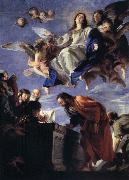
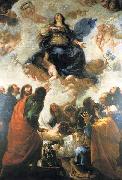
was a Spanish draftsman and painter. Born in Almaden, he studied under Juan Carreno de Miranda, court painter to Charles II of Spain; Cabezalero lived at Carreno de Miranda's house until 1666. Both he and Carreno were influenced by Van Dyck. Few works by Cabezalero have survived. His surviving works include his St Jerome (1666, Meadows Museum, Southern Methodist University, Dallas) and the Assumption of the Virgin (ca. 1670; Madrid, Prado). The latter had been formerly attributed to Mateo Cerezo, also a pupil of Carreno de Miranda. Antonio Palomino praises Cabezalero's modest, studious nature and laments that he died young.
|
|
 |
Juan Correa de Vivar
|
|
Spanish , c.1510-1566
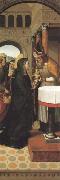
was a Spanish painter,Correa's date of birth has been determined to be around 1510. Records show he grew up wealthy. When Juan was 17 or 18 years old he joined an artist workshop in Burgundy where he met with many other Spanish artists at the time, including Pedro de Cisneros whom he befriended. Juan's brother Eufrasia and Eufrasia's son Rodrigo also grew up to be artists. Rodrigo was apprenticed with his uncle, and continued some of his uncle's works after his death. In Mascaraque, Juan was a substantial landowner with a nice house where he did much of his painting. He took frequent trips but always stayed in the Toledo area. Juan was married and a religious man. It can be seen in his testament: a copy was found in the church files of Mascaraque. When he died, Juan split all his possessions between his nephew Rodrigo and the church of Mascaraque. Juan was a well-regarded painter during his life, but many records were lost. His works and life were brought to light again when the researcher and art historian Ceen Bermudez in 1800 published a dictionary of famous artists and included a brief article about his works and Italian influences. The full reconstruction of its biography has been primarily accomplished in the 20th century. Records show Juan died on April 16, 1566 in San Miguel. Juan's body was taken back to Mascaraque where he was buried, in the same plot where his parents were laid to rest. Many members of the artistic community came to the funeral service,
|
|
 |
Juan Carreno de Miranda
|
|
English: Juan Carreño de Miranda (March 1614-September 1685) was a Spanish painter of the Baroque period.
Español: Juan Carreño de Miranda (Aviles, 1614 - Madrid, 1685) fue un pintor español del siglo XVII, que destace en la Corte española de Felipe IV, y, sobre todo, Carlos II.
|
|
 |
jozef marian chelmonski
|
|
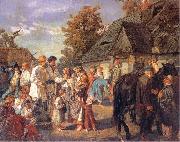
Jozef Marian Chełmoski (November 7, 1849 -- April 6, 1914) was a Polish painter.
Chełmoski was born in the village of Boczki near Łowicz in central Congress Poland, Russian Empire. His first drawing teacher was his father (a small leaseholder and administrator of Boczki village). After finishing high school in Warsaw, he studied in Warsaw Drawing Class (1867C1871) and took private lessons from Wojciech Gerson. From 1871 to 1874 Chełmoski lived in Munich. He worked with Polish painters assembled around Jozef Brandt and Maksymilian Gierymski. He also had studied for a few months at the academy of H. Anschutz and A. Strahuber. In 1872 and 1874 Chełmoski visited the Polish territories (Poland as a country did not exist then), Tatra Mountains and Ukraine.
His first paintings were done under the influence of Gerson. The works that followed were landscapes and villages. In 1875 Chełmoski went to Paris, where he had many important exhibitions and became known to the art scene. With many orders, the artistic level of his paintings decreased.
From 1878 to 1887 Chełmoski visited Poland, Vienna and Venice. In 1887 he returned to Poland and in 1889 settled in Kuklewka Zarzeczna village. Contact with his homeland and nature revealed quality in his artworks. From that time are the best liked Chełmoski's paintings such as Partridge on the Snow, The Storks or Before Thunderstorm.
Chełmoski represented the trend in art called "Polish Patriotic Painting".
He died in Kuklewka near Grodzisk Mazowiecki in 1914.
|
|
|
|
Jozef Marian Chelmonski
|
|
(November 7, 1849 - April 6, 1914) was a Polish painter.
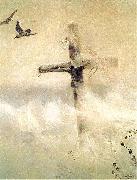
Chełmoeski was born in the village of Boczki near Łowicz in central Congress Poland, Russian Empire. His first drawing teacher was his father (a small leaseholder and administrator of Boczki village). After finishing high school in Warsaw, Jozef studied in Warsaw Drawing Class (1867-1871) and took private lessons from Wojciech Gerson. From 1871 to 1874 Chełmoeski lived in Munich. He worked with Polish painters assembled around Jozef Brandt and Maksymilian Gierymski. There, he also studied for a few months at the academy of H. Anschutz and A. Strahuber. In 1872 and 1874 Chełmoeski visited the Polish Territories (Poland, as an independent country, did not exist during this time), Tatra Mountains and Ukraine.
His first paintings were done under the influence of Gerson. The works that followed were landscapes and villages. In 1875 Chełmoeski went to Paris, where he had many important exhibitions and became known to the art scene. With many orders, the artistic level of his paintings decreased.
From 1878 to 1887 Chełmoeski visited Poland, Vienna and Venice. In 1887 he returned to Poland and in 1889 settled in the village of Kuklewka Zarzeczna. Contact with his homeland and nature are qualities revealed in his artworks. From that time are the best liked, or the most beloved of Chełmoeski's paintings are paintings such as Partridge on the Snow, The Storks or Before Thunderstorm.
|
|
 |
Jozef Chelmonski
|
|
(November 7, 1849 -- April 6, 1914) was a Polish painter.
Chełmonski was born in the village of Boczki near Łowicz in central Congress Poland, Russian Empire. His first drawing teacher was his father (a small leaseholder and administrator of Boczki village). After finishing high school in Warsaw, he studied in Warsaw Drawing Class (1867--1871) and took private lessons from Wojciech Gerson. From 1871 to 1874 Chełmonski lived in Munich. He worked with Polish painters assembled around Jozef Brandt and Maksymilian Gierymski. He also had studied for a few months at the academy of H. Anschutz and A. Strahuber. In 1872 and 1874 Chełmonski visited the Polish territories (Poland as a country did not exist then), Tatra Mountains and Ukraine.
His first paintings were done under the influence of Gerson. The works that followed were landscapes and villages. In 1875 Chełmonski went to Paris, where he had many important exhibitions and became known to the art scene. With many orders, the artistic level of his paintings decreased.
From 1878 to 1887 Chełmonski visited Poland, Vienna and Venice. In 1887 he returned to Poland and in 1889 settled in Kuklawka Zarzeczna village. Contact with his homeland and nature revealed quality in his artworks. From that time are the best liked Chełmonski's paintings such as Partridge on the Snow, The Storks or Before Thunderstorm.
Chełmonski represented the trend in art called "Polish Patriotic Painting".
He died in Kuklawka near Grodzisk Mazowiecki in 1914.
|
|
|
|
|
|
|
|
|
| Wholesale China Oil Painting Wholesale Oil Painting China Xiamen Portrait Reproduction on canvas Chinese Oil Painting Wholesale USA Oil Painting |
|
|
|
|
|