| |
|
Xiamen Oil Paintings, Wholesale Direct!
|
|
100% hand painted, 100% cotton canvas, 100% money back if not satisfaction. |
|
|
|
|
ART WORKS INDEX
A
B
C
D
E
F
G
H
I
J
K
L
M
N
O
P
Q
R
S
T
U
V
W
X
Y
Z
|
|
ARTISTS INDEX
A
B
C
D
E
F
G
H
I
J
K
L
M
N
O
P
Q
R
S
T
U
V
W
X
Y
Z
|
|
|
|
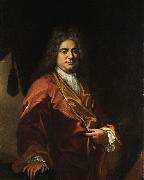 |
Giovanni Camillo Sagrestani
|
|
(1660-1731) was an Italian painter of the Baroque era.
A native of Florence, he was a follower of the style of Carlo Cignani. His major pupil was Matteo Bonechi (1672-1726) and Giovanni Battista Ranieri del Pace. Four canvases attributed to Sagrestani can be found in the church of Santa Maria della Fraternite in Foiano della Chiana. He also executed works in the church of San Frediano in Cestello, in the Oltrarno district of Florence. Paintings in the church of SS. Annunziata in San Giovanni Valdarno are attributed to Sagrestani. An Assumption of the Virgin is found in Nancy.
|
|
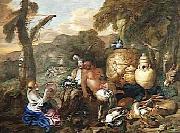 |
Giovanni Benedetto Castiglione
|
|
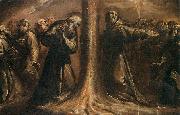
was an Italian Baroque artist, painter, printmaker and draftsman, of the Genoese school. He is best known now for his elaborate engravings, and as the inventor of the printmaking technique of monotyping. He was known as Il Grechetto in Italy and in France as Le Benedette.
|
|
|
|
 |
Giovanni Battista Crespi
|
|
Giovanni Battista Crespi (23 December 1573 - 23 October 1632), called Il Cerano, was an Italian painter, sculptor, and architect.
He was born in Romagnano Sesia, the son of a painter, Raffaele Crespi, and moved to Cerano with his family some years later. In 1591 he is known to have been living in Milan.
True to the Counter-Reformation piety zealously expressed in Milanese art of his time, his paintings focus on mysteries and mystical episodes in saintly life. The crowded canvases and the angles recall Mannerism, but his paintings show an emotion that evokes common sentiments in Baroque art. Along with other artists, he completed a series of paintings (Quadroni of St. Charles) of the life of St. Charles Borromeo[1] for the Duomo of Milan, an altarpiece with the Baptism of St. Augustine for San Marco (Milan), and a Mass of St. Gregory for the Basilica of San Vittore in Varese (1615-17). Also see the nightmarish, St. Gregory Delivers the Soul of a Monk (1617), also in San Vittore.
|
|
|
|
 |
Giovanni Antonio Canal
|
|
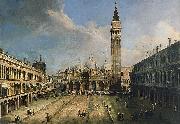
(28 October 1697 - 19 April 1768) better known as Canaletto, was a Venetian painter famous for his landscapes, or vedute, of Venice. He was also an important printmaker in etching.
He was born in Venice as the son of the painter Bernardo Canal, hence his mononym Canaletto ("little Canal"), and Artemisia Barbieri. His nephew and pupil Bernardo Bellotto was also an accomplished landscape painter, with a similar painting style, and sometimes used the name "Canaletto" to advance his own career, particularly in countrieseGermany and Polandewhere his uncle was not active.
|
|
 |
Giovanni Antonio Boltraffio
|
|
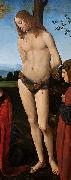
was an Italian painter of the High Renaissance from Lombardy, who worked in the studio of Leonardo da Vinci.[2] Boltraffio and Bernardino Luini are the strongest artistic personalities to emerge from Leonardo's studio. According to Giorgio Vasari, he was of an aristocratic family and was born in Milan.
His major painting of the 1490s is the Resurrection (painted with fellow da Vinci pupil Marco d'Oggiono and now in the Gemäldegalerie, Berlin). A Madonna and Child in the Museo Poldi Pezzoli of Milan, is one of the high points of the Lombard Quattrocento.
His portraits, often in profile, and his half-length renderings of the Madonna and Child are Leonardesque in conception, though the clean hard edges of his outlines lack Leonardo's sfumato.
In Bologna, where he remained in 1500-1502, he found sympathetic patrons in the Casio family, of whom he painted several portraits and for whom he produced his masterwork, the Pala Casio for the Church of the Misericordia (Louvre Museum); it depicts a Madonna and Child with John the Baptist and Saint Sebastian and two Kneeling Donors, Giacomo Marchione de' Pandolfi da Casio and his son, the Bolognese poet Girolamo Casio[3], who mentioned Boltraffio in some of his sonnets. Boltraffio's portrait of Girolamo Casio is at the Pinacoteca di Brera, Milan.
|
|
 |
GILLOT, Claude
|
|
French Painter, 1673-1722
French draughtsman, printmaker and painter. He was the son of an embroiderer and painter of ornaments, who doubtless trained him before he entered the Paris studio of Jean-Baptiste Corneille about 1690; there he learnt to paint and etch. In 1710 he was approved by the Academie Royale; he was received as a history painter five years later, on presentation of the Nailing of Christ to the Cross . Although he painted other elevated subjects, including a Death of the Virgin (1715; untraced) for his native Langres, he was most active as a draughtsman and printmaker specializing in theatre and genre scenes, as well as bacchanals and designs for decorations. Gillot's principal source of inspiration was the popular theatre; he is said to have run a puppet theatre, to have written plays and once to have been in charge of sets, machinery and costume for the opera. This interest was to have a profound effect on the art of his principal pupil, Antoine Watteau
|
|
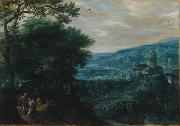 |
Gillis van Coninxloo
|
|
(1544 ?C 1607) was a Dutch painter of forest landscapes, the most famous member of a large family of artists. He travelled through France, and lived in Germany for several years to avoid religious persecution.
He was born at Antwerp and studied under Pieter Coecke van Aelst, Lenaert Kroes and Gillis Mostaert. He practiced his art in France, but in 1587, on account of religious persecution, emigrated to Frankenthal and passed his later life in Amsterdam, where he died in 1607.
Coninxloo ranks as one of the most important Dutch landscape painters of the transition from the sixteenth to the seventeenth century. He exercised a strong influence on Jan Brueghel the Elder, Schoubroeck, Savery, and other Flemish and Dutch landscape painters of the transition period. Coninxloo is considered the founder of a new approach to the painting of forests; while earlier forest landscapes had used woods as backdrops for human activity, van Coninxloo made them a subject, submerging tiny human figures in elaborate compositions of trees in hugely exaggerated scale.
During his stay at Frankenthal from 1588 to 1595, he influenced several better known Dutch landscape-painters collectively referred to as the Frankenthal School. Karel van Mander wrote about him and his father Jan den Hollander in his Schilder-boeck. He wrote that his teacher Pieter Coeke van Aelst was his cousin, and that his landscapes were among the best of all Dutch landscape artists.
|
|
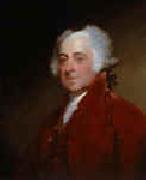 |
Gilbert Charles Stuart
|
|
1755-1828
Gilbert Charles Stuart Locations
Gilbert Charles Stuart (born Stewart) (December 3, 1755 ?C July 9, 1828) was an American painter from Rhode Island.
Gilbert Stuart is widely considered to be one of America's foremost portraitists. His best known work, the unfinished portrait of George Washington that is sometimes referred to as The Athenaeum, was begun in 1796 and left incomplete at the time of Stuart's death in 1828. The image of George Washington featured in the painting has appeared on the United States one-dollar bill for over one century.
Throughout his career, Gilbert Stuart produced portraits of over 1,000 people, including the first six Presidents of the United States. His work can be found today at art museums across the United States and the United Kingdom, most notably the Metropolitan Museum of Art in New York City, the National Gallery of Art in Washington, D.C., the National Portrait Gallery in London, and the Museum of Fine Arts in Boston.
|
|
|
|
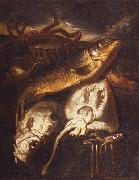 |
Giacomo Francesco Cipper
|
|
(Feldkirch, 1664 - Milan, 1736) was a German painter active in Milan from 1696 to 1736.
Of German origin, he was active in Milan in the first half of the 18th century. Fertile painter of scenes of kind of formulation caravaggesca, his first attributed work is dated 1700; he operated in Lombardia and in Veneto ( Hunters and greengrocers , Modena, Gallery Campori; Farmers' family , Venice, Galleries of the academy). Subsequently the artist, perhaps under the influence of the Cerruti (some of whose works were once attributed to Cipper), to the scrupulous surrender of the detail it replaced a less illustrative vision, more sensitive to the games of light.
His last known work is Self-portrait (1736, Hampton Court).
|
|
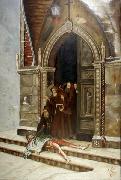 |
Giacomo Di Chirico
|
|
Giacomo Di Chirico (25 January 1844 - 26 December 1883) was an italian painter. Together with Domenico Morelli and Filippo Palizzi, he was one of the most elite Neapolitan artists of the 19th century. He received the official title eKnight of Italye from King Victor Emmanuel II.
|
|
|
|
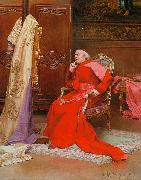 |
Georges Croegaert
|
|
1848-1923) was a Belgian academic painter. He was born in Antwerp, Belgium in 1848, and spent most of his life in Paris. Croegaert is associated with both classicism and anti-clerical art.
|
|
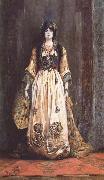 |
Georges Clairin
|
|
French Painter, 1843-1919
.French painter. In 1861 he entered the Ecole des Beaux-Arts in Paris, where he studied with Fran?ois Picot and Isidore Pils. He sent the first of many contributions to the Salon in 1866, an Episode of a Conscript of 1813 . By 1868 he had joined the painter Henri Regnault in a visit to Spain, where he was evidently impressed by Moorish architecture and influenced by the Spanish Orientalist painter Mariano Fortuny y Marsal; Clairin's Volunteers of Liberty: Episode from the Spanish Revolution was exhibited at the Salon of 1869
|
|
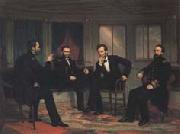 |
George P.A.Healy
|
|
American Painter, 1813-1894
American painter, active also in Europe. At the age of 17 he set up a studio in Boston after receiving encouragement from Thomas Sully, who was painting portraits there. Despite his youth and lack of training, he presented himself to the society figure Mrs Harrison Gray Otis and asked if he might paint her portrait (untraced); she agreed and later sponsored Healy's first trip abroad. In 1834 he entered the studio of Antoine-Jean Gros; the French master's suicide the following year ended Healy's only sustained period of artistic study. In Gros's studio he first encountered Thomas Couture, but they did not meet again until the next decade
|
|
|
|
|
|
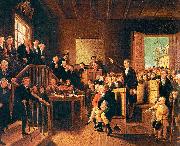 |
George Cooke
|
|
English Engraver, 1781-1849
Born in Maryland, Cooke abandoned a fledgling career in business at an early age in order to become a full time artist. After several years of painting portraits for a living, Cooke left for what would become a five year tour of Europe. His time there was mostly spent learning from and copying the works of the Renaissance master artists, with many of Cooke's copies being sent back to the United States for show or sale.
After returning to the U.S., Cooke and his wife spent the next decade traveling and working with no fixed home. His work took him throughout the Southern United States, where he primarily made his living painting portraits of both famous and ordinary people, and, by the 1840s, his portraits had earned him both financial success and regional fame.
|
|
|
|
 |
George Chinnery
|
|
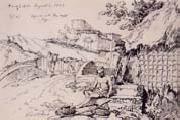
1774-1852,English painter. Although long rumoured to be Irish, Chinnery was brought up in London, where he showed a precocious talent as a portrait painter in the traditions of Romney and Cosway. His grandfather, the calligrapher William Chinnery sr, was the author of Writing and Drawing Made Easy, Amusing and Instructive (London, 1750); his father, William jr, was also a writing master, and exhibited portraits at the Free Society of Artists. George entered the Royal Academy Schools in 1792
|
|
 |
George Cattermole
|
|
1800-1868
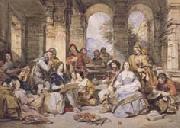
English painter and illustrator. From the age of 14 Cattermole worked with his brother Richard (?1795-1858) for the antiquarian John Britton, producing architectural drawings. This training equipped him with a repertory of accurate architectural backgrounds, and from the later 1820s his work shifted from delineations of historic buildings to imaginative depictions in watercolour of episodes from literature and history and genre subjects with historical settings. He became the foremost historical watercolour painter, recreating the medieval, Elizabethan and 17th-century past. The intimate history pictures of Richard Parkes Bonington were undoubtedly influential, while Cattermole's bold and loose handling of watercolour owed much to David Cox, an admirer of his work. As an illustrator, his works included The Great Civil War of Charles I and Parliament (written by his brother Richard and published in two volumes in 1841 and 1855) and Evenings at Haddon Hall (1846).
|
|
 |
George Catlin
|
|
1796-1872
George Catlin Galleries
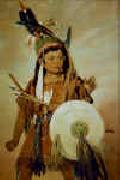
Catlin was born in Wilkes-Barre, Pennsylvania. Following a brief career as a lawyer, he produced two major collections of paintings of American Indians and published a series of books chronicling his travels among the native peoples of North, Central and South America. Claiming his interest in America??s 'vanishing race' was sparked by a visiting American Indian delegation in Philadelphia, he set out to record the appearance and customs of America??s native people.
Catlin began his journey in 1830 when he accompanied General William Clark on a diplomatic mission up the Mississippi River into Native American territory. St. Louis became Catlin??s base of operations for five trips he took between 1830 and 1836, eventually visiting fifty tribes. Two years later he ascended the Missouri River over 3000 km to Ft Union, where he spent several weeks among indigenous people still relatively untouched by European civilization. He visited eighteen tribes, including the Pawnee, Omaha, and Ponca in the south and the Mandan, Cheyenne, Crow, Assiniboine, and Blackfeet to the north. There, at the edge of the frontier, he produced the most vivid and penetrating portraits of his career. Later trips along the Arkansas, Red and Mississippi rivers as well as visits to Florida and the Great Lakes resulted in over 500 paintings and a substantial collection of artifacts.
When Catlin returned east in 1838, he assembled these paintings and numerous artifacts into his Indian Gallery and began delivering public lectures which drew on his personal recollections of life among the American Indians. Catlin traveled with his Indian Gallery to major cities such as Pittsburgh, Cincinnati, and New York. He hung his paintings ??salon style????side by side and one above another??to great effect. Visitors identified each painting by the number on the frame as listed in Catlin??s catalogue. Soon afterwards he began a lifelong effort to sell his collection to the U.S. government. The touring Indian Gallery did not attract the paying public Catlin needed to stay financially sound, and Congress rejected his initial petition to purchase the works, so in 1839 Catlin took his collection across the Atlantic for a tour of European capitals.
Catlin the showman and entrepreneur initially attracted crowds to his Indian Gallery in London, Brussels, and Paris. The French critic Charles Baudelaire remarked on Catlin??s paintings, ??M. Catlin has captured the proud, free character and noble expression of these splendid fellows in a masterly way.??
Catlin??s dream was to sell his Indian Gallery to the U.S. government so that his life??s work would be preserved intact. His continued attempts to persuade various officials in Washington, D.C. failed. He was forced to sell the original Indian Gallery, now 607 paintings, due to personal debts in 1852. Industrialist Joseph Harrison took possession of the paintings and artifacts, which he stored in a factory in Philadelphia, as security. Catlin spent the last 20 years of his life trying to re-create his collection. This second collection of paintings is known as the "Cartoon Collection" since the works are based on the outlines he drew of the works from the 1830s.
In 1841 Catlin published Manners, Customs, and Condition of the North American Indians, in two volumes, with about 300 engravings. Three years later he published 25 plates, entitled Catlin??s North American Indian Portfolio, and, in 1848, Eight Years?? Travels and Residence in Europe. From 1852 to 1857 he traveled through South and Central America and later returned for further exploration in the Far West. The record of these later years is contained in Last Rambles amongst the Indians of the Rocky Mountains and the Andes (1868) and My Life among the Indians (ed. by N. G. Humphreys, 1909). In 1872, Catlin traveled to Washington, D.C. at the invitation of Joseph Henry, the first secretary of the Smithsonian. Until his death later that year in Jersey City, New Jersey, Catlin worked in a studio in the Smithsonian ??Castle.?? Harrison??s widow donated the original Indian Gallery??more than 500 works??to the Smithsonian in 1879.
The nearly complete surviving set of Catlin??s first Indian Gallery painted in the 1830s is now part of the Smithsonian American Art Museum's collection. Some 700 sketches are in the American Museum of Natural History, New York City.
The accuracy of some of Catlin's observations has been questioned. He claimed to be the first white man to see the Minnesota pipestone quarries, and pipestone was named catlinite. Catlin exaggerated various features of the site, and his boastful account of his visit aroused his critics, who disputed his claim of being the first white man to investigate the quarry. Previous recorded white visitors include the Groselliers and Radisson, Father Louis Hennepin, Baron LaHonton and others. Lewis and Clark noted the pipestone quarry in their journals in 1805. Fur trader Philander Prescott had written another account of the area in 1831.
|
|
 |
George Carter
|
|
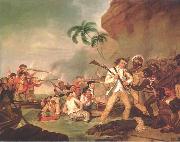
an artist of considerable merit, was born at Colchester. He was an exhibitor at the Royal Academy in 1775, when he sent 'A Wounded Hussar on the Field of Battle.' He afterwards painted 'The Dying Pilgrim,' 'The Siege of Gibraltar,' and many portraits. He is known as the painter of 'The Death of Captain Cook,' 'The Fisherman's Return,' and other popular works, which have been engraved. He died at Hendon in 1795.
|
|
 |
George Caleb Bingham
|
|
1811-1879
George Caleb Bingham Gallery
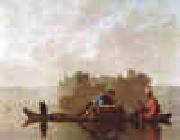
George Caleb Bingham (March 20, 1811 ?C July 7, 1879) was an American artist, whose work depicted his view of American life in the frontier lands along the Missouri River. Left to languish in obscurity, Bingham's work was rediscovered in the 1930s and he is now widely considered one of the greatest American painters of the 1800s.
Born in Augusta County, Virginia, Bingham was the second of seven children born to Henry Vest Bingham and Mary Amend. Upon their marriage, Matthias Amend, Mary's father, gave ownership to the family mill, 1,180 acres of land and several slaves to Henry with the agreement that Matthias could live with the family the rest of his life. Henry offered the land and mill as surety for a friend's debt and, when the friend died in 1818, all was lost. George's family soon moved to Franklin, Missouri "where the land was said to be bountiful, fertile and cheap."
Bingham was a self-taught artist. His sole childhood exposure to the field was as a nine-year-old boy, when famed American portraitist Chester Harding visited Franklin looking for business, having recently sketched Daniel Boone in Warren County, Missouri. George assisted Harding during his brief stay, an experience that left a powerful impression.
In 1823, Bingham's father, now judge of Howard County Court, died of malaria on December 26 at the age of thirty-eight. To keep the family going, Mary Bingham opened a school for girls and George, then twelve, worked as school janitor to help keep the family afloat. At age sixteen, Bingham apprenticed with cabinet maker Jesse Green. After Green moved, he apprenticed with another cabinet maker, Justinian Williams. Both tradesmen were Methodist ministers and, while under their tutelage, Bingham studied religious texts, preached at camp meetings and thought about becoming a minister himself. Bingham also considered becoming a lawyer.
However, by age nineteen, Bigham was painting portraits for $20.00 apiece, often completing the works in a single day. He drummed up work in both Franklin and Arrow Rock and, while his painting abilities were still developing, succeeded in impressing his patrons with his strong draftsmanship and ability to capture the likeness of his subject. Soon Bingham attempted to travel to St. Louis to ply his trade but contracted measles, which left him weak and permanently bald.
In 1836, Bingham married Sarah Elizabeth Hutchison, who bore him three children over the subsequent twelve years before dying at the age of twenty-nine. George married twice more, first to Eliza Thomas, who died in a mental institution in 1876, and then to Martha Lykins, who lived until 1890. George's mother, Mary, died in 1851.
By 1838, Bingham was already beginning to make a name for himself as a portrait artist in St. Louis, his studio visited by several prominent local citizens and statesmen, including the lawyer James S. Rollins who was to become a life-long friend. To further his education, George spent three months in Philadelphia, Pennsylvania before continuing on to New York City to visit the National Academy of Design exhibition.
Bingham was elected to the Missouri General Assembly in 1848.
From 1856 to 1859, Bingham studied art with the members of the D??sseldorf School in D??sseldorf, Germany. Critics claim that this caused him to abandon the rustic American style in his art. Upon his return, he began painting less, turning to politics in the post-Civil War years and serving as state treasurer and adjutant general. He was also president of the Board of Police Commissioners for Kansas City, Missouri in 1874, appointing the first chief of police there . Toward the end of his life he was a professor of art at the University of Missouri in Columbia, Missouri.
|
|
|
|
|
|
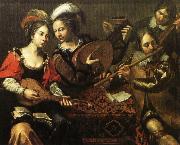 |
geoffrey chaucer
|
|
Born: c. 1340
Birthplace: London, England
Died: 1400
Best Known As: The author of The Canterbury Tales
|
|
|
|
 |
Gautier de Coinci
|
|
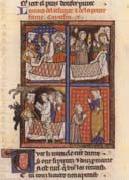
1177-1236 French,Born of noble stock, Gautier became a Benedictine novice at Saint-M??dard de Soissons in 1193 and prior at Vic-sur-Aisne in 1214, returning to Saint-M??dard to be grand prior (1233) until his death. His single work, preserved in nearly 80 manuscripts, is the massive Miracles de Nostre Dame, written at Vic (1214-27) and occupying some 30, 000 lines in two books.
|
|
 |
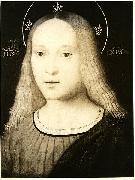
GARCIA, Pere
|
|
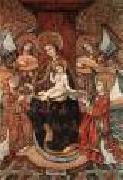
Spanish painter (active 1455-1479 in Barcelona)
|
|
 |
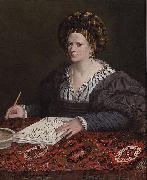
Galeazzo Campi
|
|
(1475/1477 - 1536) was an Italian painter of the Renaissance from Cremona. He was a pupil of Boccaccio Boccaccinis . His representation was rather rigid, but careful. His landscapes show influences of Perugino and Giovanni Bellini.
Campi was the head of an artist family, existing in the middle and end of 16th Century who lived in Cremona and left numerous works of art. His three sons, Giulio Campi, Antonio Campi and Vincenzo Campi are historically noteworthy.
|
|
 |
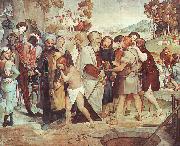
Gabriele Capellini
|
|
Gabriele Capellini was an Italian painter of the Renaissance.He was also called il Caligarino or il Calzolaretto (the little shoemaker), from his having first pursued that trade. He born in Ferrara, and there trained under Dosso Dossi, he was active c. 1520. For the church of San Francesco at Ferrara St. Peter and St. James and for San Giovannino the principal altar-piece, representing The Virgin and Infant with several Saints.
|
|
 |
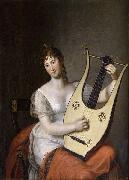
Friedrich Johann Overbeck
|
|
1789-1869
German
German religious painter. Expelled from the Vienna Academy because of his opposition to its classicism, he went to Rome and with Peter von Cornelius, Veit, Schadow-Godenhaus, and others, formed the group known as the Nazarenes. His first real successes were his frescoes for the Casa Bartholdy (now in Berlin) and for the Villa Massimo. Among his notable paintings are Christ Entry into Jerusalem and Christ Agony in the Garden. Overbeck sought to make his art serve religion. His influence was due more to the purity of his doctrine than to the power of his work, which is often lacking in pictorial appeal and in color.
|
|
 |
Friedrich Carl Groger
|
|
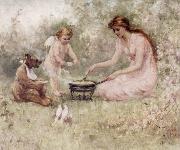
(14 October 1766, Plön - 9 November 1838, Hamburg) was a north-German portrait painter and lithographer. One of the most respected portraitists of his time in northern Germany, his works are to be found in several museums, including the Hamburger Kunsthalle, as well as in north German, Holstein and Danish private collections.
Gröger was the son of a tailor in Plön, where he grew up in modest circumstances. His parents wanted him to become a tailor or wood turner and opposed his early artistic activities. He was largely self taught in painting, though he had some contact in Lebeck with Tischbein and in 1785 was in the city of Lebeck, where he met Heinrich Jacob Aldenrath, his first, loyalest and lifelong friend - the Grögersweg in Hamburg-Barmbek named after him links the Tischbeinstraße with the Aldenrathsweg.
From 1789 he studied at Berlin's Akademie der Kenste. He and Aldenrath then went together to Hamburg, then on a joint study trip to Dresden and Paris, then back to Lebeck, where he worked until 1807. They then alternated between Hamburg, Copenhagen, Kiel and Lebeck, before finally settling in Hamburg in 1814. In 1792 Gröger was made an honorary member of the Gesellschaft zur Beförderung gemeinnetziger Tätigkeit in Lebeck.
Gröger developed from a miniature painter into a portrait painter, who towards the end of his life preferred three quarter bust portraits. Aldenrath took over the miniature painting side of their joint business. After lithography developed in northern Germany, they both worked in this medium individually as well as jointly under the business name Firma Gröger & Aldenrath.
|
|
 |
Frederick Stuart Church
|
|
Painter , Illustrator and Artist .
American , 1842-1924
was an American artist, working mainly as an illustrator and especially known for his (often allegorical) depiction of animals. He was born in Grand Rapids, Michigan. His father was an important figure in politics as well as a well-known lawyer. At the age of 13 he left school and took a job at the then newly-established American Express Company in Chicago, with his parents intending him to have a business career. Being nineteen at the outbreak of the Civil War he served in the Union Army. After his discharge he returned to Chicago, having decided to devote his life to art, and started studying drawing under Walter Shirlaw at the city's Academy of Design. In 1870 he took the decision to continue his studies in New York City, which became his home for the rest of his life. He enrolled at the National Academy of Design, where he was taught by Lemuel Wilmarth. He joined the Art Students League, headed by his old teacher Walter Shirlaw, in which he remained involved for the rest of his life. Unlike many other Americans of his time who felt themselves to be living in a cultural backwater, Church - while he did think that an artist needed to be formally taught - saw no need to study art in Europe and in fact only crossed the Atlantic late in his life. He often expressed outspoken pride in original American art and declaring that "foreign art" had "little to teach Americans". This might be a reflection of the attitudes taken by the strong nativist movements active during his young age, among other places in Chicago when he lived there.
|
|
|
|
 |
Frederick Edwin Church
|
|
1826-1900
Frederick Edwin Church Galleries
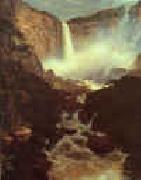
Frederic Edwin Church (May 4, 1826 ?C April 7, 1900) was an American landscape painter born in Hartford, Connecticut. He was a central figure in the Hudson River School of American landscape painters. While committed to the natural sciences, he was "always concerned with including a spiritual dimension in his works".
The family wealth came from Church's father, Joseph Church, a silversmith and watchmaker in Hartford, Connecticut.(Joseph subsequently also became an official and a director of The Aetna Life Insurance Company) Joseph, in turn, was the son of Samuel Church, who founded the first paper mill in Lee, Massachusetts in the Berkshires, and this allowed him(Frederic) to pursue his interest in art from a very early age. At eighteen years of age, Church became the pupil of Thomas Cole in Catskill, New York after Daniel Wadsworth, a family neighbor and founder of the Wadsworth Atheneum, introduced the two. In May 1848, Church was elected as the youngest Associate of the National Academy of Design and was promoted to Academician the following year. Soon after, he sold his first major work to Hartford's Wadsworth Atheneum.
Church settled in New York where he taught his first pupil, William James Stillman. From the spring to autumn each year Church would travel, often by foot, sketching. He returned each winter to paint and to sell his work.
Between 1853 and 1857, Church traveled in South America, financed by businessman Cyrus West Field, who wished to use Church's paintings to lure investors to his South American ventures. Church was inspired by the Prussian explorer Alexander von Humboldt's Cosmos and his exploration of the continent; Humboldt had challenged artists to portray the "physiognomy" of the Andes.
|
|
|
|
 |
frederick carl frieseke
|
|
American Impressionist Painter, 1874-1939
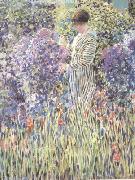
was an American Impressionist painter. He was born in Owosso, Michigan and studied at the School of the Art Institute of Chicago and the Acad??mie Julian in Paris. Frieseke and his family resided for fourteen years in Giverny, which was also home to Monet. He had a great influence on the Americans at the colony there,
|
|
 |
Frederic Edwin Church
|
|
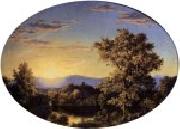
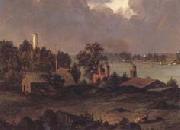
American Hudson River School Painter, 1826-1900 ..American painter. He was a leading representative of the second generation of the HUDSON RIVER SCHOOL, who made an important contribution to American landscape painting in the 1850s and 1860s. The son of a wealthy and prominent businessman, he studied briefly in Hartford with two local artists, Alexander Hamilton Emmons (1816-84) and Benjamin Hutchins Coe (1799-1883). Thanks to the influence of the Hartford patron DANIEL WADSWORTH, in 1844 he became the first pupil accepted by Thomas Cole. This was an unusual honour
|
|
 |
Frederic E.Church
|
|
1826-1900
American painter. He was a leading representative of the second generation of the HUDSON RIVER SCHOOL, who made an important contribution to American landscape painting in the 1850s and 1860s. The son of a wealthy and prominent businessman, he studied briefly in Hartford with two local artists, Alexander Hamilton Emmons (1816-84) and Benjamin Hutchins Coe (1799-1883). Thanks to the influence of the Hartford patron DANIEL WADSWORTH, in 1844 he became the first pupil accepted by Thomas Cole.
|
|
 |
frederic chopin
|
|
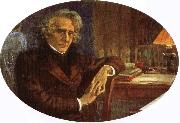
Period: Romantic (1820-1869)
Country: Poland
Born: March 01, 1810 in Zelazowa Wola, Poland
Died: October 17, 1849 in Paris, France
Genres: Ballet, Chamber Music, Concerto, Keyboard Music, Miscellaneous Music, Vocal Music
|
|
 |
Franz Ludwig Catel
|
|
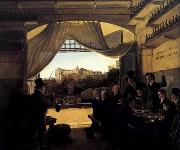
German Painter, 1778-1856,German painter. As a child, Catel helped carve small wooden figures in the toyshop owned by his father. With the encouragement of the printmaker Daniel Chodowiecki, Catel enrolled at the Berlin Kunstakademie, becoming a full member in 1806. In 1807, after already making a name for himself as a watercolourist and book illustrator, he began several years of study at the Acad?mie des Beaux-Arts in Paris, where his main subject was oil painting. In 1811 he moved to Italy, where he stayed for the rest of his life. Initially he wavered between Joseph Anton Koch's classically heroic style of landscape painting and the Romantic lyricism of the Nazarenes. Eventually he found that he could best exercise his technical ability, and most quickly achieve fame and fortune, by producing Italian landscapes. He specialized in Neapolitan scenes depicting festive folk customs; and such paintings proved popular with the mass of wealthy travellers who came to Italy after the Napoleonic Wars.
|
|
|
|
|
|
 |
Frank Crawford Penfold
|
|
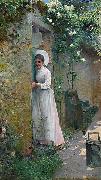
Frank (Francis) Crawford Penfold (1849-1921) was an American artist and teacher, remembered for his genre, landscape and portrait paintings, many of which he completed while living in Pont-Aven in Brittany.
|
|
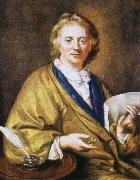 |
francois couperin
|
|
was a French Baroque composer, organist and harpsichordist. François Couperin was known as "Couperin le Grand" (Couperin the Great) to distinguish him from the other members of the musically talented Couperin family.
|
|
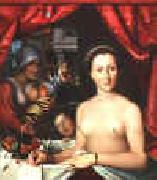 |
Francois Clouet
|
|
1510-1572 French
Francois Clouet Locations
The earliest reference to him is a document dated December 1541 (see Jean Clouet), in which the king renounces for the benefit of François his father estate, which had escheated to the crown as the estate of a foreigner. In this document, the younger Clouet is said to have followed his father very closely in his art. Like his father, he held the office of groom of the chamber and painter in ordinary to the king, and so far as salary is concerned, he started where his father left off. Many drawings are attributed to this artist, often without perfect certainty. There is, however, more to go upon than there is in the case of his father.
As the praises of Francois Clouet were sung by the writers of the day, his name was carefully preserved from reign to reign, and there is an ancient and unbroken tradition in the attribution of many of his pictures. There are not, however, any original attestations of his works, nor are any documents known which would guarantee the ascriptions usually accepted. To him are attributed the portraits of Francis I at the Uffizi and at the Louvre, and various drawings relating to them. He probably also painted the portrait of Catherine de Medici at Versailles and other works, and in all probability a large number of the drawings ascribed to him were from his hand. One of his most remarkable portraits is that of Mary, queen of Scots, a drawing in chalks in the Bibliotheque Nationale, and of similar character are the two portraits of Charles IX and the one at Chantilly of Marguerite of France. Perhaps his masterpiece is the portrait of Elizabeth of Austria in the Louvre. This piece made an important impression on Claude Levi-Strauss. In particular it helped inspire his theory of the mod??le reduit, or of works of art as simplifications and scale models of the realities they represent, and other theories of artworks, in his book The Savage Mind.
Clouet resided in Paris in the rue de Ste Avoye in the Temple quarter, close to the Hotel de Guise, and in 1568 is known to have been under the patronage of Claude Gouffier de Boisy, Seigneur d Oiron, and his wife Claude de Baune. Another ascertained fact concerning Francois Clouet is that in 1571 he was summoned to the office of the Court of the Mint, and his opinion was taken on the likeness to the king of a portrait struck by the mint. He prepared the death-mask of Henry II, as in 1547 he had taken a similar mask of the face and hands of Francis I., in order that the effigy to be used at the funeral might be prepared from his drawings; and on each of these occasions he executed the painting to be used in the decorations of the church and the banners for the great ceremony.
Several miniatures are believed to be his work, one very remarkable portrait being the half-length figure of Henry II in the collection of J. Pierpont Morgan. Another of his portraits is that of Francois, duc d Alençon in the Jones collection at South Kensington, and certain representations of members of the royal family which were in the Hamilton Palace collection and the Magniac sale are usually ascribed to him. He died on the 22nd of December 1572, shortly after the massacre of St Bartholomew, and his will, mentioning his sister and his two illegitimate daughters, and dealing with the disposition of a considerable amount of property, is still in existence. His daughters subsequently became nuns.
His work is remarkable for the extreme accuracy of the drawing, the elaborate finish of all the details, and the exquisite completeness of the whole portrait. He must have been a man of high intelligence, and of great penetration, intensely interested in his work, and with considerable ability to represent the character of his sitter in his portraits. His coloring is perhaps not specially remarkable, nor from the point of style can his pictures be considered especially beautiful, but in perfection of drawing he has hardly any equal.
|
|
|
|
|
|
|
|
|
| Wholesale China Oil Painting Wholesale Oil Painting China Xiamen Portrait Reproduction on canvas Chinese Oil Painting Wholesale USA Oil Painting |
|
|
|
|
|