| |
|
Xiamen Oil Paintings, Wholesale Direct!
|
|
100% hand painted, 100% cotton canvas, 100% money back if not satisfaction. |
|
|
|
|
ART WORKS INDEX
A
B
C
D
E
F
G
H
I
J
K
L
M
N
O
P
Q
R
S
T
U
V
W
X
Y
Z
|
|
ARTISTS INDEX
A
B
C
D
E
F
G
H
I
J
K
L
M
N
O
P
Q
R
S
T
U
V
W
X
Y
Z
|
|
|
|
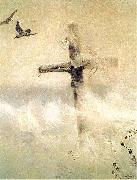 |
Jozef Chelmonski
|
|
(November 7, 1849 - April 6, 1914) was a Polish painter.
Chełmoski was born in the village of Boczki near Łowicz in central Congress Poland, Russian Empire. His first drawing teacher was his father (a small leaseholder and administrator of Boczki village). After finishing high school in Warsaw, he studied in Warsaw Drawing Class (1867-1871) and took private lessons from Wojciech Gerson. From 1871 to 1874 Chełmoski lived in Munich. He worked with Polish painters assembled around Jozef Brandt and Maksymilian Gierymski. He also had studied for a few months at the academy of H. Anschutz and A. Strahuber. In 1872 and 1874 Chełmoski visited the Polish territories. Tatra Mountains and Ukraine.
His first paintings were done under the influence of Gerson. The works that followed were landscapes and villages. In 1875 Chełmoski went to Paris, where he had many important exhibitions and became known to the art scene. With many orders, the artistic level of his paintings decreased.
From 1878 to 1887 Chełmoski visited Poland, Vienna and Venice. In 1887 he returned to Poland and in 1889 settled in Kuklewka Zarzeczna village. Contact with his homeland and nature revealed quality in his artworks. From that time are the best liked Chełmoski's paintings such as Partridge on the Snow, The Storks or Before Thunderstorm.
|
|
|
|
Jozef Chelmonski
|
|
(November 7, 1849 - April 6, 1914) was a Polish painter.
Chełmoki was born in the village of Boczki near Łowicz in central Congress Poland, Russian Empire. His first drawing teacher was his father (a small leaseholder and administrator of Boczki village). After finishing high school in Warsaw, Jozef studied in Warsaw Drawing Class (1867-1871) and took private lessons from Wojciech Gerson. From 1871 to 1874 Chełmoki lived in Munich. He worked with Polish painters assembled around Jozef Brandt and Maksymilian Gierymski. There, he also studied for a few months at the academy of H. Anschutz and A. Strahuber. In 1872 and 1874 Chełmoki visited the Polish Territories (Poland, as an independent country, did not exist during this time), Tatra Mountains and Ukraine.
His first paintings were done under the influence of Gerson. The works that followed were landscapes and villages. In 1875 Chełmoki went to Paris, where he had many important exhibitions and became known to the art scene. With many orders, the artistic level of his paintings decreased.
From 1878 to 1887 Chełmoki visited Poland, Vienna and Venice. In 1887 he returned to Poland and in 1889 settled in the village of Kuklewka Zarzeczna. Contact with his homeland and nature are qualities revealed in his artworks. From that time are the best liked, or the most beloved of Chełmoki's paintings are paintings such as Partridge on the Snow, The Storks or Before Thunderstorm.
Chełmoki represented the trend in art called "Polish Patriotic Painting".
He died in Kuklewka near Grodzisk Mazowiecki in 1914.
|
|
|
|
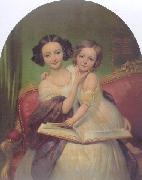 |
Joseph-Desire Court
|
|
a painter of historical subjects and portraits, was born at Rouen in 1797. He became a pupil at the École des Beaux-Arts under Gros, and after carrying off the principal honours there pursued his studies still further at Rome. High expectations were formed of him when he exhibited in 1827 'The Death of Caesar,' a work manifesting earnest thought, and a conscientious handling of the facts of history. This is now preserved in the Louvre. Having shown himself in this and other works a vigorous painter, capable of seizing a subject with a masterly grasp, and having also in the region of portrait painting proved himself an artist of no common merit, he eventually dissipated his talents in the production of a series of empty official pictures painted by order of Louis Philippe. He died in Paris in 1865. The Bordeaux Museum has a portrait of Henri Fonfrede by him; that of Lyons, a 'Scene in the Deluge'; that of Rouen,
|
|
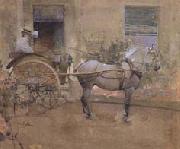 |
Joseph Crawhall
|
|
1861-1913
English painter, active in Scotland. He was brought up in Newcastle upon Tyne and was encouraged by his father and by Charles Keene, the cartoonist for Punch, studying at King's College School in London under P. H. Delamotte. There he met E. A. Walton, with whom, joined by James Guthrie, he painted at Roseneath, near Glasgow, in 1879. Crawhall also collaborated with Walton and Guthrie on illustration. His association with the Glasgow Boys was consolidated during the early 1880s on further painting trips in the Trossachs, Berwicks, and Crowland, Lincs. A keen huntsman and rider, Crawhall specialized in bird, animal and humorous subjects, and his work, with that of Arthur Melville, exemplifies the achievement of the Glasgow Boys in watercolour. After studying in Paris in 1882 under Aim? Morot (1850-1913), Crawhall exhibited for the first and only time at the Royal Academy, probably showing A Lincolnshire Meadow (1883; Glasgow, A.G. & Mus.). He then virtually abandoned oil painting and the plein-air technique, working instead from memory and using line and watercolour.
|
|
|
|
|
|
|
|
|
|
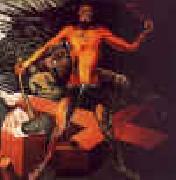 |
Jose Clemente Orozco
|
|
Mexican
1883-1949
Jose Clemente Orozco Gallery
Jose Clemente Orozco (November 23, 1883 ?C September 7, 1949) was a Mexican social realist painter, who specialized in bold murals that established the Mexican Mural Renaissance together with murals by Diego Rivera, David Siqueiros, and others. Orozco was the most complex of the Mexican muralists, fond of the theme of human suffering, but less realistic and more fascinated by machines than Rivera. Mostly influenced by Symbolism, he was also a genre painter and lithographer. Between 1922 and 1948, Orozco painted murals in Mexico City, Orizaba, Claremont, California, New York City, Hanover, New Hampshire, Guadalajara, Jalisco, and Jiquilpan, Michoac??n. His drawings and paintings are exhibited by the Carrillo Gil Museum in Mexico City, and the Orozco Workshop-Museum in Guadalajara.
Jos?? Clemente Orozco was born in Zapotl??n el Grande (now Ciudad Guzm??n), Jalisco to Rosa de Flores Orozco. He married Margarita Valladares, and had three children. In a childhood accident, Orozco lost his left hand while playing with gunpowder.
Jos?? Guadalupe Posada, a satirical illustrator whose engravings about Mexican culture and politics challenged Mexicans to think differently about post-revolutionary Mexico, worked in full view of the public in shop windows located on the way Orozco went to school. In his autobiography, Orozco confesses, "I would stop [on my way to and from school] and spend a few enchanted minutes in watching [Posada]?? This was the push that first set my imagination in motion and impelled me to cover paper with my earliest little figures; this was my awakening to the existence of the art of painting." (Orozco, 1962) He goes to say that watching Posado's engraving decorated gave him his introduction to the use of color. After attending school for Agriculture and Architecture, Orozco studied art at the San Carlos Academy.
With Diego Rivera, he was a leader of the artist movement known as Mexican Muralism. An important distinction he had from Rivera was his critical view of the Mexican Revolution. While Diego was a bold, optimistic figure, touting the glory of the revolution, Orozco was less comfortable with the bloody toll the social movement was taking. Orozco is known as one of the "Big Three" muralists along with Diego Rivera and David Alfaro Siqueiros. All three artists, as well as the painter Rufino Tamayo, experimented with fresco on large walls, and elevated the art of the mural.
|
|
 |
Jose del Castillo
|
|
1737-1793
Spanish
Jose del Castillo Location
a Spanish painter and a leader of the artistic movement Illustrious Absolutism. Many of his paintings were done on tapestries.
Castillo made many attempts to become Royal Painter for the Spanish monarchy, but he was never successful. This was not due to a lack of talent, but rather because Castillo allied himself with the wrong noble. His patron, the Earl of Floridablanca, feuded bitterly with the Earl of Aranda. The Earl of Aranda was favored by King Carlos III, and as a result, Ram??n Bayeu (Aranda favorite painter) became Royal Painter.
After Carlos III died, Castillo tried again to become Royal Painter. Unfortunately, the new monarch, Carlos IV, decided to leave the position of Royal Painter vacant.
|
|
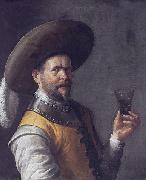 |
Joost Cornelisz Droochsloot
|
|
(1586, Utrecht (city) - May 14, 1666, Utrecht (city)), was a Dutch Golden Age painter.
According to Houbraken his village scenes (Boerekermisstuk) were as popular as flower pieces by Bartholomeus Assteyn.Houbraken thought he was born in Gorinchem or Dordrecht, and claimed he worked for a long time in Dordrecht. He felt his work was always according to a set pattern, where cake sellers were portrayed in front of village houses with figures in a festive setting called a "farmer's circus". It is unclear why Houbraken would have thought he was from Dordrecht, especially since Houbraken's data on painters from Dordrecht was generally quite accurate. Droochsloot and his son were highly respected citizens of Utrecht with a large workshop.
According to the RKD his monogram was "JCODS" and he became a member of the Utrecht Guild of Saint Luke in 1616. He later became deacon of the guild in 1623 and regent of the St. Jobs Gasthuis in 1638, deacon of the Dutch Reformed church, and in 1665 officer of the Utrecht schutterij. He was the father of the painter Cornelis Droochsloot (1630-1673) whose paintings are hard to distinguish from his own, and the teacher of Jacob Duck.
|
|
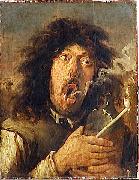 |
Joos van Craesbeeck
|
|
(c. 1605/06- c. 1660) was a Flemish painter who specialized in tavern interiors, tronies, and other works similar to his teacher Adriaen Brouwer. Born in Neerlinter (Flemish Brabant), he became a master in Antwerp's guild of St. Luke in 1633?C1634, and like his contemporaries David Teniers the Elder and David Rijckaert III he developed rustic genre scenes. He subsequently moved to Brussels, where he joined that city's painters' guild in 1651.
Paintings such as Death is Violent and Fast are typical of his small, theatrical images of peasants brawling crowded with violent expressive figures. Unlike Teniers, whose style became more elegant, Craesbeeck continued to paint bawdy figures later in his career.
|
|
|
|
|
|
|
|
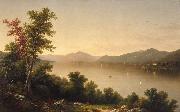 |
John William Casilear
|
|
(June 25, 1811 - August 17, 1893) was an American landscape artist belonging to the Hudson River School.
Casilear was born in New York City. His first professional training was under prominent New York engraver Peter Maverick in the 1820s, then with Asher Durand, himself an engraver at the time. Casilear and Durand became friends, and both worked as engravers in New York through the 1830s.
By the middle 1830s Durand had become interested in landscape painting through his friendship with Thomas Cole. Durand, in turn, drew Casilear's attention to painting. By 1840 Casilear's interest in art was sufficiently strong to accompany Durand, John Frederick Kensett, and artist Thomas P. Rossiter on a European trip during which they sketched scenes, visited art museums, and fostered their interest in painting.
Casilear gradually developed his talent in landscape art, painting in the style that was later to become known as the Hudson River School. By the middle 1850s he had entirely ceased his engraving career in favor of painting full-time. He was elected a full member of the National Academy of Design in 1851, having been an associate member since 1831, and exhibited his works there for over fifty years.
Casilear died in Saratoga Springs, New York in 1893.
|
|
 |
John Steuart Curry
|
|
American Regionalist Painter,
b.1897 d.1946
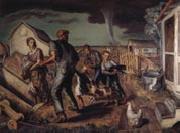
American painter and illustrator. As one of the 'Regionalist triumvirate', with Thomas Hart Benton and Grant Wood, he has been most often characterized as a faithful chronicler of rural life in Kansas. From 1916 to 1918 he was at the School of the Art Institute of Chicago. In 1919 he began study in the studio of Harvey Dunn (1884-1952) in Tenafly, NJ. After seven years as an illustrator in and around New York, he went to Paris in 1926 to study with the Russian Academician Vasily Shukhayev. Ironically, it was on Curry's return to the East Coast the following year that he began to earn his reputation as a Regionalist by painting memories of Kansas from his studio in the fashionable art colony of Westport, CT. Baptism in Kansas
|
|
 |
John Singleton Copley
|
|
American Colonial Era Painter, 1738-1815
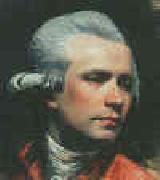
John Singleton Copley (1738[1] - 1815) was an American painter, born presumably in Boston, Massachusetts and a son of Richard and Mary Singleton Copley, both Irish. He is famous for his portrait paintings of important figures in colonial New England, depicting in particular middle-class subjects. His paintings were innovative in their tendency to depict artifacts relating to these individuals' lives.
|
|
 |
John sell cotman
|
|
English Romantic Painter, 1782-1842
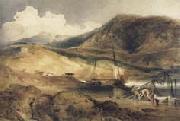
English painter and etcher. Cotman was born in the parish of St Mary Coslany, Norwich, the son of Edmund Cotman, a hairdresser, later a haberdasher, and Ann Sell. In 1793 he entered Norwich Grammar School as a 'freeplacer'. In 1798 he moved to London, where he worked as an assistant to the publisher Rudolph Ackermann. Following in the footsteps of Turner and Thomas Girtin he joined Dr Monro's 'Academy' in 1799 and became a member of the sketching society that had developed around the personality and talent of Girtin.
|
|
 |
John Robert Cozens
|
|
British
1752-1797
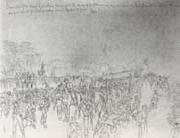
). Painter, draughtsman and printmaker, son of (1) Alexander Cozens.
He was taught by his father, and an album by John Robert (Aberystwyth, N. Lib. Wales) indicates that he also learnt to sketch landscape directly from nature. The album contains drawings that record sketching tours to Nacton, near Ipswich, Suffolk (Aug 1768); day trips to the outskirts of London: Greenwich and Blackheath (1768, 1771), Epsom (1768) and Hampstead (1770-71); and a trip to Matlock, Derbys (June 1772). The earliest of these sketches are careful pencil drawings, some later reworked in pen, ink and wash, and there is at least one attempt at added colour. Later drawings are freer, either noting an idea for a composition or recording light and shade with rapid washes of ink over pencil. His father worked mainly in monochrome brown or grey washes, and John Robert earliest exhibits (he exhibited at the Society of Artists every year from 1767 to 1771) were also in this medium.
|
|
 |
John R.Chapin
|
|
1823 - 1904,was a 19th-century American artist and illustrator, who worked for Harper's Magazine. He was especially noted for a series of illustrations entitled Artist life in the highlands of New Jersey published in April 1860 which gave a realistic depiction of the daily life of miners.
|
|
|
|
 |
John Maler Collier
|
|
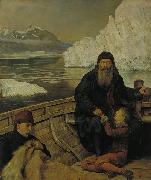
(27 January 1850 - 11 April 1934), called 'Jack' by his family and friends, was a leading English artist, and an author. He painted in the Pre-Raphaelite style, and was one of the most prominent portrait painters of his generation. Both his marriages were to daughters of Thomas Henry Huxley. He studied painting at the Munich Academy where he enrolled on 14 April 1875 (Register: 3145) at the age of 25.
Collier was from a talented and successful family. His grandfather, John Collier, was a Quaker merchant who became a Member of Parliament. His father (who was a Member of Parliament, Attorney General and, for many years, a full-time judge of the Privy Council) was created the first Lord Monkswell. He was also a member of the Royal Society of British Artists. John Collier's elder brother, the second Lord Monkswell, was Under-Secretary of State for War and Chairman of the London County Council.
Collier's first wife, Marian Huxley, 1883In due course, Collier became an integral part of the family of Thomas Henry Huxley PC, sometime President of the Royal Society. Collier married two of Huxley's daughters and was "on terms of intimate friendship" with his son, the writer Leonard Huxley. Collier's first wife, in 1879, was Marian (Mady) Huxley. She was a painter who studied, like her husband, at the Slade and exhibited at the Royal Academy and elsewhere. After the birth of their only child, a daughter, she suffered severe post-natal depression and was taken to Paris for treatment where, however, she contracted pneumonia and died in 1887.
In 1889 Collier married Mady's younger sister Ethel Huxley. Until the Deceased Wife's Sister's Marriage Act 1907 such a marriage was not possible in England, so the ceremony took place in Norway. Collier's daughter by his first marriage, Joyce, was a portrait miniaturist, and a member of the Royal Society of Miniature Painters. By his second wife he had a daughter and a son, Sir Laurence Collier KCMG, who was the British Ambassador to Norway 1941-51.
|
|
 |
John Gadsby Chapman
|
|
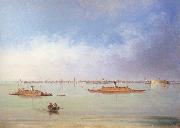
American Painter, 1808-1889,was an American artist famous for The Baptism of Pocahontas, which was commissioned by the United States Congress and hangs in the United States Capitol rotunda. John Chapman was born in 1808 in Alexandria, Virginia. Chapman began his study of art in Philadelphia for two years, then departed for Europe where he eventually spent time in Italy. In 1831, Chapman returned to his hometown of Alexandria, and exhibited his artwork in the nearest metropolitan areas, such as Washington, D.C., Richmond, and Philadelphia. He specialized in landscapes and portraits. By 1834, Chapman had moved to New York City and become a member of the National Academy of Design, and found work as an illustrator. In New York, Chapman embarked on a series of historic paintings, such as Landing at Jamestown and the Crowning of Powhatan. The success of these paintings helped Chapman land a commission from the United States Congress in February 1837 to paint a historical scene for the rotunda of the Capitol building. For this work, Chapman received a total payment of $10,000. On November 30th, 1840, The Baptism of Pocahontas was formally unveiled in the Capitol rotunda. On the swell of this success, Chapman moved his family to Rome, and made an earnest living selling paintings of rural Campagna to American visitors. However, at the onset of the American Civil War, the tourist industry dried up, affecting Chapman fortunes greatly. In addition, Chapman own son, Conrad Chapman, returned to America to fight on the side of the Confederate States of America. The economic deprivation inflicted on Chapman during the 1860s became insurmountable. In Rome, he was forced to live off the kindness of fellow expatriates, and finally returned to America, sick and poor, to spend his last days with another son, John Linton Chapman, in Brooklyn, New York. It was there, in 1889, that he died a pauper.
|
|
|
|
 |
John Crome
|
|
English Romantic Painter,
1768-1821
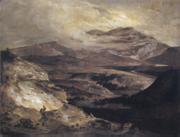
was an artist in the Romantic era. Born in the English city of Norwich, John Crome is also known as Old Crome to distinguish him from his son, John Berney Crome, who was also a well-known artist. The son of a weaver, he was apprenticed to a coach painter or sign painter. It is said that he acquired his skills by copying Gainsboroughs and Hobbemas owned by Thomas Harvey of Old Catton, his patron from 1790. The two main influences on his style are considered Dutch 17th century painting and Wilson. Crome went on to become the founder of the Norwich school of painters, of which John Sell Cotman is another famous member. He worked both in watercolour and oil. His oil paintings alone number in excess of 300. Many can be seen at major galleries around the world, including the Tate Gallery and the Royal Academy, but he is also well represented in Norwich itself. He also produced etchings and taught art. One of his pupils was James Stark. Crome's Broad and nearby Crome's Farm.
|
|
 |
John Constable
|
|
1776-1837
British
John Constable Locations
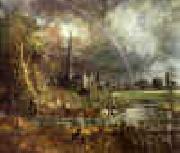
1837). English painter and draughtsman. His range and aspirations were less extensive than those of his contemporary J. M. W. Turner, but these two artists have traditionally been linked as the giants of early 19th-century British landscape painting and isolated from the many other artists practising landscape at a time when it was unprecedentedly popular. Constable has often been defined as the great naturalist and deliberately presented himself thus in his correspondence, although his stylistic variety indicates an instability in his perception of what constituted nature. He has also been characterized as having painted only the places he knew intimately, which other artists tended to pass by. While the exclusivity of Constable approach is indisputable, his concern with local scenery was not unique, being shared by the contemporary Norwich artists. By beginning to sketch in oil from nature seriously in 1808, he also conformed with the practice of artists such as Thomas Christopher Hofland (1777-1843), William Alfred Delamotte, Turner and, particularly, the pupils of John Linnell. Turner shared his commitment to establishing landscape as the equal of history painting, despite widespread disbelief in this notion. Nevertheless, although Constable was less singular than he might have liked people to believe, his single-mindedness in portraying so limited a range of sites was unique, and the brilliance of his oil sketching unprecedented, while none of his contemporaries was producing pictures resembling The Haywain (1821; London, N.G.) or the Leaping Horse (1825; London, RA). This very singularity was characteristic of British artists at a time when members of most occupations were stressing their individuality in the context of a rapidly developing capitalist economy
|
|
|
|
 |
John Closterman
|
|
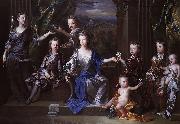
John Closterman (1660-1711) (also spelled Cloosterman, Klosterman), portrait-painter, born in Osnabruck, the son of an artist, who taught him the rudiments of design.
In 1679 he went to Paris, accompanied by his countryman Tiburen, and there worked under Francois de Troy. In 1681 he came to England, and painted draperies for John Riley, at whose death, in 1691, Closterman finished several of his portraits. This recommended him to the Duke of Somerset, but he lost his favour on account of a dispute about a picture of Guercino, specially acquired for his grace, and which was afterwards purchased by Lord Halifax. In 1696 he was invited to the court of Spain, and executed the portraits of the king and queen; he also went to Italy twice, and made several acquisitions of works of art. On returning to England he obtained considerable employment, and married an Englishwoman. He buried his wife, Hannah, on 27 January 1702. According to Arnold Houbraken, he later took a mistress, who then ruined him by her extravagant habits, and ultimately left him in a state of dejection of body and mind that led to his ultimate decline. Jacob Campo Weyerman, who took much of his biographical material from Houbraken, states "Closterman had taken a beautiful mistress who, while he was away in the country, robbed him of his valuables and disappeared, actions which drove the painter into madness".
He died in 1711, and was buried in Covent Garden churchyard.
|
|
 |
John Cleveley
|
|
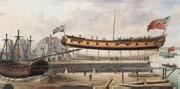
circa 1712-77 English painter, born in Southwark, London. Cleveley did not come from an artistic background
|
|
 |
John Christian Schetky
|
|
(1778-1874)
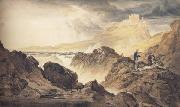
Scottish painter. Schetky came from a cultured family: his father, Johann (1737-1824), was a German composer, and his mother, Maria, was the trumpeter Joseph Reinagle's sister. He took drawing lessons from Alexander Nasmyth and received a good education in Edinburgh before embarking on a Continental tour in 1801. After a spell as a drawing-master at the Royal Military College, Great Marlow, he was appointed Professor of Drawing at the Royal Naval College, Portsmouth, in 1811, a post he held for 25 years. He exhibited regularly at the Royal Academy between 1805 and 1872, his subjects ranging from ship portraits and royal embarkations to reconstructions of earlier sea battles of the time of Nelson. In 1820 he was made Marine Painter in Ordinary to George IV and was granted the same title by Queen Victoria in 1844.
|
|
|
|
 |
John Charles Dollman
|
|
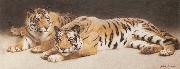
British, 1851-1934, He was an English painter and illustrator. Dollman was born in Hove on 6 May 1851 and moved to London to study at South Kensington and the Royal Academy Schools, after which he set up a studio at Bedford Park, London. He exhibited at the Royal Academy from 1870 to 1912, and was elected RWS (Member of the Royal Watercolour Society) in 1913. Dollman was also an illustrator, working in black and white or colour for magazines such as the Graphic during and after the 1880s. Some of his early work has been said to have influenced Van Gogh . A central theme was ambitious mythological pictures such as a Viking Foray, a Viking horde entitled the Ravagers, The Unknown (1912), featuring a girl surrounded by chimps and Orpheus and his Lute with Lions. He also produced bold compositions of animals and people such as Robinson Crusoe and His Man Friday, Polo and Mowgli made leader of the Bandar-log (1903) . His best known work is possibly A London Cab Stand (1888) , focussing on a group of horses in a stormy scene . He composed at least three variants of this picture, and there are other instances where he made copies or near-copies of individual pictures. In the 1890s he painted pictures of soldiers, and some less well regarded genre pictures of people with animals. He also painted wild animal pictures without attempting any narrative content . Dollman's works are in the collections of various galleries. The Immigrants' Ship (1884) is in the Art Gallery of South Australia, Adelaide . 'The Ravager' is owned by the Trustees of the Royal Watercolour Society, London, [8]. A version of The Unknown is in the Laing Art Gallery, Newcastle. A London Cab Stand is in the London Museum. A Dog's Home, Table d'Hote (1879) is in the Walker Art Gallery, Liverpool , and During the Time of the Sermonses (1896), an odd picture of a pair of religious people approaching two golfers, is in the collection of the Harris Museum, Preston , while 'Famine' (1904) is at the Salford Museum and Art Gallery Dollman died on 11 December 1934, aged 83.
|
|
 |
John Cecil Clay
|
|
Illustrator and genre, caricature painter
American
1875-1930
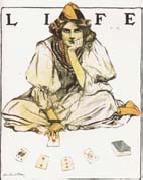
American illustrator known for genre and caricature paintings. Clay was born in Ronceverte, West Virginia to an long-time Southern family. He was a student of Henry Siddons Mowbray at the Art Students League of New York and had a graphic style that was suited to illustration. A reoccurring subject was pretty young women. During his life he worked for Life and Frank Leslie's Popular Monthly. He was a member of Society of Illustrators and was represented at the St. Louis Exposition-World's Fair 1904. Apart from the above mentioned magazines he also worked as an illustrator for The Century Magazine, Saturday Evening Post and Good Housekeeping.
|
|
 |
John callcott horsley,R.A.
|
|
1817-1903
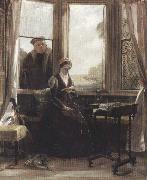
English painter. A nephew of the landscape painter Augustus Wall Callcott, and later Isambard Kingdom Brunel's brother-in-law, he was born into the artistic establishment. He was educated at Henry Sass's Academy and at the Royal Academy. Although he executed two frescoes for the Houses of Parliament (The Spirit of Religion, 1847; London, House of Lords; Satan Wounded by Ithuriel's Lance, 1848; London, Pal. Westminster), his career began with portraiture. Success later came with literary subjects,
|
|
 |
Johannes Cornelisz Verspronck
|
|
(between 1600 and 1603, Haarlem - buried June 30, 1662, Haarlem) was a gifted Dutch Golden Age portraitist.
He was the son of the painter Cornelis Engelsz from Gouda, who taught him to paint portraits. In 1632 he became a member of the Haarlem Guild of St. Luke and started a successful career as a portraitist of mostly Catholic sitters in Haarlem. He may have been a Frans Hals pupil, and was strongly influenced by him, especially in his natural expressions and relaxed poses. He is best known for his exactness in painting details such as jewelry and lace, which made him quite popular with female sitters. Most notably, he won a lucrative commission in 1642 for a group portrait of the regentesses of the St. Elisabeth Gasthuis, at the time the wealthiest charity institution in Haarlem. This was won at the expense of Frans Hals himself, who had painted the regents of the St. Elisabeth Gasthuis in 1641 and fully expected to win the commission for the women.
|
|
|
|
 |
Johann Hermann Carmiencke
|
|
Johann Hermann Carmiencke, a landscape painter and etcher, was born at Hamburg in 1810. He went to Dresden in 1831 as a journeyman painter, and while there studied in Dahl's school. Thence he went to Copenhagen in 1834, where he studied in the Academy, and presently repairing to Leipsic, received instruction there from Sohonberg. Returning to Copenhagen in 1838, he proceeded to travel as an artist in Sweden, Bavaria, and the Tyrol, visiting Italy from 1845 to 1846. He was then appointed court painter to Christian VIII, for whom he executed many works. In consequence of the war, he went in 1851 to New York, where he was well received, and admitted into the Academy of Brooklyn. His works were mainly groups of mountain ranges, which were very effectively rendered, and possessed an excellent tone the execution being simple and true to nature. The 'Mountain Tarn' and the 'View on the Zillerthal' may be particularly noticed. There are thirty-five careful etchings of landscapes by him, some of which were published by the Art Association of Copenhagen in 1850 and 1851. He died at New York in 1867.
|
|
 |
Johann Conrad Seekatz
|
|
1719-1768 Rococo,German,German painter. He studied with his brother, Johann Ludwig Seekatz (b 1711), and with Philipp Hieronymus Brinckmann (1709-61) in Mannheim (1748-51); he became court painter to Landgraf Ludwig VIII von Hesse-Darmstadt in Darmstadt in 1753.
|
|
 |
Johann Christoph Rincklake
|
|
Johann Christoph Rincklake (1764-1813).
Date of birth and death 19 October 1764(1764-10-19) and 19 June 1813(1813-06-19) .
Location of birth and death, Harsewinkel and Munster.
|
|
 |
Johann Christian Reinhart
|
|
German , 1761-1847
He revealed an interest in art while still at school and, though he began to study theology in Leipzig in 1778, he soon transferred to the private art academy of Adam Friedrich Oeser (1717-99). Here he made copies of the work of his teacher and drew after plaster casts of antique statues. The Liber Veritatis, a collection of 200 drawings by Claude Lorrain, was also used as a model and had an important influence on him. In 1783 he went to Dresden where he was especially attracted to the Dutch landscape paintings in the Gem?ldegalerie. In 1785 Reinhart returned to Leipzig where he made the acquaintance of the German poet Friedrich Schiller, with whom he had a lifelong friendship, and to whom he later dedicated an etching of a heroic landscape (1800). From 1786 to 1789, while resident at the court of the Duke of Sachsen-Meiningen, he explored the Thuringian countryside on foot, making sketches as he went.
|
|
|
|
|
|
 |
Johann Christian Brand
|
|
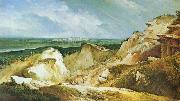
(March 6, 1722 ?C June 12, 1795)was an Austrian painter (son of the German painter Christian Hilfgott Brand (1694-1756) who taught in Vienna with Karl Aigen) and brother of Friedrich August Brand.Johann Christian Brand influenced ending the baroque era of landscape painting. He died in Vienna.
Johann Christian Brand was born in Vienna on March 6, 1722. Influential in ending the baroque era, Johann studied at the Vienna Academy from 1736.He was awarded with the titles Kammermaler* in 1766 and "Professor of Landscape Drawing" in 1772.
|
|
|
|
|
|
 |
Johann Carl Loth
|
|
German Baroque Era Painter, 1632-1698
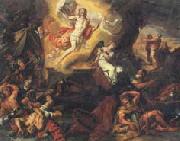
was a German painter, born in Munich but active most of his life in Venice. He is also called Johann Karl, Carlotto, and Carlo Lotti. He was the son and pupil of Johann Ulrich Loth (1590- 1662). He was commissioned to paint for the emperor Leopold in Vienna. He was influenced by Pietro Liberi. His brother Franz Loth was also a painter in Venice and Germany. He had numerous pupils including Willem Drost, Cornelis de Bruijn, Johann Michael Rottmayr, Paul Strudel, Santo Prunati, Daniel Seiter, and Giovan Battista Langetti.
|
|
|
|
 |
Johan Christoffer Boklund
|
|
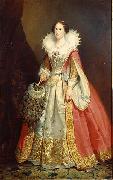
(15 July 1817 - 9 December 1880) was a Swedish history, genre, and portrait painter from Kulla-Gunnarstorp in Scania.He was the son of a gardener. At the age of fifteen, Boklund came to Lund, where he worked on illustrations for Sven Nilsson's works on Scandinavian fauna (under the supervision of Magnus Körner). He then became a student at the Royal Danish Academy of Fine Arts in Copenhagen where J. L. Lund was his teacher.
In 1837, Boklund went to Stockholm and began studying at the Royal Swedish Academy of Arts. He made a living as a lithograph and drawing teacher, and produced several small genre paintings of the everyday life (such as Flicka med blomster (English: Girl with flowers) and Köksinteriör (English: Kitchen interior)) and history paintings of the 17th century (such as Gustaf Adolfs afsked från Maria Eleonora (English: Gustaf Adolf's farewell from Maria Eleonora), which was awarded with a medal at the academy).
Together with fellow Swedish painter Johan Fredrik Höckert, Boklund traveled to Munich in Germany in 1846 and stayed there for eight years. During the summers he went on study trips to Bavaria, Tyrol, and northern Italy. During this period, Boklund primarily devoted his painting to the history genre with subjects from the 17th century, but he also made some paintings depicting picturesque and architectural interior. In 1853, he sent his painting Den nyfikne trumpetaren (English: The curious trumpet player) home to Sweden and it earned him a scholarship from the government. This allowed Boklund to move to Paris, where he worked at Thomas Couture's atelier from 1854 to 1855. In December 1855 he returned to Sweden.
|
|
|
|
|
|
|
|
|
| Wholesale China Oil Painting Wholesale Oil Painting China Xiamen Portrait Reproduction on canvas Chinese Oil Painting Wholesale USA Oil Painting |
|
|
|
|
|