| |
|
Xiamen Oil Paintings, Wholesale Direct!
|
|
100% hand painted, 100% cotton canvas, 100% money back if not satisfaction. |
|
|
|
|
ART WORKS INDEX
A
B
C
D
E
F
G
H
I
J
K
L
M
N
O
P
Q
R
S
T
U
V
W
X
Y
Z
|
|
ARTISTS INDEX
A
B
C
D
E
F
G
H
I
J
K
L
M
N
O
P
Q
R
S
T
U
V
W
X
Y
Z
|
|
|
|
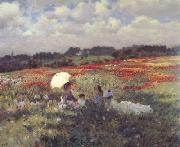 |
Giuseppe de nittis
|
|
Italian, 1846-1884
Italian painter, pastellist and printmaker. Throughout his career he was committed to a plein-air aesthetic and was particularly interested in rendering varying light effects, a concern that brought him into contact with the Impressionists. He was also acquainted with the members of the Macchiaioli, for whom his work was influential. In addition to oils, he experimented with printmaking and made innovative use of pastels. Practising a restrained, and therefore 'acceptable', form of Impressionism,
|
|
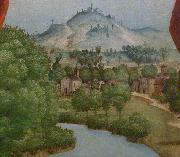 |
Girolamo dai Libri
|
|
(1474/1475 - July 2, 1555) was an Italian illuminator of manuscripts and painter of altarpieces, working in an early-Renaissance style.
He was born and mainly active in Verona. His father was Francesco dai Libri, and was so named because he was an illuminator of books. Girolamo's works were noted by Giorgio Vasari. Girolamo was a pupil of Domenico Morone. Dai Libri painted his first altarpiece, a Deposition from the Cross for Santa Maria in Organo in Verona, at the age of sixteen.
|
|
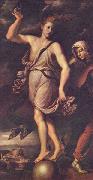 |
Girolamo da Carpi
|
|
(1501-1556) was an Italian painter and decorator who worked at the Court of the House of Este in Ferrara. He began painting in Ferrara, by report apprenticing to Benvenuto Tisi (il Garofalo); but by age 20, he had moved to Bologna, and is considered a figure of Early Renaissance painting of the local Bolognese School.
He trained in the studio of a local painter who showed the influence of Lorenzo Costa and Raphael. In the 1520s Girolamo visited Rome and Bologna and was inspired by the Mannerist style of Giulio Romano. Geographically and stylistically he straddles the various influences.
He returned to Ferrara and collaborated with Dosso Dossi and Garofalo among others on commissions for the d'Este family. Girolamo became the architect to Pope Julius III in 1550 and supervised the remodeling of the Vatican's belvedere. Returning to Ferrara, he was charged of the enlargements of the Castello Estense.
Da Carpi's paintings include a Descent of the Holy Spirit, in the church of St Francis at Rovigo; a Madonna, an Adoration of the Magi, and a St. Catharine at Bologna; and the St. George and the St. Jerome at Ferrara.
|
|
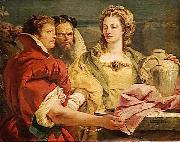 |
Giovanni Domenico Tiepolo
|
|
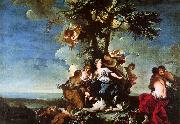
(August 30, 1727 - March 3, 1804) was a Venetian painter and printmaker in etching. He was the son of artist Giovanni Battista Tiepolo and elder brother of Lorenzo Baldissera Tiepolo..
Domenico was born in Venice, studied under his father, and by the age of 13 was the chief assistant to him. He was one of the many assistants, including Lorenzo, that transferred the designs of his father (executed in the 'oil sketch' invented by the same). By the age of 20, he was producing his own work for commissioners.
He assisted his father in Werzburg 1751-3, decorating the famous stairwell fresco, in Vicenza at the Villa Valmarana in 1757, and in Madrid at the palace of Charles III from 1762-70.
|
|
 |
Giovanni Domenico Ferretti
|
|
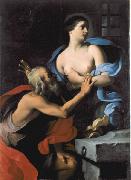
1692-1768 Italian Giovanni Domenico Ferretti Location Italian painter. He was the son of the goldsmith Antonio di Giovanni da Imola and Margherita di Domenico Gori. His mother family, which included her brother, the antiquarian ANTONIO FRANCESCO GORI, was extremely influential in Florence and proved very important for Ferretti. In the first years of his life he lived in Imola, where he was sent to study (1708) with the local painter Francesco Chiusuri. After the family moved to Florence, Ferretti was taught there by Tommaso Redi and Sebastiano Galeotti. Later he spent five years in Bologna, an important centre for the practice and teaching of academic painting, where, in the workshop of Felice Torelli, his work acquired its characteristic style.
|
|
 |
Giovanni Domenico Cerrini
|
|
(1609-1681), also called Gian Domenico Cerrini or il Cavalier Perugino, was an Italian painter of the Baroque period, active mainly in Rome and influenced in large part by painter of the Bolognese School.
Born in Perugia, Cerrini initially apprenticed under Giovanni Antonio Scaramuccia, then in 1638 moved into the Roman studio of Guido Reni, but strongly influenced by Lanfranco, Guercino, Domenichino, and Andrea Sacchi. He was patronized by the family of Cardinal Bernardino Spada. Cardinal Giulio Rospigliosi gave him the commission to decorate the cupola of Santa Maria della Vittoria (1654-5). His style has the monumental clarity of Domenichino, but somewhat sapped of vitality.
Paintings of his can be found in many of the churches of Rome, where he died, including Santa Maria in Traspontina, San Carlino alle Quattro Fontane, Chiesa Nuova, San Carlo ai Catinari, Santissimo Sudario dei Piemontesi, Sant??Isidoro, as well as in Galleria Colonna, Palazzo Spada, and the Palazzo Corsini art gallery.
|
|
 |
Giovanni di Paolo
|
|
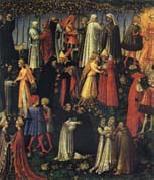
Italian Early Renaissance Painter, ca.1403-1483,major Italian painter of the Sienese school. Typical of the Sienese painters of his era, he paid scant attention to the artistic innovations made in nearby Florence, but often depended on the style established by the Sienese masters of the 14th cent. Fortunately, Giovanni di Paolo was endowed with great imagination. His first dated work (1426) was the Pecci altarpiece (major panels in Siena; predella panels in the Walters Art Gall., Baltimore). He produced a tremendous number of works during his long career. Many paintings have remained in Siena, but there are probably more examples of his art in the United States. The Metropolitan Museum has several of his paintings; among them is a delightful scene of Paradise; in the Philip Lehman collection is the exquisite Creation of the World. The Madonna and Child in a Landscape (Mus. of Fine Arts, Boston) exemplifies his inclination toward pure fantasy and disregard for the laws of perspective. Giovanni di Paolo is best represented by six highly expressive scenes from the life of St. John the Baptist (Art Inst., Chicago).
|
|
|
|
|
|
 |
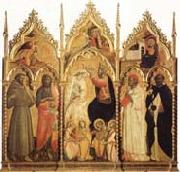
Giovanni del Biondo
|
|
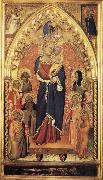
Italian Gothic Era Painter, active 1356-1399,was a 14th century Italian painter of the Gothic and early-Renaissance period, active 1356-1399.
|
|
 |
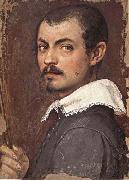
Giovanni dal ponte
|
|
Italian Painter, 1385-1437
He was reputed to have been a student of Spinello Aretino. He acquired the name dal Ponte due to the location of his studio at Santo Stefano a Ponte, Florence. He joined the Arte dei Medici e degli Speziali in 1410 and the Compagnia di S Luca in 1413. Outstanding debts brought him a prison sentence in 1424, but he still owed money to a carpenter three years later. By the late 1420s he had opened his own studio and formed a partnership with the painter Smeraldo di Giovanni (c. 1365-after 1442). Giovanni dal Ponte's varied and prolific production, which continued until his death, included fresco cycles, panels and the decoration of small objects. A number of allegorical panel paintings and cassoni are attributed to him. The animated, stylized figures in the Seven Liberal Arts (1435; Madrid, Prado) are shown in a garden dotted with naturalistic flowers and plants. His early work shows the impact of the Late Gothic style.
|
|
 |
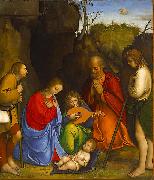
Giovanni da san giovanni
|
|
1592-1636
Italian painter and draughtman. He was the most distinguished of the artists working in fresco in 17th-century Florence. An eccentric personality, he was attracted by the charm and informality of northern art and by a satirical approach to Classical themes. He went to Florence in 1608 to study in the workshop of Matteo Rosselli, where he learnt both fresco and oil painting techniques and drew extensively (Baldinucci). In 1615 he painted two ceiling canvases of Putti Supporting the Impresa of Michelangelo for a room in the Casa Buonarroti and in the same period frescoed the dome of the church of the Ognissanti, Florence (completed 1615), with a choir of musician angels. He also painted five lunettes showing scenes from the Life of St Francis in the cloister (completed 1619; in situ). In 1616 his frescoed decoration of an Allegory of Florence (destr.; preparatory drawing, Florence, Uffizi, G.D.S. U. 1122F) on the fa?ade of Cosimo II de' Medici's house in Piazza della Calza won him unexpected and lasting fame. His early works also included several tabernacles, made for patrons in the town and in the surrounding countryside. The Virgin and Child with Saints
|
|
|
|
|
|
 |
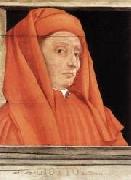
Giovanni Agostino da Lodi
|
|
was an Italian painter who was active from c. 1495 to c. 1525.
The attribution of his works has been dubious for centuries, until his style and career was defined by the American art historian Bernard Berenson in the 1960s. One of his first identified work is the Pala dei Barcaioli ("Boatmen Altarpiece") in the church of San Pietro Martire at Murano. His only signed work is the St. Peter and St. John the Evangelist in the Pinacoteca di Brera, which shows Lombard influeces, such as that of Bramantino.
Later he was also influenced by Leonardo da Vinci's style, as visible in the Christ Washing the Feet of the Apostles in the Gallerie dell'Accademia of Venice. After moving to Venice in the wake of Ludovico Sforza's fall, he returned to Milan in 1506. He subsequently executed works for privates and for the Certosa di Pavia; one of his late works, the Calvary, is housed in the National Gallery in Prague. He also collaborated with Marco d'Oggiono for a polyptych in the church of Santa Maria della Pace in Milan, some panels of which are now in the Pinacoteca di Brera.
|
|
 |
GIOTTO di Bondone
|
|
Italian Early Renaissance Painter, 1267-1337
Italian painter and designer. In his own time and place he had an unrivalled reputation as the best painter and as an innovator, superior to all his predecessors, and he became the first post-Classical artist whose fame extended beyond his lifetime and native city. This was partly the consequence of the rich literary culture of two of the cities where he worked, Padua and Florence. Writing on art in Florence was pioneered by gifted authors and, although not quite art criticism, it involved the comparison of local artists in terms of quality. The most famous single appreciation is found in Dante's verses (Purgatory x) of 1315 or earlier. Exemplifying the transience of fame, first with poets and manuscript illuminators, Dante then remarked that the fame of Cimabue, who had supposed himself to be the leader in painting, had now been displaced by Giotto. Ironically, this text was one factor that forestalled the similar eclipse of Giotto's fame, which was clearly implied by the poet.
|
|
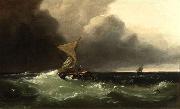 |
Gideon Jacques Denny
|
|
(1830-1886) was a marine artist who was born in Wilmington, Delaware on July 15, 1830. As a young man, he worked on ships in the Chesapeake Bay. He traveled to California in 1849 with the Gold Rush. He worked as a teamster on the San Francisco docks and was a member of the San Francisco Committee of Vigilance. After two years in California, he moved to Milwaukee, where he studied painting with Samuel Marsden Brookes. After six years of study in Milwaukee, Denny returned to San Francisco and established a studio on Bush Street. In 1862, Brooks moved to San Francisco and shared a studio with Denny. In 1868, Denny spent two months in Hawaii visiting several islands. He is also known to have visited Canada and South America. Denny died of malaria in Cambria, California on Oct. 7, 1886.
The Berkeley Art Museum and Pacific Film Archive, the Bishop Museum (Honolulu), the Crocker Art Museum (Sacramento, California), the Fine Arts Museums of San Francisco, Monterey Peninsula Museum of Art, and the Oakland Museum of California are among the public collections holding works by Gideon Jacques Denny.
|
|
 |
Giacomo Di Chirico
|
|
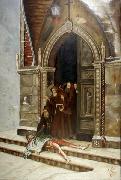
Giacomo Di Chirico (25 January 1844 - 26 December 1883) was an italian painter. Together with Domenico Morelli and Filippo Palizzi, he was one of the most elite Neapolitan artists of the 19th century. He received the official title eKnight of Italye from King Victor Emmanuel II.
|
|
|
|
|
|
 |
GHIRLANDAIO, Domenico
|
|
Italian Early Renaissance Painter, 1449-1494
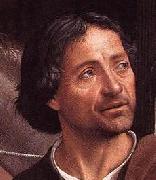
Florentine painter, whose family name was Bigordi. He may have studied painting and mosaics under Alesso Baldovinetti. Ghirlandaio was an excellent technician. Keenly observant of the contemporary scene, he depicted many prominent Florentine personalities within his religious narrative paintings. Among his earliest frescoes are the Madonna with the Vespucci Family and the Last Supper (Church of the Ognissanti, Florence). He painted scenes from the life of Santa Fina (collegiate church in San Gimigniano) and frescoes in the Palazzo Vecchio, Florence. In 1481, Pope Sixtus IV called him to Rome, along with Botticelli, to decorate the Sistine Chapel. He painted the Calling of the First Apostles, a scene close in spirit to Masaccio. He returned to Florence to work on the frescoes in the Sassetti Chapel in Santa Trinita. He introduced Sassetti, Corsi, Poliziano, the Medici, and many other contemporaries as participants in the life of St. Francis. Ghirlandaio's most famous achievement is his fresco cycle of the life of Mary and St. John the Baptist for the choir of Santa Maria Novella. Michelangelo served an apprenticeship with him at this time and probably worked on these frescoes. Other examples of his art are the Adoration of the Magi (Uffizi); another Adoration (Hospital of the Innocents); a mosaic of the Annunciation for the Cathedral; a portrait of Francesco Sassetti and his son (Metropolitan Mus.);
|
|
|
|
 |
Gerrit Dou
|
|
1613-1675
Dutch
Gerard Dou Locations
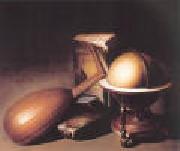
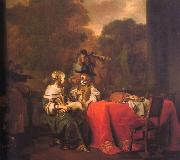
Dutch genre and portrait painter of Leiden. The son of a glass painter, he was apprenticed to an engraver and worked from 1628 to 1631 in the studio of the young Rembrandt. Although he occasionally borrowed Rembrandt themes, he was more detailed and meticulous in his execution. His scenes of domestic, middle-class life were tremendously popular and often imitated. Among his most famous works are Evening Light (Rijks Mus.), Young Man (The Hague), The Cook (Louvre), and a self-portrait (Metropolitan Mus.).
|
|
|
|
|
|
|
|
|
|
 |
Gerbrand van den Eeckhout
|
|
1621-1674
Dutch
Gerbrand van den Eeckhout Location
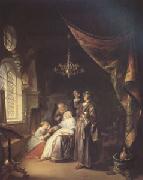
Dutch painter, draughtsman and etcher. He was the son of the goldsmith Jan Pietersz. van den Eeckhout and a great friend as well as a pupil of Rembrandt, according to Houbraken, who commented that van den Eeckhout painted in the style of his master throughout his career. This is certainly true of van den Eeckhout (biblical) history paintings, but less so of either his portraits, which gradually displayed more Flemish elegance, or his genre pieces (from 1650), in which he followed various trends; he adapted his style to suit his subject with sensitive versatility. He was also a gifted colourist and an artist of great imagination, superior in both these respects to such better-known Rembrandt pupils as Ferdinand Bol and Nicolaes Maes. Moreover, he was extremely productive, and there is at least one dated painting for virtually every year between 1641 and 1674. In addition, he created a large body of drawings comprising histories, figures, landscapes and genre scenes executed in various media, including watercolour. He also made several etchings, mostly studies of heads, such as the Self-portrait (1646; B. 66). He died a bachelor, aged 53.
|
|
 |
Gerard Dou
|
|
Leiden 1613-1675
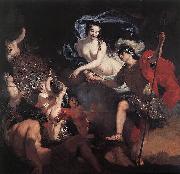
was a Dutch Golden Age painter, whose small, highly-polished paintings are typical of the Leiden fijnschilders. He specialised in genre scenes and is noted for his trompe l'oeil "niche" paintings and candlelit night-scenes with strong chiaroscuro. His first instructor in drawing and design was Bartholomew Dolendo, an engraver; and he afterwards learned the art of glass-painting under Peter Kouwhoorn. At the age of 15 he became a pupil of Rembrandt, with whom he continued for three years. From the great master of the Dutch school he acquired his skill in coloring, and in the more subtle effects of chiaroscuro; and the style of Rembrandt is reflected in several of his earlier pictures, notably in a portrait of himself at the age of 22, in the Bridge-water House gallery, and in the "Blind Tobit going to meet his Son", at Wardour Castle. At a comparatively early point in his career, however, he had formed a manner of his own distinct from, and indeed in some respects antagonistic to, that of his master. Gifted with unusual clearness of vision and precision of manipulation, he cultivated a minute and elaborate style of treatment; and probably few painters ever spent more time and pains on all the details of their pictures down to the most trivial. He is said to have spent five days in painting a hand; and his work was so fine that he found it necessary to manufacture his own brushes. Notwithstanding the minuteness of his touch, however, the general effect was harmonious and free from stiffness, and his color was always admirably fresh and transparent. He was fond of representing subjects in lantern or candle light, the effects of which he reproduced with a fidelity and skill which no other master has equaled. He frequently painted by the aid of a concave mirror, and to obtain exactness looked at his subject through a frame crossed with squares of silk thread. His practice as a portrait painter, which was at first considerable, gradually declined, sitters being unwilling to give him the time that he deemed necessary. His pictures were always small in size, and represented chiefly subjects in still life. Upwards of 200 are attributed to him, and specimens are to be found in most of the great public collections of Europe. His chef-d'oeuvre is generally considered to be The dropsical woman, 1663, and The Dutch Housewife, 1650, both in the Louvre. The Evening School, in the Amsterdam Rijksmuseum, is the best example of the candlelight scenes in which he excelled. In the National Gallery, London, favorable specimens are to be seen in the Poulterer's Shop,
|
|
 |
Gerard de Lairesse
|
|
Gerard or Gerard de Lairesse (11 September 1640 or 1641 - June 1711) was a Dutch Golden Age painter and art theorist.
Lairesse was born in Liege. His broad range of talent included music, poetry, and the theatre. He was perhaps the most celebrated Dutch painter in the period following the death of Rembrandt. His treatises on painting and drawing, Grondlegginge der teekenkonst (1701) and Groot Schilderboek (1707), were highly influential on 18th-Century painters like Jacob de Wit. Students of De Lairesse included the painter Jan van Mieris. He died in Amsterdam.
|
|
 |
Gerard David
|
|
b.c. 1460, Oudewater, Neth.
d.Aug. 13, 1523, Bruges
Flemish Gerard David Locations
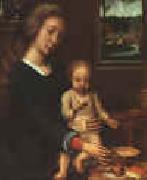
Netherlandish painter. He is known as the last of the Flemish Primitives. Although born in the northern Netherlands, he moved to Bruges as a young man, and most of his work expresses the impassive, unmannered, microscopically realistic approach peculiar to south Netherlandish art in the time of Jan van Eyck. David was skilled at synthesizing the art of several important south Netherlandish predecessors, adapting, for instance, the compositions of van Eyck and the technique of Hugo van der Goes. He was also influenced by Hans Memling, whose example led him to refine and polish his cruder northern Netherlandish style and to adopt the popular theme of the Virgin and Child enthroned.
|
|
|
|
 |
Georges de La Tour
|
|
1593-1652
French
Georges de La Tour Galleries
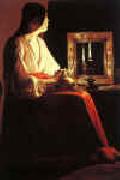
His early work shows influences from Caravaggio, probably via his Dutch followers, and the genre scenes of cheats??as in The Fortune Teller ??and fighting beggars clearly derive from the Dutch Caravaggisti, and probably also his fellow-Lorrainer, Jacques Bellange. These are believed to date from relatively early in his career.
La Tour is best known for the nocturnal light effects which he developed much further than his artistic predecessors had done, and transferred their use in the genre subjects in the paintings of the Dutch Caravaggisti to religious painting in his. Unlike Caravaggio his religious paintings lack dramatic effects. He painted these in a second phase of his style, perhaps beginning in the 1640s, using chiaroscuro, careful geometrical compositions, and very simplified painting of forms. His work moves during his career towards greater simplicity and stillness ?? taking from Caravaggio very different qualities than Jusepe de Ribera and his Tenebrist followers did.
He often painted several variations on the same subjects, and his surviving output is relatively small. His son Etienne was his pupil, and distinguishing between their work in versions of La Tour's compositions is difficult. The version of the Education of the Virgin, in the Frick Collection in New York is an example, as the Museum itself admits. Another group of paintings (example left), of great skill but claimed to be different in style to those of de La Tour, have been attributed to an unknown "Hurdy-gurdy Master". All show older male figures (one group in Malibu includes a female), mostly solitary, either beggars or saints.
After his death in 1652, La Tour's work was largely forgotten until rediscovered by Hermann Voss, a German scholar, in 1915. In 1935 an exhibition in Paris began the revival in interest among a wider public. In the twentieth century a number of his works were identified once more, and forgers tried to help meet the new demand; many aspects of his œuvre remain controversial among art historians.
|
|
 |
Georges de Feure
|
|
1868-1928
French designer and painter. Son of a Dutch architect and a Belgian mother, he started out as an actor, costumier and then interior decorator in Paris. In 1894 at the Galerie des Artistes Modernes he exhibited watercolours and paintings of a moderate Symbolist style, typically depicting women in a manner reminiscent of Aubrey Beardsley work. Capturing the essence of the feminine spirit became his trademark. With Eugene Gaillard and Edouard Colonna he was selected by Siegfried Bing, founder of the Galeries de l Art Nouveau, to design rooms for his Pavilion Bing at the Exposition Universelle, Paris (1900). De Feure carpets, glassware and furniture designs for the boudoir and toilette were based on the theme of woman, emphasizing delicate lines and elegant sensuality. He later left Bing gallery and, as an independent designer, created vide-poche furniture, which contained hidden marquetry compartments. This furniture suggested notions of secrecy and coquetry, themes that de Feure pursued throughout his career.
|
|
 |
George Henry Durrie
|
|
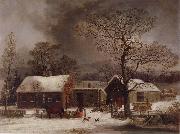
American Painter, 1820-1863,American painter. Durrie and his older brother John (1818-98) studied sporadically from 1839 to 1841 with the portrait painter Nathaniel Jocelyn. From 1840 to 1842 he was an itinerant painter in Connecticut and New Jersey, finally settling permanently in New Haven. He produced c. 300 paintings, of which the earliest were portraits (e.g. Self-portrait, 1839; Shelburne, VT, Mus.); by the early 1850s he had begun to paint the rural genre scenes and winter landscapes of New England that are considered his finest achievement. His landscapes, for example A Christmas Party (1852; Tulsa, OK, Gilcrease Inst. Amer. Hist. & A.), are characterized by the use of pale though cheerful colours and by the repeated use of certain motifs: an isolated farmhouse, a road placed diagonally leading the eye into the composition, and a hill (usually the West or East Rocks, New Haven) in the distance. By the late 1850s Durrie's reputation had started to grow, and he was exhibiting at prestigious institutions, such as the National Academy of Design. In 1861 the firm of Currier & Ives helped popularize his work by publishing prints of two of his winter landscapes,
|
|
 |
George Durrie
|
|
Landscape painter, Portrait Painter .
American , 1820-1863
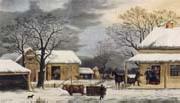
American painter. Durrie and his older brother John (1818-98) studied sporadically from 1839 to 1841 with the portrait painter Nathaniel Jocelyn. From 1840 to 1842 he was an itinerant painter in Connecticut and New Jersey, finally settling permanently in New Haven. He produced c. 300 paintings, of which the earliest were portraits (e.g. Self-portrait, 1839; Shelburne, VT, Mus.); by the early 1850s he had begun to paint the rural genre scenes and winter landscapes of New England that are considered his finest achievement. His landscapes, for example A Christmas Party (1852; Tulsa, OK, Gilcrease Inst. Amer. Hist. & A.), are characterized by the use of pale though cheerful colours and by the repeated use of certain motifs: an isolated farmhouse, a road placed diagonally leading the eye into the composition, and a hill in the distance. By the late 1850s Durrie's reputation had started to grow, and he was exhibiting at prestigious institutions, such as the National Academy of Design. In 1861 the firm of Currier & Ives helped popularize his work by publishing prints of two of his winter landscapes, New England Winter Scene and the Farmyard in Winter.
|
|
 |
George Desmarees
|
|
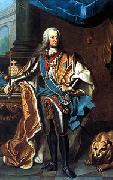
was born in 1697 at Stockholm, where he was instructed in painting by Peter Martin van Meytens, whose assistant he afterwards became. In 1724 he made a stay in Amsterdam, and in the following year in Nuremberg and then in Venice, where he received further tuition from Piazzetta. In 1731 he settled in Munich, where he became court painter, and where he continued to reside till his death in 1776. A portrait of himself and one of his daughter are, with a third in the Munich Gallery, and other portraits by him are at Augsburg.
|
|
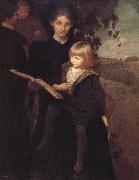 |
George de Forest Brush
|
|
American figure and portrait painter.
b.1855 d.1941
was an American figure and portrait painter. He was born in Shelbyville, Tennessee He was a pupil of G??rome in Paris. He studied in Paris under Jean Leon Gerome, among others. His work was printed in Harpers and Century Magazines as early as 1881, including an illustrated article, An Artist Among the Indians in 1885. He taught at Cooper Union and at The Art Students League and he exhibited and was a member of the National Academy of Design. In 1883, public attention was first attracted to his work by his pictures of Native American life in the West, such as "The Silence Broken," "The Sculptor and the King," "The Indian and the Lily," and "The Moose Chase" (National Gallery, Washington).
|
|
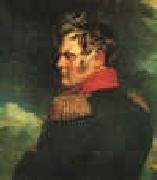 |
George Dawe
|
|
1781-1829
British
George Dawe Locations
English painter and writer. He was the son of the mezzotint engraver Philip Dawe who taught him engraving. He continued to concentrate on engraving when he entered the Royal Academy Schools, London, in 1796, producing portraits until 1802, when he turned to history painting. In 1803 he won a gold medal and the following year made his d?but at the Royal Academy, where he exhibited until 1818, often showing such anecdotal and literary works as Imogen Found in the Cave of Belarius (exh. RA 1809; London, Tate). He was elected an ARA in 1809 and an RA in 1814 and soon afterwards returned to portrait painting. In 1816 he painted a number of portraits of George IV daughter Princess Charlotte (e.g. London, N.P.G.), several of which were engraved. In 1817 he went to Brussels and was present at the review of the allied troops by Arthur Wellesley, 1st Duke of Wellington in Cambrai. Soon afterwards he was invited by Tsar Alexander I of Russia to paint the portraits of all the senior officers who had taken part in the Napoleonic Wars. He travelled to St Petersburg in 1819 where, over the next nine years, he painted nearly 400 portraits. These were placed in a specially built gallery (destr.) in the Winter Palace in St Petersburg. He returned briefly to England in 1828 before travelling to Berlin, where he painted the portraits of Ernest Augustus, Duke of Cumberland (1828; London, N.P.G.) and Frederick William III, King of Prussia (1828; untraced). From Berlin he moved to St Petersburg and then to Warsaw before being forced by illness to return to England, where he died shortly afterwards. His book The Life of George Morland with Remarks on his Works (1807) is both a lively account of his godfather dissipated lifestyle and a fairly critical appreciation of his work.
|
|
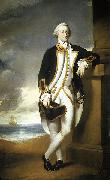 |
George Dance the Younger
|
|
George Dance the Younger (1 April 1741 - 14 January 1825) was an English architect and surveyor. The fifth and youngest son of George Dance the Elder, he came from a distinguished family of architects, artists and dramatists. He was hailed by Sir John Summerson as "among the few really outstanding architects of the century", but few of his buildings remain.
He was educated at the St. Paul's School, London. Aged 17, he was sent to Italy to prepare himself for an architectural career and joined his brother Nathaniel, who was studying painting in Rome. George was a member of academies in Italy, showing much promise as a draughtsman, and much of his later work was inspired by Piranesi, with whom he was acquainted.
He succeeded his father as City of London surveyor and architect on his father's death in 1768, when he was only 27. He had already distinguished himself by designs for Blackfriars Bridge, sent to the 1761 exhibition of the Incorporated Society of Artists.
His earliest London project was the rebuilding of All Hallows-on-the-Wall church in 1767. His first major public works were the rebuilding of Newgate Prison in 1770 and the front of the Guildhall, London. His other London works include the church of St Bartholomew-the-Less (1797). In Bath he largely designed the Theatre Royal, built by John Palmer in 1804-5. Sir John Soane was a pupil.
Many of his buildings have been demolished, including the Royal College of Surgeons, Newgate Prison, St Luke's Hospital for Lunatics, the Shakespeare Gallery in Pall Mall, the library at Lansdowne House, the Common Council Chamber and Chamberlain's Court at the Guildhall, Ashburnham Place, and Stratton Park (demolished save for its Tuscan portico)
With his brother Nathaniel, he was a founder member of the Royal Academy in 1768, and its second professor of architecture, from 1798 to 1805. For a number of years, he was the last survivor of the 40 original Academicians.
|
|
 |
Gentile da Fabriano
|
|
1370-1427
Italian
Gentile da Fabriano Locations
Gentile da Fabriano, whose real name was Gentile di Niccolo di Giovanni di Massio, came from Fabriano in the Marches. According to tradition, his family was an old one and moderately prosperous. His father, who was said to have been a scholar, mathematician, and astrologer, became an Olivetan monk when a monastery of that order was established in Fabriano in 1397. Gentile brother, Ludovico, was a monk of the same order in Fabriano, and Gentile himself was living in the Olivetan monastery of S. Maria Nuova in Rome at the time of his death. A document of Oct. 14, 1427, speaks of him as dead.
Gentile art indicates that he was probably trained in Lombardy, perhaps in Milan. He worked in the then current International Gothic style, to which he brought his own personal quality. His earliest works display the decorative rhythmic drapery patterns preferred by the International Gothic masters, which Gentile tempered and ultimately abandoned after his contact with Florentine art.
In a document of 1408 Gentile is recorded in Venice, where he painted an altarpiece (now lost) for Francesco Amadi. Testifying to his high reputation was his commission in 1409 for frescoes in the Doges Palace in Venice (painted over in 1479). Pandolfo Malatesta commissioned Gentile to decorate a chapel (destroyed) in Brescia in 1414. The artist is last recorded in Brescia on Sept. 18, 1419, when he departed for Rome to answer the summons of Pope Martin V. Gentile name first appeared on the roll of painters in Florence in 1421. He was in Siena in 1420 and 1424-1425 and in Orvieto late in 1425. From 1426 until the time of his death he was in Rome.
Typical of Gentile early style is the polyptych (ca. 1400) from the convent of Valle Romita in Fabriano, in which Gentile displays the International Gothic love for naturalistic detail in the floral turf beneath the feet of the graceful, slender saints whose figures are swathed in rhythmic, linear drapery. The central panel, the Coronation of the Virgin, shows the love for calligraphic drapery so characteristic of Gentile early style. Other noteworthy early works include the much damaged Madonna in Perugia and the Madonna with Saints and Donor in Berlin.
The altarpiece Adoration of the Magi, signed and dated 1423, was Gentile major work in Florence. In remarkably good condition, with its original frame still intact, it shows Gentile Gothicism now tempered by his contact with the more austere art of Florence. The rich display of gold leaf and brilliant colors were favorite International Gothic traits, but in the interest in perspective and foreshortening and especially in the exquisite predella panels Gentile shows the influence of the Florentines.
The altarpiece for the Quaratesi family, signed and dated 1425, also demonstrates the composite quality of Gentile art. The fresco Madonna Enthroned in Orvieto Cathedral of late 1425 has few traces of the International Gothic style and displays a corporeality and fullness in keeping with his evolution after Florence. His last works, the frescoes in St. John Lateran in Rome depicting the life of John the Baptist and grisaille portraits of saints, were destroyed in 1647, when Francesco Borromini reconstructed the interior.
|
|
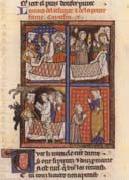 |
Gautier de Coinci
|
|
1177-1236 French,Born of noble stock, Gautier became a Benedictine novice at Saint-M??dard de Soissons in 1193 and prior at Vic-sur-Aisne in 1214, returning to Saint-M??dard to be grand prior (1233) until his death. His single work, preserved in nearly 80 manuscripts, is the massive Miracles de Nostre Dame, written at Vic (1214-27) and occupying some 30, 000 lines in two books.
|
|
 |
Gaspare Diziani
|
|
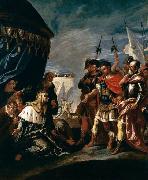
(1689 - 17 August 1767) was an Italian painter of the late-Baroque or Roccoco period, active mainly in the Veneto but also in Dresden and Munich.
His earliest training was in his native town of Belluno with Antonio Lazzarini, then moved to Venice, to the studio of Gregorio Lazzarini and later that of Sebastiano Ricci. He was seven years older, but otherwise his career was contemporary with the Lazzarini and Ricci fellow-pupil, Giovanni Battista Tiepolo.
Between 1710-1720, he painted a group of eight pictures that included the Mary Magdalene for the church of San Stefano in Belluno, and Entry into Jerusalem for San Teodoro in Venice. He also painted three frescoes on the Life of Saint Helena in the Scuola del Vin next to the church of San Silvestro. Dizianies celerity and technical assurance are evident preparatory oil sketches, with color applied in rapid and spirited strokes.
He was also working as a scenery painter for the theater and opera in Venice, Munich (1717), and later in Dresden, working with Alessandro Mauro. Diziani was invited to Rome by Cardinal Ottoboni in 1726, to paint a emagnificent decoration for the church of San Lorenzo in Damaso. The decoration is now known only through an engraving by Claude Vasconi.
The Sala dei Pastelli in Ca' Rezzonico has an sotto in su allegorical ceiling fresco presenting Triumph of Poetry (Poetry surrounded by Painting, Architecture, Music and Sculpture).
|
|
 |
Gaspard Dughet
|
|
1615-1675
French Gaspard Dughet Location
Italian painter. He was one of the most distinguished landscape painters working in Rome in the 17th century, painting decorative frescoes and many easel paintings for such major Roman patrons as Pope Innocent X and the Colonna family. He is associated with a new genre of landscape, the storm scene, although of some 400 catalogued works little more than 30 treat this theme. His most characteristic works depict the beauty of the scenery around Rome, particularly near Tivoli, and suggest the shifting patterns of light and shade across a rugged terrain. Dughet drew from nature, yet his landscapes are carefully structured, and figures in antique dress suggest the ancient beauty of a landscape celebrated by Virgil. Very few can be securely dated; his development may be inferred from his few dated fresco paintings and from the wider context in which he was working. Most writers, following Pascoli, have divided Dughet career into three periods. His first landscapes were a little dry (Pascoli); in his second period he developed a more learned style, closer to that of his teacher, Nicolas Poussin; his late works were more intimate and more original.
|
|
|
|
 |
Gabriel-Francois Doyen
|
|
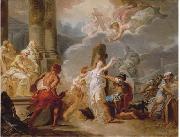
(1726 - 5 June 1806) was a French painter, who was born at Paris.
His passion for art prevailed over his father's wish, and he became in his twelfth year a pupil of Charles-Andra van Loo. Making rapid progress, he obtained at twenty the Grand Prix, and in 1748 set out for Rome. He studied the works of Annibale Carracci, Pietro Berrettini da Cortona, Giulio Romano and Michelangelo, then visited Naples, Venice, Bologna and other Italian cities, and in 1755 returned to Paris. At first unappreciated and disparaged, he resolved by one grand effort to achieve a reputation, and in 1758 he exhibited his Death of Virginia. It was completely successful, and procured him admission to the Acad??mie Royale de Peinture et de Sculpture. Among his greatest works are reckoned the Miracle des Ardents, painted for the church of St Genevieve at St Roch (1767)this painting was exhibited in the salon of 1767 which was recorded by Saint-Aubin in "View of the salon of 1767"; the Triumph of Thetis, for the chapel of the Invalides; and the Death of St Louis, for the chapel of the Military School. In 1776 he was appointed professor at the Academy. Soon after the beginning of the French Revolution he accepted the invitation of Catherine II of Russia. and settled at St Petersburg, where he was loaded with honors and rewards. He died there on 5 June 1806.
|
|
 |
Gabriel Jacques de Saint-Aubin
|
|
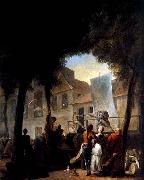
French Painter, 1724-1780,Draughtsman, etcher and painter, brother of (1) Charles-Germain de Saint-Aubin. He studied with the painters Etienne Jeaurat and Hyacinthe Colin de Vermont, but failed three times to win the Prix de Rome (competition paintings, 1752-4; Paris, Louvre). He broke with the Academie Royale, preferring to support and exhibit at the Academie de St Luc. Although he continued to paint such pictures as a Street Show in Paris (c. 1760; London, N.G.; other examples in Rouen, Mus. B.-A.), he is best known as a draughtsman and etcher. He was a passionate and unconventional observer of the sights of the Paris streets and of the social scene. Dacier saw him as the 'man who drew at all times and in all places', and his contemporary Jean-Baptiste Greuze spoke of his 'priapism of draughtsmanship'. In his many drawings he combined pencil, black and red chalk, bistre, ink and watercolour to create dazzling spontaneous effects. He drew incidents that struck him as he wandered the streets, or entertainments that he attended. He recorded them, noting dates and times, in sketchbooks (e.g. Paris, Louvre and Stockholm, Nmus.) or sometimes in the margins and blank pages of printed books that he was carrying (such as a volume of the poems of Jean-Michel Sedaine, in the Mus. Cond?, Chantilly). These drawings of contemporary incidents include the Fire at the Foire Saint-Germain on the Night of 16-17 May 1762 (ex-David Weill priv. col.) and the Crowning of Voltaire at the Theetre-Franeais in 1778 (Paris, Louvre; see fig.). He went regularly to the Salon of the Academie Royale and to art sales, covering the margins and flyleaves of his sale catalogues and Salon livrets with tiny sketches of works of art and the passing scene. One hundred of these illustrated catalogues were among his effects when he died, and of these about a third survive. These include the livrets for the Salons of 1761, 1769 and 1777 (all Paris, Bib. N.), as well as the catalogues of the sales of Louis-Michel van Loo in 1772 and Charles Natoire in 1778 (both Paris, Bib. N.), and that of Pierre-Jean Mariette in 1775 (Boston, MA, Mus. F.A.). Together with his etchings and large watercolours (e.g. Paris, Louvre) of the Louvre's Salon Carre at the time of the exhibitions of 1753, 1767 and 1769,
|
|
 |
fritz von dardel
|
|
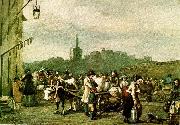
Fritz Ludvig von Dardel, född den 24 mars 1817 i Neuchâtel, död den 27 maj 1901 i Stockholm, var en schweiziskfödd svensk överintendent, militär, målare och tecknare.
Fritz von Dardel var son till godsägaren Georges-Alexandre von Dardel och grevinnan Hedvig Sofia Charlotta Amalia Lewenhaupt. Han var gift med friherrinnan Augusta Silfverschiöld. Släkten von Dardel kommer från Schweiz och adlades i Sverige 1810.
Von Dardel blev vid sexton års ålder konstapelkadett vid Vendes artilleriregemente, 1837 underlöjtnant vid Svea livgarde och avancerade till överstelöjtnant i armen 1862. Han blev 1850 adjutant hos kronprinsen och sedan hos Karl XV. Von Dardel var 1858-62 militärattach?? i Paris samt blev 1864 kabinettskammarherre hos Karl XV och samma år överintendent och ordföranden i Akademin för de fria konsterna, av vilken han 1861 invalts till hedersledamot. Dessutom var han ordförande i Nationalmuseums nämnd i 25 år (1867-92).
Vid flera konstutställningar i Europa (1867, 1871, 1873 och 1878) samt i Philadelphia (1876) var han juryman.
Själv hade von Dardel bedrivit studier på L??on Cogniets och E. Lamis ateljeer i Paris.
Fritz von Dardel tillhörde Karl XV:s intima krets och har gjort ett flertal dråpliga, akvarellerade teckningar av personer och händelser vid hovet eller under kungens resor, vidare folklivsbilder samt litografier. Hans dagböcker (se nedan) som utgavs postumt är skrivna på franska och översatta och redigerade av hans söner.
|
|
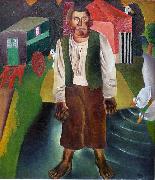 |
Frits Van den Berghe
|
|
(3 April 1883 - 22 September 1939) was a Belgian expressionist painter.
He was born at Ghent. Like his friends Constant Permeke and Gustave De Smet, he first adopted the late-impressionist style of Emile Claus, but converted to expressionism during World War I.
|
|
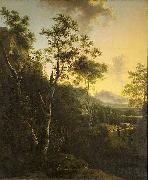 |
Frederik de Moucheron
|
|
(1633-2 January 1686) was a Dutch Golden Age landscape painter.
Frederik de Moucheron was the son of the painter Balthazar de Moucheron and Cornelia van Brouckhoven. His father came from a wealthy family of wine traders and is portrayed as one of the younger sons in the Moucheron Family portrait, 1563. Frederik trained with Jan Asselijn and became a landscape painter. He set off at age 22 for Paris, where he spent 3 years and then after a tour of Antwerp, Paris. and Lyon, he settled in 1659 in Amsterdam. In the same year he married Mariecke de Jouderville there and they had 11 children. He is buried in Amsterdam.
He painted French, Italian, and Dutch landscapes. To finish these scenes, contemporaries specialized in painting figures collaborated with him, such as Adriaen van de Velde in Amsterdam, Theodor Helmbreker in Paris, and at times Johannes Lingelbach, and Nicolaes Pieterszoon Berchem.
|
|
|
|
|
|
|
|
|
| Wholesale China Oil Painting Wholesale Oil Painting China Xiamen Portrait Reproduction on canvas Chinese Oil Painting Wholesale USA Oil Painting |
|
|
|
|
|