| |
|
Xiamen Oil Paintings, Wholesale Direct!
|
|
100% hand painted, 100% cotton canvas, 100% money back if not satisfaction. |
|
|
|
|
ART WORKS INDEX
A
B
C
D
E
F
G
H
I
J
K
L
M
N
O
P
Q
R
S
T
U
V
W
X
Y
Z
|
|
ARTISTS INDEX
A
B
C
D
E
F
G
H
I
J
K
L
M
N
O
P
Q
R
S
T
U
V
W
X
Y
Z
|
|
|
|
 |
Juan de Juanes
|
|
1523-1579
Spanish
Juan de Juanes Gallery
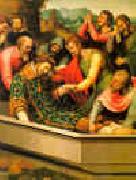
Born in Bocairent and was considered the premier painter of the Valencian school of painters, and often called "the Spanish Raphael", was born at La Font de la Figuera in the province of Valencia. He is said to have studied his art for some time in Rome, with which school his affinities are closest, but he greater part of his professional life was spent in the city of Valencia, where most of the extant examples of his work are now to be found. All relate to religious subjects, and are characterized by dignity of conception, accuracy of drawing, ruth and beauty of color, and minuteness of finish. He died at Bocairent (near X??tiva) while engaged upon an altarpiece in the church there.
Since his name Macip made him sound like a laborer (macero), he adopted the name of Juanes or de Juan, and the heraldy of that family of nobility. He painted a Raphaelesqe Holy Family for the sacristy in the Cathedral of Valencia. He never painted a profane subject, and emulated Luis de Cargas and Fra Angelico de Fiesole, in never painting unless he had underwent holy communion. Painting for him was a solemn exercise, an oratory process, full of prayers and fasts. He never lacked church patronage; the archbishop of Valencia, St. Thomas of Villanova, ordered a set of cartoon panels about the Life of the Virgin to model for some tapestries. He also painted for the churches of the Jesuits, Domicans, Minims, Augustinians, Franciscans, and for the churches of San Nicol??s , Santa Cruz , Carmen Calzado, St Esteban, Corona, Temple, San Andr??s, San Bartolom?? and San Miguel de los Reyes. Among his best works is the Immaculate Conception painted for the Jesuit church, supposedly inspired by a revelation undergone by the painter's confessor, Father Martin Alberto, confesor del pintor. Macip also painted portraits. His son, Juan Vicente Joanes, imitated his style. His two daughters, Dorotea and Margarita were also painters. Him most prominent pupil was Nicolas Borras.
|
|
 |
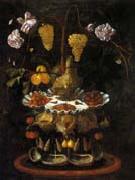
Juan de Flandes
|
|
Flemish-born Spanish Northern Renaissance Painter, ca.1460-1519
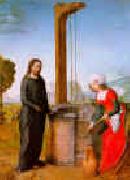
South Netherlandish painter, active in Spain. Nothing is known of his life or work before he went to Spain, where he is first mentioned in a document of 1496 as Juan de Flandes, a painter in the service of Queen Isabella of Castile. Treasury accounts confirm that he held this position until the Queen death in 1504. On arriving in Spain, he must have lived in Burgos, where he certainly met MICHEL SITTOW, another painter in the Queen service, who had been at the Castilian court since 1492.
|
|
 |
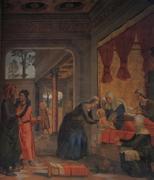
Juan de Espinosa
|
|
Spanish Baroque Era Painter, ca.1590-1641, Spanish painter. Details of his life are scarce. He is documented in Madrid and Toledo between 1612 and 1626, and while he is recorded as having painted religious pictures and portraits (untraced), he is only known today for his still-life paintings. Documents relating to another artist of the same name, known as Juan de Espinosa, dating from 1645 to 1677, concern a different painter.
|
|
 |
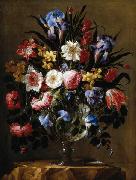
Juan de Borgona
|
|
Spanish Painter,
ca.1470-1534
was a High Renaissance painter who was born in the Duchy of Burgundy, probably just before it ceased to exist as an independent state, and was active in Spain from about 1495 to 1534. His earliest documented work was painted in 1495 for the cloister of the Cathedral of Toledo. Borgoña??s compositions are well balanced with finely drawn figures in elegant, tranquil poses. They are set either against open spaces leading on to craggy landscapes or against gold embroidered drapery. There were a number of foreign painters active in Spain in this period, including Juan de Flandes. Borgona??s students include Pedro de Cisneros the Elder (died 1546), Antonio de Comontes (ca. 1500-1519),
|
|
 |
Juan de Arellano
|
|
(3 August 1701 - 13 October 1776) was a Spanish painter of the Baroque era who specialized in floral still life paintings.
Born in Santorcaz, near Madrid, where he died. He was a pupil of Juan de Solis. Heavily influenced by Flemish and Italian painters (such as Mario Nuzzi), Juan de Arellano was considered to be exceptional in this thematic. According to one of his colleagues, de Arellano decided to focus exclusively on floral paintings because it offered more pay while requiring less work . Some of de Arellano's most famous pieces include Bouquet of Flowers (c.1660), and Garland of Flowers, Birds and Butterfly, currently on display at the Louvre. He also painted for the sacristy of the church of San Jerenimo el Real of Madrid. See Bodegen for a description of one style of Spanish still life painting.
|
|
 |
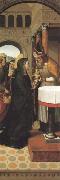
Juan de Espinosa
|
|
Spanish Baroque Era Painter, ca.1590-1641
Spanish painter. Details of his life are scarce. He is documented in Madrid and Toledo between 1612 and 1626, and while he is recorded as having painted religious pictures and portraits (untraced), he is only known today for his still-life paintings. Documents relating to another artist of the same name, known as Juan de Espinosa, dating from 1645 to 1677, concern a different painter.
|
|
 |
Juan Correa de Vivar
|
|
Spanish , c.1510-1566
was a Spanish painter,Correa's date of birth has been determined to be around 1510. Records show he grew up wealthy. When Juan was 17 or 18 years old he joined an artist workshop in Burgundy where he met with many other Spanish artists at the time, including Pedro de Cisneros whom he befriended. Juan's brother Eufrasia and Eufrasia's son Rodrigo also grew up to be artists. Rodrigo was apprenticed with his uncle, and continued some of his uncle's works after his death. In Mascaraque, Juan was a substantial landowner with a nice house where he did much of his painting. He took frequent trips but always stayed in the Toledo area. Juan was married and a religious man. It can be seen in his testament: a copy was found in the church files of Mascaraque. When he died, Juan split all his possessions between his nephew Rodrigo and the church of Mascaraque. Juan was a well-regarded painter during his life, but many records were lost. His works and life were brought to light again when the researcher and art historian Ceen Bermudez in 1800 published a dictionary of famous artists and included a brief article about his works and Italian influences. The full reconstruction of its biography has been primarily accomplished in the 20th century. Records show Juan died on April 16, 1566 in San Miguel. Juan's body was taken back to Mascaraque where he was buried, in the same plot where his parents were laid to rest. Many members of the artistic community came to the funeral service,
|
|
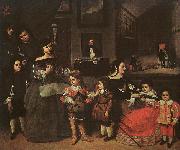 |
Juan Bautista Martinez del Mazo
|
|
1612-1667
Spanish
Juan Bautista Martinez del Mazo Gallery
Mazo??s works owe credit above all to Vel??zquez, whose style he was long compelled to emulate in court portraits. However, Mazo shows in his paintings a personality of his own. His portraits exhibit startling naturalism and marvelously executed. Mazo was specially skillful in painting small figures, a cardinal element in both his hunting scenes and the landscapes he painted as in his most celebrate work View of Saragossa.
Mazo??s palette was rather like that of Vel??zquez, except for a penchant often shown for stressing blue or bluish tints. .The departure from his master style was in his way of shaping people and things by highlights which flash the pictorial image towards the surface of the painting, even from the background.. As a counterbalance, an explicit, even emphatic, perspective design marks out the spatial confines of the composition, making it appear squarish.. A further departure from Velazquez is his luxurious depiction of detail or incident, which he achieved with brilliant, depthless strokes, whether on the figure of a sitter, a curtain on a wall, a floor, the surface of a river, or plain grounds. .These stylistic traits reveal Mazo??s own personality as an artist. .For centuries, Mazo??s paintings were attributed to Vel??zquez, but modern art criticism, techniques and knowledge have been able to separate their works.
|
|
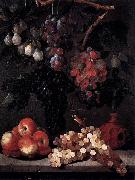 |
Juan Bautista de Espinosa
|
|
(1590-1641, Madrid) was a Spanish still life painter.
More paintings remain of him than biographical data and there is only one known painting remaining.
It is only known that he worked in Toledo and Madrid from 1612 to 1626 and, judging by his style, he was trained in Holland. De Espinosa's style is judged to be the transition from Flemish Baroque to Spanish Baroque.
Several mural paintings in Spanish churches are also attributed to him; one of these is in Alcaudete.
|
|
|
|
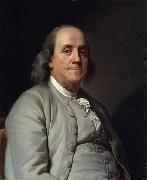 |
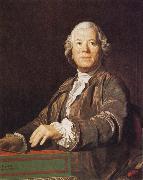
Joseph-Siffred Duplessis
|
|
(22 September 1725 - 1 April 1802) was a French painter, known for the clarity and immediacy of his portraits.
He was born in Carpentras, near Avignon, into a family with an artistic bent and received his first training from his father, a surgeon and talented amateur, then with Joseph-Gabriel Imbert (1666-1749), who had been a pupil of Charles Le Brun. From 1744-47 or later he worked in Rome, in the atelier of Pierre Subleyras, who was also from the south of France, who died in 1749. In Italy Duplessis became fast friends with Joseph Vernet, another Occitan.
He returned to Carpentras, spent a brief time in Lyon then arrived about 1752 in Paris, where he was accepted into the Academie de Saint-Luc and exhibited some portraits, which were now his specialty, in 1764, but did not achieve much notice until his exhibition of ten paintings at the Paris salon of 1769, very well received and selected for special notice by Denis Diderot; the Academie de peinture et de sculpture accepted him in the category of portraitist, considered a lesser category at the time. He continued to exhibit at the Paris salons, both finished paintings and sketches, until 1791, and once more, in 1801.
His portrait of the Dauphine in 1771 and his appointment as a peintre du Roi assured his success: most of his surviving portraits date from the 1770s and 1780s. He received privileged lodgings in the Galeries du Louvre. In the Revolution, he withdrew to safe obscurity at Carpentras during the Reign of Terror. Afterwards, from 1796, he served as curator at the newly-founded museum formed at Versaillles, so recently emptied of its furnishings at the Revolutionary sales. His uncompromising self-portrait at this time of his life is at Versailles, where he died.
|
|
 |
Joseph-Siffred Duplessis
|
|
1725-1802
French
Joseph Siffred Duplessis Locations
French painter. He trained with his father, an amateur painter, and then with Joseph-Gabriel Imbert (1666-1749), a pupil of Charles Le Brun. In 1744 he went to Rome and worked with Pierre Subleyras. He remained there until at least 1747 and possibly until the death of his master in 1749. He must have learnt portrait painting in Rome, but he also painted landscapes, because Joseph Vernet advised him to specialize in this genre.
|
|
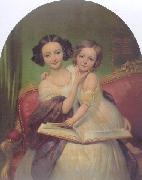 |
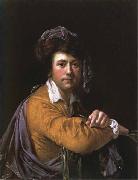
Joseph-Desire Court
|
|
a painter of historical subjects and portraits, was born at Rouen in 1797. He became a pupil at the École des Beaux-Arts under Gros, and after carrying off the principal honours there pursued his studies still further at Rome. High expectations were formed of him when he exhibited in 1827 'The Death of Caesar,' a work manifesting earnest thought, and a conscientious handling of the facts of history. This is now preserved in the Louvre. Having shown himself in this and other works a vigorous painter, capable of seizing a subject with a masterly grasp, and having also in the region of portrait painting proved himself an artist of no common merit, he eventually dissipated his talents in the production of a series of empty official pictures painted by order of Louis Philippe. He died in Paris in 1865. The Bordeaux Museum has a portrait of Henri Fonfrede by him; that of Lyons, a 'Scene in the Deluge'; that of Rouen,
|
|
 |
Joseph wright of derby
|
|
1734-97
English painter. He painted portraits, landscapes and subjects from literature, but his most original and enduringly celebrated works are a few which reflect the philosophical and technological preoccupations of the later 18th century and are characterized by striking effects of artificial light. He was the first major English painter to work outside the capital all his life: apart from spells in Liverpool (1768-71), Italy (1773-5) and Bath (1775-7), he lived and worked in his native Derby, though exhibiting in London at both the Society of Artists (1765-76, 1791) and the Royal Academy (1778-82, 1789-90, 1794).
|
|
 |
Joseph Siffred Duplessis
|
|
French Painter, 1725-1802
was a French painter, known for the clarity and immediacy of his portraits. He was born into a family with an artistic bent and received his first training from his father, a surgeon and talented amateur, then with Joseph-Gabriel Imbert (1666?C1749), who had been a pupil of Charles Le Brun. From 1744-47 or later he worked in Rome, in the atelier of Pierre Subleyras, who was also from the south of France, who died in 1749. In Italy Duplessis became fast friends with Joseph Vernet, another Occitan. He returned to Carpentras, spent a brief time in Lyon then arrived about 1752 in Paris, where he was accepted into the Academie de Saint-Luc and exhibited some portraits, which were now his specialty, in 1764, but did not achieve much notice until his exhibition of ten paintings at the Paris salon of 1769, very well received and selected for special notice by Denis Diderot; the Academie de peinture et de sculpture accepted him in the category of portraitist, considered a lesser category at the time. He continued to exhibit at the Paris salons, both finished paintings and sketches, until 1791, and once more, in 1801. His portrait of the Dauphine in 1771 and his appointment as a peintre du Roi assured his success: most of his surviving portraits date from the 1770s and 1780s. He received privileged lodgings in the Galeries du Louvre. In the Revolution, he withdrew to safe obscurity at Carpentras during the Reign of terror. Afterwards, from 1796, he served as curator at the newly-founded museum formed at Versaillles, so recently emptied of its furnishings at the Revolutionary sales. His uncompromising self-portrait at this time of his life is at Versailles. His adjusted his style to the social condition of his sitter: his portrait of Charles-Claude, comte d'Angiviller, director of the Batiments du Roi, is as distant and conventional as his state portrait of Louis XVI in coronation robes (1776), while his realistic and intimate portrait of the opera composer Christoph Willibald Gluck (Kunsthistorisches Museum, Vienna) catches the composer at the keyboard in a moment of inspiration and his penetrating portrait of the sculptor Christophe Gabriel Allegrain (Louvre Museum, illustration) shows him having just laid down his chisel: this was the morceau de reception that gained him admittance to the Academie. Duplessis' Benjamin Franklin on the U.S. hundred dollar billHis portrait of Benjamin Franklin (1778),
|
|
|
|
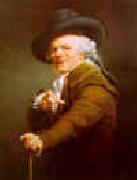 |
Joseph Ducreux
|
|
1735-1802
French
French painter, pastellist and engraver. He lived in Paris from 1760 and from 1762 kept a list of his works. Among the portraits he completed in his early years were those in pastel of the well-known connoisseurs Pierre-Jean Mariette, the Comte de Caylus and Ange-Laurent de la Live de July (all untraced), which apparently were copies after Maurice-Quentin de La Tour. Ducreux has traditionally been seen as de La Tour favourite pupil, while Jean-Baptiste Greuze is supposed to have initiated him into oil painting. From his age, it can be assumed that by the time Ducreux reached Paris he had already acquired a grounding in his art.
|
|
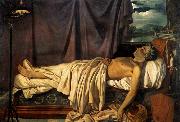 |
Joseph Denis Odevaere
|
|
1778-1830,Flemish painter. He attended evening classes at the Bruges Academie in 1794-5 and then went to Paris, where he entered the studio of the Bruges artist Joseph-Benoet Suvee. In 1801 he began training under Jacques-Louis David and in 1804 won the Prix de Rome for his Death of Phocion (Paris, Ecole N. Sup. B.-A.), in which he faithfully adhered to the principles of David's teaching. Before going to Italy he spent a year in Bruges carrying out portrait commissions, including the Marquis de Chauvelin (1805; Bruges, Groeningemus.). During his time in Rome (1805-12) he copied antique and Renaissance works, taking a particular interest in Raphael, who features in his wash drawing the Master of Urbino Introduced by Bramante to Julius II (1807; Bruges, Groeningemus.), a study for a lost painting. Around 1811 he was among the artists chosen to decorate the Palazzo del Quirinale for Napoleon's visit, although he never executed more than a sketch, Tanaquil Predicting the Future Greatness of Servius Tullius (c. 1811-12; Dijon, Mus. Magnin). Odevaere successfully exhibited in Paris in 1812 and then moved to Ghent, showing works at the Salon there two years later. After the union of the Low Countries in 1815 he became official painter to William I. As a result of this post he executed several works illustrating the history of the Dutch royal family, including the Prince of Orange Wounded at Waterloo (1817) and the Battle of Nieuwpoort (1820; both Brussels, Pal. Nation, on dep. Brussels, Pal. Justice). In 1815 he was commissioned to recover works of art taken from the Low Countries by the French. David's arrival in Brussels in 1816 coincided with the beginning of Odevaere's most ambitious composition, the Departure of the Athenians for Salamis (1816-25; Brussels, Mus. A. Anc.), inspired as much by Jean-Auguste-Dominique Ingres as by David, although the latter frequently advised Odevaere on the painting. From 1825 to 1829 he worked on a series of paintings conveying his support of the philhellenic committees created during the Greek War of Independence.
|
|
|
|
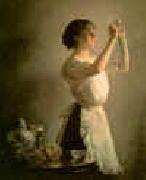 |
Joseph Decamp
|
|
1858-1923
Joseph Rodefer DeCamp (November 5, 1858 - February 11, 1923) was an American painter.
Born in Cincinnati, Ohio, he studied with Frank Duveneck in that city. In the second half of the 1870s he went with Duveneck and fellow students to the Royal Academy of Munich, then spent time in Florence, Italy, returning to Boston in 1883.
He became known as a member of the Boston school led by Edmund Charles Tarbell and Emil Otto Grundmann, focusing on figure painting, and in the 1890s adopting the style of Tonalism. He was a founder of the Ten American Painters, a group of American Impressionists, in 1897.
A 1904 fire in his Boston studio destroyed several hundred of his early paintings, including nearly all of his landscapes.
He died in Boca Grande, Florida.
|
|
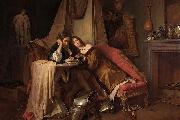 |
Josef Danhauser
|
|
Josef Danhauser (August 19, 1805, Laimgrube (now a part of Mariahilf or Neubau) - May 4, 1845) was an Austrian painter, one of the main artists of Biedermeier period, together with Ferdinand Georg Waldmeller, Peter Fendi, among others. His works, not very appreciated in his days, dealt with very moralising subjects and they had a clear influence of William Hogarth.
Joseph Danhauser was born in Vienna in 1805, the eldest son of sculptor and furniture manufacturer Joseph Ulrich Danhauser and his wife Johanna (nee Lambert).
He took his first painting lessons with his father and he later assisted the Vienna Academy of Fine Arts. He studied with Johann Peter Krafft and made his first exhibition 1826.
Invited by Johann Ladislaus Pyrker, patriarch of Venice, he visited the city of Doges, where he started to study the Italian masters. He came back to Vienna via Trieste in 1827, visiting Prague. That very year he painted Ludwig van Beethoven's death mask, roughly 12 hours after his death and a water-colour representing his deathbed. In 1828, he spent some time in Eger, with an invitation of this Hungarian city archbishop Pyrker. He solicited him for some pictures for the gallery of the Archdiocese.
After his father's death in 1829, his brothers and he managed his furniture factory during the Biedermeier movement, being the precursors of modern design. That made him put his painting career aside.
In 1833, he responded to a second invitation from Eger's archbishop and he painted The martyr of Saint John for a new basilica in the city and he received the Vienna Academy prize for his picture Die Verstobung der Hagar and he specialised in Genre works. In 1838, he was appointed vice-rector of the Academy and married Josephine Streit, who was the daughter of a physician and with whom he had three children, Josef, Marie and Julie, born in 1839, 1841 and 1843 respectively.
Josef Danhauser was appointed professor of historical Painting at the Academy in 1841, but he left this occupation and he travelled around Germany and the Netherlands with the textile maker, art aficionado and art sponsor Rudolf von Arthaber. In this journey, he was very interested in the Dutch School and the format of his works was littler. He died of typhus in Vienna in 1845. They named a street with his name in Vienna in 1862.
|
|
|
|
|
|
|
|
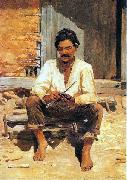 |
Jose Ferraz de Almeida Junior
|
|
(8 May 1850 - 13 November 1899) was a Brazilian painter of the 19th century. He is widely regarded as the most important Brazilian realist painter of the 19th century, and a major inspiration for the modernist painters. While most Brazilian academic artists made their fame painting mythological or historical subjects, Almeida Junior would become popular for painting rural figures, especially farmers and the caipira violeiro , the countrymen that are a kind of a symbol of the rural areas of the São Paulo state.
While most realist painters used farmers and countrymen as an allegory of workers, Almeida Junior would paint his caipiras mostly on leisure time. He would also produce touching images of upscale landowners. The Bandeirantes, the ruthless explorers of colonial Brazil, would be depicted in the A partida da monção, showing an expedition on the Tiete River.
Almeida Junior was born in the city of Itu, then a small town in the state of São Paulo. After becoming a sensation in his town he would be invited to study in the Brazilian Imperial Fine Arts Academy of Rio de Janeiro, but in 1876 would study in France after being granted a scholarship by emperor Pedro II of Brazil in person in the city of Moji-Mirim. He would have Alexandre Cabanel as one of his masters. In 1877 he was already enrolled in the School of Fine Arts in Paris. He took part at the Salon de Paris with several works of art in 1879 (Retrato do Dr. Jose de Magalhães), 1880 (O Derrubador Brasileiro) and (Remorso de Judas), 1881 (Fuga para o Egito) and 1882 (Descanso do Modelo) He admired the French realist and naturalist painting (a major influence at his work), and, after returning to Brazil in 1882, became of the leading names in Brazilian realist painting.
He was stabbed to death by the husband of his mistress on November 13, 1899 in Piracicaba.
|
|
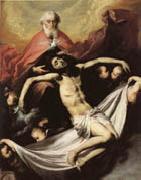 |
Jose de Ribera
|
|
Spanish Painter and Print engraver , 1591-1652
Information concerning the life and personality of Jusepe de Ribera is sparse. He was born the son of a shoemaker in Jetiva, Valencia Province. He appears to have gone to the city of Valencia while still a boy, but nothing is known of his possible artistic training there. As an adolescent, he traveled to Italy and spent time in Lombardy. Next he was in Parma, from which, it is said, he was driven by the contentious jealousy of local artists. He located himself in Rome until an accumulation of debts forced him to flee. Finally he settled in Naples, where in 1616 he married Caterina Azzolino, the daughter of a painter, by whom he had seven children between the years 1627 and 1636. The Academy of St. Luke in Rome elected Ribera to membership in 1625, and 6 years later the Pope conferred upon him the Order of Christ. It is understandably speculated that Ribera revisited Rome for these events. Being sought after in Naples by the Church and the various Spanish viceroys who ruled there in the name of the Spanish monarchy, he dismissed the idea of returning to his homeland. He was quoted as saying that he was honored and well paid in Naples and that Spain was a cruel stepmother to its own children and a compassionate mother to foreigners. Nevertheless, he generally added his nationality when he signed his works. This practice inspired the Italians to nickname him "the Little Spaniard" (Lo Spagnoletto). The last decade of Ribera's life was one of personal struggle. He suffered from failing health, the taunts of other artists that his fame was "extinct," and difficulty in collecting payments due him. Nevertheless, he kept it from being a tragic defeat by continuing to paint until the very year of his death in Naples. Actually, he was the victim of the local politics and finances. Naples was in the throes of a severe economic depression for which the foreign rulers, the patrons of Ribera, were naturally blamed, and the desperate citizenry was rioting in the streets. It is significant that Ribera continued to receive commissions in such a time, even if there was a dearth of payments. Ribera was inventive in subject matter, ranging through visionary spectacles, biblical themes, genre, portraits, mythological subjects, and portraits of ascetics and penitents.
|
|
 |
Jose del Castillo
|
|
1737-1793
Spanish
Jose del Castillo Location
a Spanish painter and a leader of the artistic movement Illustrious Absolutism. Many of his paintings were done on tapestries.
Castillo made many attempts to become Royal Painter for the Spanish monarchy, but he was never successful. This was not due to a lack of talent, but rather because Castillo allied himself with the wrong noble. His patron, the Earl of Floridablanca, feuded bitterly with the Earl of Aranda. The Earl of Aranda was favored by King Carlos III, and as a result, Ram??n Bayeu (Aranda favorite painter) became Royal Painter.
After Carlos III died, Castillo tried again to become Royal Painter. Unfortunately, the new monarch, Carlos IV, decided to leave the position of Royal Painter vacant.
|
|
 |
Joris van der Haagen
|
|
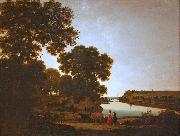
(ca. 1615 - The Hague, 23 May 1669 (buried)) was a Dutch Golden Age painter specialized in landscapes.
Contents
It is unclear where Joris van der Haagen was born, either in Arnhem or Dordrecht, but archival evidence shows that he started his drawing career in Arnhem. He probably learned to paint from his father, the painter Abraham van der Haagen. When his father died he moved in 1639 to the Hague, where he joined the Guild of St. Luke in 1643. A year later he became honorary citizen of The Hague. In 1656 he was one of the founding members of the Confrerie Pictura, which was located on the Princessegracht in the Hague. The painting he made of the Princessegracht at this time probably shows the original building, which has since been renovated beyond recognition.
|
|
 |
Joost Cornelisz Droochsloot
|
|
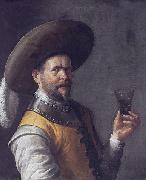
(1586, Utrecht (city) - May 14, 1666, Utrecht (city)), was a Dutch Golden Age painter.
According to Houbraken his village scenes (Boerekermisstuk) were as popular as flower pieces by Bartholomeus Assteyn.Houbraken thought he was born in Gorinchem or Dordrecht, and claimed he worked for a long time in Dordrecht. He felt his work was always according to a set pattern, where cake sellers were portrayed in front of village houses with figures in a festive setting called a "farmer's circus". It is unclear why Houbraken would have thought he was from Dordrecht, especially since Houbraken's data on painters from Dordrecht was generally quite accurate. Droochsloot and his son were highly respected citizens of Utrecht with a large workshop.
According to the RKD his monogram was "JCODS" and he became a member of the Utrecht Guild of Saint Luke in 1616. He later became deacon of the guild in 1623 and regent of the St. Jobs Gasthuis in 1638, deacon of the Dutch Reformed church, and in 1665 officer of the Utrecht schutterij. He was the father of the painter Cornelis Droochsloot (1630-1673) whose paintings are hard to distinguish from his own, and the teacher of Jacob Duck.
|
|
 |
Joos de Momper
|
|
Flemish Baroque Era Painter, 1564-1635
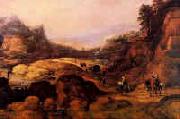
known as Josse de Momper, is one of the most important Flemish landscape painters between Pieter Brueghel the Elder and Peter Paul Rubens. Brueghel's influence is clearly evident in this many of de Momper's paintings.
Born in 1564 in Antwerp, Joos de Momper was first apprenticed to his father. In the 1580s, he travelled to Italy to study art. De Momper primarily painted landscapes, the genre for which he was well-regarded during his lifetime. He painted both fantasy landscapes, viewed from a high vantage point and employing a conventional Mannerist color transition of brown in the foreground to blue and finally green in the background, and more realistic landscapes with a lower viewpoint and more natural colors. His wide panoramas also feature groups of figures. Only a small number of the 500 paintings attributed to De Momper are signed, and just one is dated.
|
|
 |
john scarlett davis
|
|
John Scarlett Davis (1 September 1804 - 29 September 1845), or Davies, was an English painter of the first half of the nineteenth century.
Davis was born in Leominster, the son of James Davis, a watchmaker; Scarlett was his mother's maiden name. At the age of eleven, Davis won an award from the local society for the encouragement of the arts. He was educated at the Royal Academy of Art School in London, and began exhibiting his works at the annual Royal Academy shows in 1825. He was influenced by the work of his contemporary, Richard Parkes Bonington.
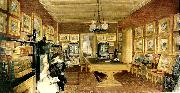
Davis painted portraits, landscapes, and church interiors, and developed a distinctive specialty in painting the interiors of art galleries. His picture The Interior of the British Institution Gallery (1829) records a collection of Old Masters. His watercolor of the collection of Benjamin Godfrey Windus (1835) shows the Turner pictures on the walls. (John Ruskin studied those Turners while writing his Modern Painters.) Davis painted the interiors of the Louvre as well. Between 1842 and 1845 he was commissioned to draw copies of the paintings in the collections of the British royal palaces.
Davis painted scenes on the Continent during his travels there. He was in Florence in 1834, and Amsterdam in 1841. He painted the interior of the Uffizi Gallery.
Davis's later years were marred by alcoholism and spells of imprisonment. His posthumous reputation suffered as a result.
Davis's name is almost identical to that of John Scarlett-Davies, a modern video artist and director.
|
|
|
|
 |
John Durand
|
|
American.
active1766-1782
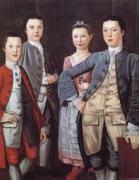
A signed portrait (priv. col.) dated 1765 provides the first documentary information on him. He advertised in the New York Journal on 26 November 1767 that he had opened a drawing school, and again on 7 April 1768, announcing his availability as a history painter, though no examples of this activity survive. Like other painters in the colonies, he made his living from portrait painting. His most noted work, the Rapalije Children (1768; New York, NY Hist. Soc.), demonstrates the strong decorative sense, the delicate use of colour and the attempts at sophisticated value and texture application that characterize all his paintings. His skill as a draughtsman is evident in the carefully described details. Here, as in other works, he used a dark outline to define one plane from another, and he imparted a sense of elegance, particularly in the slightly turned heads and animated arms and hands.
|
|
 |
John Downman
|
|
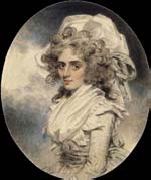
English Painter, ca.1750-1824, English painter and draughtsman. He became a pupil of Benjamin West in 1768 and entered the Royal Academy Schools, London, the following year. In 1770 and 1772 he exhibited portraits at the Royal Academy and showed his first subject picture in 1773. He left for a period of study in Italy and was in Rome with Joseph Wright of Derby from 1773 to 1774. When he next exhibited at the Royal Academy (1777) he was living in Cambridge, but from 1778 to 1804 his considerable annual contribution to the Academy exhibitions was sent from various London addresses. His very popular small portraits were often shown in groups of six or nine. His occasional subject pictures were based on themes from mythology, Classical history, poetry and the theatre. They included a scene from As You Like It (untraced) painted for John Boydell's Shakespeare Gallery. Downman became ARA in 1795 and travelled widely in later life, marrying in Exeter in 1806 and sending works to the Royal Academy (1805-12 and 1816-19) from all over the country.
|
|
|
|
|
|
 |
John Charles Dollman
|
|
British, 1851-1934, He was an English painter and illustrator. Dollman was born in Hove on 6 May 1851 and moved to London to study at South Kensington and the Royal Academy Schools, after which he set up a studio at Bedford Park, London. He exhibited at the Royal Academy from 1870 to 1912, and was elected RWS (Member of the Royal Watercolour Society) in 1913. Dollman was also an illustrator, working in black and white or colour for magazines such as the Graphic during and after the 1880s. Some of his early work has been said to have influenced Van Gogh . A central theme was ambitious mythological pictures such as a Viking Foray, a Viking horde entitled the Ravagers, The Unknown (1912), featuring a girl surrounded by chimps and Orpheus and his Lute with Lions. He also produced bold compositions of animals and people such as Robinson Crusoe and His Man Friday, Polo and Mowgli made leader of the Bandar-log (1903) . His best known work is possibly A London Cab Stand (1888) , focussing on a group of horses in a stormy scene . He composed at least three variants of this picture, and there are other instances where he made copies or near-copies of individual pictures. In the 1890s he painted pictures of soldiers, and some less well regarded genre pictures of people with animals. He also painted wild animal pictures without attempting any narrative content . Dollman's works are in the collections of various galleries. The Immigrants' Ship (1884) is in the Art Gallery of South Australia, Adelaide . 'The Ravager' is owned by the Trustees of the Royal Watercolour Society, London, [8]. A version of The Unknown is in the Laing Art Gallery, Newcastle. A London Cab Stand is in the London Museum. A Dog's Home, Table d'Hote (1879) is in the Walker Art Gallery, Liverpool , and During the Time of the Sermonses (1896), an odd picture of a pair of religious people approaching two golfers, is in the collection of the Harris Museum, Preston , while 'Famine' (1904) is at the Salford Museum and Art Gallery Dollman died on 11 December 1934, aged 83.
|
|
 |
Johannes Hubertus Leonardus de Haas
|
|
(25 March 1832 - 4 August 1908) was a Dutch animal and landscape painter, and a peripheral figure of the Hague School.
Born at Hedel, De Haas spend his youth in Amsterdam where he got his first art education at evening-classes at the Koninklijke Academie. Consequently he moved to Haarlem where he was apprenticed to the artist Pieter Frederik van Os. During his stay in Haarlem he befriended Paul Gabriël and Hendrik Dirk Kruseman Van Elten who were also studying with Van Os.
In 1853, together with his two friends, De Haas decided to go to Oosterbeek. Here they came into contact with the influential landscape painter Johannes Warnardus Bilders and the group of painters which had gathered around him, many of whom would later be part of the Hague School. De Haas also met his future wife in Oosterbeek, Bilders' daughter, Caroline. In 1855 he received good reviews for his pictures that were exhibited in Paris from the noted art critic Jean Baptiste Gustave Planche.
In 1857 De Haas first went to Brussels, where he became friends with Willem Roelofs. De Haas frequently returned to the Netherlands and Oosterbeek for inspiration and Caroline. From 1860 his friend Gabriël also lived in Brussels, and De Haas often painted cattle in the landscapes of both Roelofs and Gabriel, fitting in perfectly with both their styles. In 1860 he won the gold medal at the exhibition of Utrecht.
From 1861 until 1869 De Haas is permanently settled in Brussels, painting mainly on the coasts of Flanders and Picardie in northern France. He married Caroline Bilders in 1862, and in 1864 they are briefly joined by her brother, the promising painter Gerard Bilders. In 1865 Caroline dies at the age of 24 of tuberculosis, leaving him with a young son. During his stay in Brussels De Haas is instrumental in passing on the style of the Barbizon school to the painters at Oosterbeek.
|
|
|
|
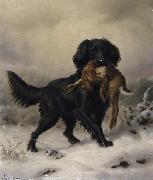 |
Johannes Deiker
|
|
painted Schwarzer Setter apportiert Hasen in winterlicher Landschaft in 1886
1822-1895
|
|
|
|
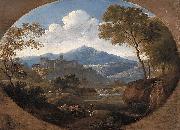 |
Johann Georg von Dillis
|
|
(born Gmain, December 26, 1759 - died Munich, September 28, 1841) was a German painter. Son of a gamekeeper and forester, he was educated in Munich with support from the prince-elector of Bavaria. Initially he was trained for the priesthood, but by 1786 his real interest, art, was beginning to be developed, and he taught drawing both at court and to private families. In 1790 he was appointed inspector of the Hofgarten Galerie, the princely collection. He continued in a curatorial role for the Bavarian court for much of the rest of his career; this allowed him some freedom to travel and expand his knowledge of European art. In 1792 he traveled to Dresden, Prague, and Vienna, and in 1794 he made his first trip to Italy, where he made watercolor studies from nature. A further trip to Italy followed in 1805, and brought him to Rome, where he met Pierre-Henri de Valenciennes, who introduced him to the idea of painting in open air. He studied the work of Simon Denis and Joseph Mallaord William Turner, and encountered Washington Allston. The next year, in Paris, he saw oil sketches by Jean-Joseph-Xavier Bidauld, and with Ludwig, the crown prince visited the Musee Napoleon; he would later advise the prince on collecting and other matters artistic, remaining in this capacity for the rest of his life. He also made several trips to Italy to purchase art for the royal collection. In 1816 he was made responsible for packing and returning to Munich from Paris art stolen from Bavaria by Napoleon. In the fall of 1817 he and Ludwig traveled to Sicily before spending four months in Rome. Dillis helped to shape the collections of the Alte Pinakothek, which opened in 1836. He died in Munich in 1841.
|
|
|
|
|
|
 |
Johan Christian Dahl
|
|
1788-1857
Norwegian
1857). Norwegian painter and collector, active in Germany. His paintings, imbued with Romantic and patriotic sentiments, had a strong influence on the landscape tradition both in Germany (especially Dresden) and in his native Norway.
|
|
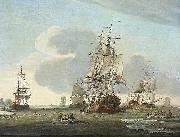 |
Jochem de Vries
|
|
painted The Zaandam shipping company Claes Tan en Zns Greenland farer Zaandam whaling in 1772
|
|
|
|
 |
Jo Davidson
|
|
American Sculptor, 1883-1952,was an American sculptor of Russian-Jewish descent. Although he specialized in realistic, intense portrait busts, Davidson did not require his subjects to formally pose for him; rather, he observed and spoke with them. He worked primarily with clay, while the final products were typically cast in terra-cotta, marble and bronze. Born in New York City, Davidson attended Yale University before moving to Paris to study sculpture at Ecole nationale superieure des beaux arts in 1907. After returning to the United States, he was befriended by Gertrude Vanderbilt Whitney, who purchased some of Davidson's work. In 1911 Davidson secured his first solo gallery shows; in 1934 he won the National Academy of Design Maynard Prize, and in 1947 the American Academy of Arts and Letters hosted a retrospective featuring nearly 200 of his works. He was one of 250 sculptors who exhibited in the 3rd Sculpture International held at the Philadelphia Museum of Art in the summer of 1949. Among Davidson commissions are a design for a United States War Industries badge, a collection of pieces for the Government of France to commemorate the first victory of the Troupes de Marine and bronze busts of the leaders of the Allies. His portraits of world leaders and celebrated personalities gained him international acclaim, and included such luminaries as Woodrow Wilson, Franklin Delano Roosevelt, Rudyard Kipling, James Joyce, Gertrude Stein, Andrew Mellon, Will Rogers, John D. Rockefeller, Joseph Conrad, Anatole France, Lincoln Steffens, Gertrude Vanderbilt Whitney, Marshall Ferdinand Foch, General John J. Pershing, John Marin, Rabindranath Tagore, Frank Harris, Israel Zangwill, Charlie Chaplin, Robert M. La Follette, Clarence Darrow, Emile Coue (who was also a sculptor in his spare time), H. G. Wells, Robinson Jeffers, Andre Gide. George Bernard Shaw, James Barrie, Arthur Conan Doyle,D. H. Lawrence, W. Averell Harriman, Madame Chiang Kai shek, Dolores Ibarruri, aka La Passionaria, Helen Keller, Mahatma Gandhi, Dwight D. Eisenhower, Ida Rubinstein, Albert Einstein, Carl Sandburg, Marshall Tito, E. W. Marland and Walt Whitman. Will Rogers statue is a full-body bronze portrait erected at the United States Capitol in 1939. Walt Whitman portrait is also a full-body bronze, and stands in Bear Mountain State Park, New York. Some of Davidson's work is in the National Gallery of Art and in the Capitol Building where he has placed two works, Will Rogers of Oklahoma and Robert M. La Follette of Wisconsin in the National Statuary Hall, and busts of two vice presidents, Henry A. Wallace and Charles G. Dawes, all of which are located in Washington, D.C.. He also designed a statue of Henry D. Thoreau, the author of WALDEN. The statue is located at Walden Pond State Reservation in Concord, MA. In 2006, The Smithsonian Institution's National Portrait Gallery opened a permanent exhibition, Jo Davidson: Biographer in Bronze, showcasing fourteen Davidson works in terracotta and bronze, including portraits of Gertrude Stein and Lincoln Steffens.
|
|
 |
Jeronymus van Diest
|
|
(1631, The Hague - ca.1687, The Hague), was a Dutch Golden Age seascape painter.
According to Houbraken, a Jeronymus van Diest was good with grisailles and was the teacher of Adriaen van de Venne.[1] This grisaille painter Jeronymus Diest (I) may possibly have been a grandfather of the younger Jeronymus Diest (II); since they are both from the Hague.
According to the RKD this younger Jeronymus Diest (II) was the son of the painter Willem van Diest and the father of the painter Adriaen van Diest who was a follower of Jan van Goyen and Hendrik Dubbels.His known works are all seascapes with various ships at sail.
|
|
 |
Jean-Pierre Norblin de La Gourdaine
|
|
(in Polish, Jan Piotr Norblin; 15 July 1745 - 23 February 1830) was a French-born painter, draughtsman, engraver, drawing artist and caricaturist. From 1774 to 1804 he resided in the Polish-Lithuanian Commonwealth, where he obtained citizenship.
He is considered one of the most important painters of the Polish Enlightenment. He achieved great success in Poland. Given many commissions from some of the most notable families of the Polish-Lithuanian Commonwealth, he stayed there for many years, not returning to Paris until the early 19th century. His style showed the influence of Antoine Watteau, and combined the Rococo tradition of charming fates galantes and fetes champetres with a panorama of daily life and current political events, captured with journalistic accuracy. He created a gallery of portraits of representatives of all social classes in the last years of the Polish-Lithuanian Commonwealth.
|
|
|
|
|
|
|
|
|
| Wholesale China Oil Painting Wholesale Oil Painting China Xiamen Portrait Reproduction on canvas Chinese Oil Painting Wholesale USA Oil Painting |
|
|
|
|
|