| |
|
Xiamen Oil Paintings, Wholesale Direct!
|
|
100% hand painted, 100% cotton canvas, 100% money back if not satisfaction. |
|
|
|
|
ART WORKS INDEX
A
B
C
D
E
F
G
H
I
J
K
L
M
N
O
P
Q
R
S
T
U
V
W
X
Y
Z
|
|
ARTISTS INDEX
A
B
C
D
E
F
G
H
I
J
K
L
M
N
O
P
Q
R
S
T
U
V
W
X
Y
Z
|
|
|
|
 |
Theodore R. Davis
|
|
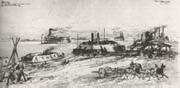
1840 ?C 1894,was a 19th century American artist, who made numerous drawings of significant military and political events during the American Civil War and its aftermath. Some of these drawings include the Battle of Champion Hill, and the most significant sketch of General Joseph E. Johnston and General William T. Sherman meeting at the Bennett Farm near Durham Station to discuss the surrender terms of the remaining Confederate armies in the Southeast. After the war when the Cyclorama in Atlanta was being painted, Davis was asked for his ideas having traveled with Sherman's army. He was later added to the painting.
|
|
|
|
 |
Theo van Doesburg
|
|
Dutch
1883-1931
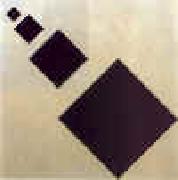
Dutch painter, architect, designer and writer. He was officially registered as the son of Wilhelm Kepper and Henrietta Catharina Margadant, but he was so convinced that his mother second husband, Theodorus Doesburg, was his father that he took his name. Little is known of his early life, but he began painting naturalistic subjects c. 1899. In 1903 he began his military service, and around the same time he met his first wife, Agnita Feis, a Theosophist and poet. Between about 1908 and 1910, much influenced by the work of Honor Daumier, he produced caricatures, some of which were later published in his first book De maskers af! (1916). Also during this period he painted some Impressionist-inspired landscapes and portraits in the manner of George Hendrik Breitner. Between 1914 and 1915 the influence of Kandinsky became clear in such drawings as Streetmusic I and Streetmusic II (The Hague, Rijksdienst Beeld. Kst) and other abstract works.
|
|
 |
TENIERS, David the Younger
|
|
Flemish Baroque Era Painter, 1610-1690
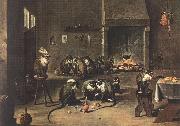
a Flemish artist born in Antwerp, was the more celebrated son of David Teniers the Elder, almost ranking in celebrity with Rubens and Van Dyck. His son David Teniers III and his grandson David Teniers IV were also painters. His wife Anna nee, Anna Breughel was the daughter of Jan Brueghel the Elder and the granddaughter of Pieter Bruegel the Elder. Through his father, he was indirectly influenced by Elsheimer and by Rubens. The influence of Adriaen Brouwer can be traced to the outset of his career. There is no evidence, however, that either Rubens or Brouwer interfered in any way with Teniers's education, and Smith (Catalogue Raisonn) may be correct in supposing that the admiration which Brouwer's pictures at one time excited alone suggested to the younger artist his imitation of them. The only trace of personal relations having existed between Teniers and Rubens is the fact that the ward of the latter
|
|
|
|
 |
Taddeo di Bartolo
|
|
Italian Gothic Era Painter, ca.1362-1422
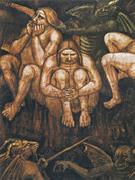
Italian painter. Taddeo, son of the barber Bartolo di Mino, was under 25 in 1386 when he was first recorded, painting statuettes of angels for the new choir-stalls in Siena Cathedral. In 1388-9 he was a counsellor to the Cathedral Works and in 1389 he was first listed as an independent painter. His earliest dated work is the polyptych of the Virgin and Child with Saints (1389; sold London, Christie's, 8 Dec 1950), painted for the chapel of S Paolo at Collegarli, near San Miniato al Tedesco.
|
|
|
|
 |
Steven van der Meulen
|
|
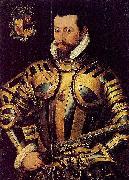
(b. eAntwerp - d. London, e1563-64) was a Dutch artist active c. 1543-1564. He gained prominence in England in the first decade of the reign of Elizabeth I as one of many Flemish artists active at the Tudor court. He is best known for the "Barrington Park" portrait type of Elizabeth I and for three-quarter length portraits of members of the English court in the first half of the 1560s. A recently discovered will indicates that he died in London between October 1563 and January 1564.
|
|
 |
Stefano di Giovanni Sassetta
|
|
1423-1451
Italian
Stefano di Giovanni Sassetta Gallery
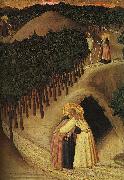
Stefano di Giovanni, known as il Sassetta, (Siena 1392 ?C 1450 or 1451) was an Italian painter. He was born in Siena, although there is also an hypothesis that he was born in Cortona. However, the first historical record of him was in Siena in 1423. Di Giovanni was probably the apprentice of Paolo di Giovanni Fei although it is also thought that he may have studied under Benedetto di Bindo. He painted in the semi-archaic Sienese School style of painting. Francesco di Giorgio e di Lorenzo, better known as Vecchietta, is said to have been his apprentice.
|
|
 |
Stefano della Bella
|
|
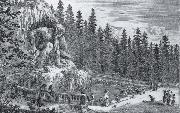
Italian Baroque Era Printmaker, 1610-1664,was an Italian printmaker known for etchings of many subjects, including military ones. He was born at Florence, and apprenticed initially to a goldsmith, but became an engraver working under Orazio Vanni and then Cesare Dandini. He studied etching under Remigio Cantagallina, who had also been the instructor of Jacques Callot, who had lived in Florence 1612-1621, and whose prints imparted a strong influence to printmakers. The patronage of Don Lorenzo de Medici enabled della Bella to study for three years in Rome. In Rome, he created a then admired print of the cavalcade celebrating the entry of the Polish ambassador into Rome in 1633. He also created a number of prints of views of Rome. In 1642 he went to Paris, introduced by the Tuscan ambassador, Alessandro del Nero, and where he resided for seven years. Cardinal Richelieu engaged him to go to Arras and make drawings of the siege and taking of that town by the royal army. After residing a considerable time at Paris he returned to Florence, where he obtained a pension from the grand duke, whose son, Cosimo de Medici, he instructed in drawing. His productions were very numerous, amounting to over 1000 separate pieces. He is known to have illustrated some discoveries for Galileo. See entry for Hansken for his etching of the famous elephant after death. Wikimedia Commons has media related to: Stefano della Bella
|
|
 |
Stefano da Verona
|
|
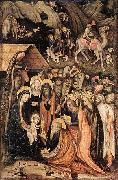
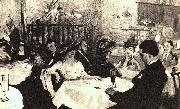
Stefano da Verona. Dating to 1434, it is currently housed in the Pinacoteca di Brera of Milan, northern Italy.
|
|
 |
stefan Dimitrescu
|
|
(January 18, 1886 - May 22, 1933) was a Romanian Post-impressionist painter and draftsman.
Born in Huşi into a modest family, he completed his primary and secondary studies in his hometown. In 1902, deciding to follow his passion for music, he left for Iaşi, where he took cello classes at the Iaşi Conservatory.
In summer of 1903, Dimitrescu entered the National School of Fine Arts in the city, studying in the same class as Nicolae Tonitza; the two studied under Gheorghe Popovici and Emanoil Bardasare. After graduation, Dimitrescu painted murals for the Orthodox churches in Agăş and Asău (Bacău County).
|
|
|
|
|
|
 |
Sir Frank Dicksee
|
|
1853-1928
English
Sir Frank Dicksee Location
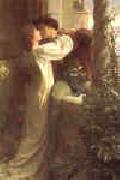
English painter and illustrator. He studied in the studio of his father, Thomas Francis Dicksee (1819-95), who painted portraits and historical genre scenes; he then entered the Royal Academy Schools, London, where he was granted a studentship in 1871. He won a silver medal for drawing from the Antique in 1872 and a gold medal in 1875 for his painting Elijah confronting Ahab and Jezebel in Naboth Vineyard (untraced), with which he made his debut at the Royal Academy in 1876. He also began to work as an illustrator during the 1870s, contributing to Cassell Magazine, Cornhill Magazine, The Graphic and other periodicals. During the 1880s he was commissioned by Cassell & Co. to illustrate their editions of Longfellow Evangeline (1882), Shakespeare Othello (1890) and Romeo and Juliet (1884).
|
|
 |
Sir Francis Drake
|
|
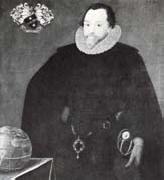
1540-1596,English admiral, the most renowned seaman of the Elizabethan Age. Brought up by his wealthy Hawkins relatives (see John Hawkins) in Plymouth, Drake went to sea at about age 18. He gained a reputation as an outstanding navigator and became wealthy by raiding and plundering Spanish colonies. In 1577 he set sail with five ships, but ultimately only his flagship, the Golden Hind, made its way through the Strait of Magellan into the Pacific and up the coast of South and North America. He sailed at least as far north as what is now San Francisco, claiming the area for Elizabeth, and continued westward to the Philippines and around the Cape of Good Hope. Having circumnavigated the globe, he returned to Plymouth, Eng., in 1580 laden with treasure, the first captain ever to sail his own ship around the world. In 1581 he was knighted. Appointed vice admiral (1588), he destroyed ships and supplies destined for the Spanish Armada and delayed the Spanish attack for a year. But he is not known to have played any part in the battle that eventually occurred. In his lifetime, his reputation at home was equivocal, yet his legend grew. On his last voyage he succumbed to fever and was buried at sea.
|
|
 |
Sir David Wilkie
|
|
1785-1841
British Sir David Wilkie Galleries
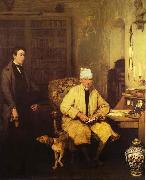
Wilkie may have inherited his rectitude and tenacity, even his nervous inhibitions, from his father, the minister of his native parish. Though little responsive to schooling, he showed an early inclination towards mimicry that expressed itself in drawings, chiefly of human activity. In these he was influenced by a copy of Allan Ramsay pastoral comedy in verse, the Gentle Shepherd (1725), illustrated by David Allan in 1788. One of the few surviving examples of his early drawings represents a scene from it (c. 1797; Kirkcaldy, Fife, Mus. A.G.). Wilkie cherished the demotic spirit of this book and its illustrations throughout his life.
|
|
|
|
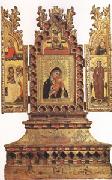 |
Simone Dei Crocefissi
|
|
Fourteenth century
Fourteenth century.Italian painter. He was the son of a Bolognese cobbler and was almost certainly the pupil of Jacopo di Scannabecchi di Dalmasio, who married his sister in 1350. Simone was already a master painter when first recorded in 1355, probably living opposite S Domenico, Bologna,
|
|
|
|
|
|
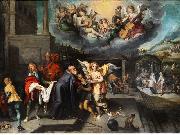 |
Simon de Vos
|
|
Simon de Vos (Antwerp, 20 October 1603-15 October 1676, Antwerp) was a Flemish Baroque painter of genre and cabinet pictures.
De Vos studied with Cornelis de Vos (1603-76), to whom he is not related, from 1615 until 1620. In 1620 he joined Antwerp's guild of St. Luke, and then he probably travelled to Rome where he came under the influence of the "low-life" genre paintings of the Bentvueghels and the bambocciate. A Caravaggesque influence, by way of the German painter Johann Liss active in Italy during the 1620s is discernible in De Vos's paintings from this time on. In contrast to the earlier "low-life" paintings, works from the late 1620s until around 1640, which were made after returning to Antwerp, are mostly small "merry company" and courtly genre scenes reminiscent of contemporary Dutch painters Dirck Hals and Pieter Codde. After 1640, De Vos turned away from genre scenes altogether and painted mostly small cabinet paintings of history subjects, influenced stylistically at first by Peter Paul Rubens and then increasingly by Anthony van Dyck. Examples include The Beheading of St. Paul (1648) in the Royal Museum of Fine Arts, Antwerp.
He married Catharina van Utrecht, the sister of Adriaen van Utrecht, in 1628.
|
|
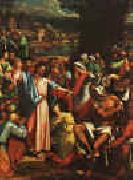 |
Sebastiano del Piombo
|
|
1485-1547 Italian Sebastiano del Piombo Galleries
Italian painter. He was one of the most important artists in Italy in the first half of the 16th century, active in Venice and Rome. His early, Venetian, paintings are reminiscent of Giovanni Bellini and to a lesser extent of Giorgione. With his move to Rome in 1511 he came under the influence of Raphael and then of Michelangelo, who supplied him with drawings. After the death of Raphael (1520) he was the leading painter working in Rome and was particularly noted as a portrait painter. In his finest works, such as the Piete (1513; Viterbo, Mus. Civ.) and the Flagellation (1516-24; Rome, S Pietro in Montorio), there is a remarkable fusion of the Venetian use of colour and the grand manner of central Italian classicism.
|
|
|
|
|
|
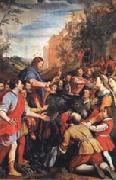 |
Santi Di Tito
|
|
Italian Painter and Architect, 1536-ca.1602
was an Italian painter of Late-Mannerist or proto-Baroque style, what is sometimes referred to as Contra-Maniera. Born in Borgo San Sepolcro, in Tuscany. There is little documentation to support the alleged training under Bronzino or Baccio Bandinelli. From 1558-1564, he worked in Rome on frescoes in Palazzo Salviati and the Sala Grande of the Belvedere (Homage of the People) alongside Giovanni de' Vecchi and Niccol?? Circignani. He acquired a classical trait, described as Raphaelesque by S.J. Freedburg. This style contrasted with the reigning ornate Roman painterliness of the Federico and Taddeo Zuccari or their Florentine equivalents: Vasari, Alessandro Allori, and Bronzino. Among his pupils was Cigoli. Another pupil named Francesco Mochi became a sculptor in the Baroque style, creating among other pieces, the colossal Saint Veronica', supervised by Gianlorenzo Bernini and placed in the crossing of St. Peter's Basilica in Rome. After returning to Florence in 1564, He joined the Accademia del Disegno, and he did not venture to paint outside of Tuscany. He contributed two unusual paintings for the Duke's study and laboratory, the Studiolo of Francesco I in the Palazzo Vecchio. This artistic project was partly overseen by Giorgio Vasari. These paintings are (the Sisters of Fetonte and Hercules and Iole).
|
|
|
|
|
|
 |
Samuel De Wilde
|
|
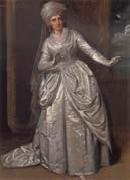
British 1748-1832,English painter and etcher of Dutch descent. He was the son of a Dutch joiner who had settled in London by 1748. On 19 November 1765 he was apprenticed for seven years to his godfather, Samuel Haworth, a joiner in London. However, he left after five years and enrolled as a student at the Royal Academy Schools in 1769. He exhibited small portraits at the Society of Artists (1776-8) and at the Royal Academy (from 1778), where he also showed fancy pictures of banditti in the style of Philippe Jacques de Loutherbourg. But the genre that he made very much his own was theatrical portraiture: he exhibited theatrical portraits at the Royal Academy almost every year from 1792 to 1821.
|
|
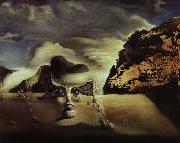 |
salvadore dali
|
|
Born: 11 May 1904
Birthplace: Figueres, Spain
Died: 23 January 1989 (Heart failure)
Best Known As: Surrealist artist with the curly mustache
|
|
 |
Salomon de Caus
|
|
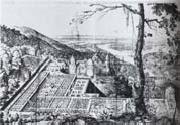
b France, 1576; bur Paris, 28 Feb 1626,He was a Huguenot from the Dieppe region (Normandy). Between c. 1595 and 1598 he visited Italy, where he was strongly influenced by the gardens laid out c. 1570 by Bernardo Buontalenti at Pratolino, near Florence, and by their mechanical artifices. De Caus's work also reveals a knowledge of the gardens of the Villa d'Este in Tivoli. From c. 1598 to 1610 he was in Brussels, in the service of the Stadholder of the Netherlands, Albert, Archduke of Austria. There he was the engineer responsible for wells, fountains and the automatic works in the two grottoes (destr. 1768) in the garden of the Stadholder's residence. From 1610 he lived in England, moving in the artistic circle of Henry, Prince of Wales, to whom he taught drawing and for whom he built a picture gallery at Richmond. Together with Constantino de' Servi (1554-1622) he was engineer and supervisor of the waterworks at Richmond Palace. De Caus dedicated his first book, La Perspective (1612), to Prince Henry and included garden designs for the Prince in his second book, Les Raisons des forces movvantes (1615). He worked at several sites in England, including Somerset House in London, where he is thought to have erected a Parnassus, and at Greenwich Palace, Hatfield House and Gorhambury House (Herts) and Wilton House (Wilts). Nothing has survived of his work of this period.
|
|
 |
Salomon de Bray
|
|
(Amsterdam, 1597 - Haarlem, 11 May 1664) was a Dutch Golden Age architect and painter.
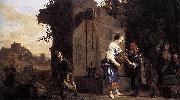
De Bray established himself in Haarlem before 1617, where he is registered as being a member of the schutterij that year in the St. Adrian's cloveniers.[1] He probably followed draftsmanship and painting lessons in the small academy started by Karel van Mander, Hendrick Goltzius and Cornelis van Haarlem, and where he married in 1625. He is registered as a pupil of Goltzius and Cornelis van Haarlem, but he probably started his training in Amsterdam with Jan Pynas, Nicolaes Moeyaert and Pieter Lastman.He painted history paintings, portraits and landscapes. As a Catholic he probably also made altar pieces for the Haarlem underground Catholic churches known as mission stations, or staties. He was a member of the Chamber of rhetoric called "De Wijngaertranken". This is probably how he met his wife Anna, the sister of the painter Jan and the poet Jacob Westerbaen. They married in 1625 and in 1630 he became a member of the Haarlem Guild of St. Luke. He cooperated with fellow Haarlem lukasguild member Jacob van Campen in the decoration of Huis ten Bosch in The Hague. His works draw on the spirit of the Dutch classicism beginning at that time, and are comparable with those of Pieter de Grebber.
Transcription of Salomon de Bray's proposed hierarchy of the guild in 1631. The Haarlem archivist C.J. Gonnet published a book in 1877 on the Haarlem St. Lukasgilde archives. This was meant for historians wishing to do research on Haarlem painting, but who could not read the old handwriting.De Bray was also active as a designer of silverwork, as a poet, as an architect and as a town planner for the city council of Haarlem. He designed an ambitious plan to expand the city on the North side that was partially implemented in the decades after his death. He became headman of the Guild of St. Luke and even prepared a new charter for the guild (that was never ratified) in 1631. As an architect, he was involved in the construction or expansion of Haarlem's City Hall, Zijlpoort, and St. Annakerk (Church of St. Anne), and Nijmegen's city orphanage. One of his poems was set to music by his friend the composer Cornelis Padbru??.
Salomon de Bray was the father of ten children, of whom three (Dirck de Bray, Jan de Bray, and Joseph de Bray) became notable artists. He probably died of the plague that hit Haarlem in 1664, as he and his children Jacob, Josef, Juliana and Margaretha all died in April and May of that year. His wife had already died the previous year. He was buried in the Sint-Bavokerk in Haarlem.
In 1631 Salomon de Bray wrote "Architectura Moderna" which provided a biography and descriptions of buildings built by Hendrick de Keyser, one of the key Dutch architects of the period
|
|
 |
Rogier van der Weyden
|
|
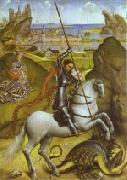
Rogier van der Weyden 1399/1400 - 1464 was the most important representative of Netherlandish painting or Northern Renaissance ... is, with Jan van Eyck, considered one of the greatest exponents of the school of Early Netherlandish painting. Rogier van der Weyden was born in Tournai as 'Rogier de le Pasture' (Roger of the Pasture) in 1399 or 1400. His parents were Henri de le Pasture and Agnes de Watr??los. The family had settled before in the city of Tournai where Rogiers father worked as a 'maître-coutelier' (knife manufacturer). In 1426 Rogier married Elisabeth, the daughter of the Brussels shoemaker Jan Goffaert and his wife Cathelyne van Stockem. Rogier and Elisabeth had four children: Cornelius, who became a Carthusian monk, was born in 1427, a daughter Margaretha in 1432. Before 21 October 1435 the family settled in Brussels where the two younger children were born: Pieter in 1437 and Jan the next year. From the second of March 1436 onwards held the title of 'painter to the town of Brussels' (stadsschilder) a very prestigious post because Brussels was at that time the most important residence of the splendid court of the Dukes of Burgundy. It was at the occasion of his move to the Dutch-speaking town of Brussels that Rogier began using the Dutch version of his name: 'Rogier van der Weyden'Little is known about Rogier's training as a painter. The archival sources from Tournai (completely destroyed during World War II, but luckily partly transcribed in the 19th and early 20th century) are somewhat confusing and have led to different interpretations by scholars. From a document it is known that the city council of Tournai offered wine in honour of a certain 'Maistre Rogier de le Pasture' on March the 17th 1427. However, on the 5th of March of the following year the records of the painters' guild show a certain 'Rogelet de le Pasture' entered the workshop of Robert Campin together with Jacques Daret. Only five years later, on the first of August 1432, Rogier de le Pasture obtains the title of 'Master' (Maistre) as a painter.[1] Many have doubted whether Campin's apprentice 'Rogelet' was the same as the master 'Rogier' that was offered the wine back in 1426. The fact that in 1426-1427 Rogier was a married man in his late twenties, and well over the normal age of apprenticeship has been used as an argument to consider 'Rogelet' as a younger painter with the same name. In the 1420's however the city of Tournai was in crisis and as a result the guilds were not functioning normally. The late apprenticeship of Rogier/Rogelet may have been a legal formality. Also Jacques Daret was then in his twenties and had been living and working in Campin's household for at least a decade. It is possible that Rogier obtained an academic title (Master) before he became a painter and that he was awarded the wine of honour on the occasion of his graduation. The sophisticated and 'learned' iconographical and compositional qualities of the paintings attributed to him are sometimes used as an argument in favour of this supposition. The social and intellectual status of Rogier in his later life surpassed that of a mere craftsman at that time. In general the close stylistical link between the documented works of Jacques Daret, and the paintings attributed to Robert Campin and Rogier van der Weyden is considered as the main argument to consider Rogier van der Weyden as a pupil of Robert Campin. The last mention of Rogier de la Pasture in the financial records of Tournai, on October 21, 1435, lists him as demeurrant ?? Brouxielles ('living in Brussels'). At the same time, the first mention of Rogier de Weyden is made as the official painter of Brussels. Therefore Rogier de la Pasture and Rogier Van der Weyden are thought to be one and the same painter. The post of city painter was created especially for Van der Weyden and was meant to lapse on his death. It was linked to a huge commission to paint four justice scenes for the 'Golden Chamber' of Brussels City Hall.[2] Different properties and investments are documented and witness his material prosperity. The portraits he painted of the Burgundian Dukes, their relatives and courtiers, demonstrate a close relationship with the elite of the Netherlands. The Miraflores Altarpiece was probably commissioned by King Juan II of Castile, since Juan II donated it to the monastery of Miraflores in 1445.
|
|
 |
Roger Van Der Weyden
|
|
c.1399-1464
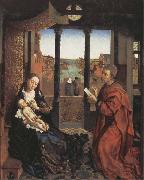
Rogier van der Weyden was the son of Henri de le Pasture, a cutler in Tournai, and Agn?s de Watreloz. His birthdate is estimated from the facts that he was stated to be 35 in April 1435 and 43 in September 1441. Before or in 1427 he married Elisabeth Goffaert (c. 1405-77), whose father was a prosperous shoemaker in Brussels. Rogier may have lived for a time in Brussels: his eldest child Cornelis (b 1427) was sometimes referred to as 'de Bruxella' but was not necessarily a native of Brussels. On 5 March 1427 'Rogelet de le Pasture, natif de Tournai' was apprenticed to the Tournai painter Robert Campin. This Rogelet duly completed his apprenticeship in 1431 and on 1 August 1432 became a master of the Tournai guild. Despite much debate, it would appear that Rogelet was Rogier van der Weyden, though it has also been argued that in 1427 Rogier was a married man well past the normal age of apprenticeship and that Rogelet must have been a second Tournai painter of the same name. JACQUES DARET, however, was in his twenties when in 1428 he was apprenticed to Campin, and other instances can be cited of married apprentices. The political situation at Tournai in 1427-8 was unusual, and the guild system was not functioning normally.
|
|
 |
Rodrigo de Villandrando
|
|
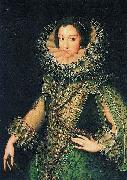
Rodrigo de Villandrando (1588 - December 1623) was a court painter during the reign of Philip III of Spain. He worked in the tradition of Alonso Senchez Coello and Juan Pantoja de la Cruz. His death opened the road to court for the young painter Diego Velezquez from Sevilla.
|
|
 |
Robert Scott Duncanson
|
|
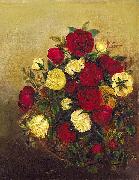
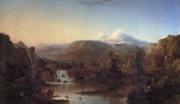
(1821 - December 21, 1872) was born in Seneca County, New York in 1821.Duncansones father was a Canadian of Scottish descent and his mother was an African American, thus making him ea freeborn person of color.e Duncanson, an artist who is relatively unknown today, painted America, both physically and figuratively, at a time when the country was in turmoil. Beautiful and serene, Duncansones work sheds light on American art that has been forgotten over the years.
|
|
 |
Robert S.Duncanson
|
|
American artist .
1821-1872
A self-taught mulatto artist and a landscape painter of the Hudson River school tradition, Duncanson was the first Afro-American artist to receive international recognition. Born into a family of painters and handymen, Duncanson first worked as a house-painter and glazier in Monroe, MI. By 1841 he was in Cincinnati, OH, where he learnt to paint by executing portraits and copying prints. Throughout the 1840s he travelled as an itinerant artist between Cincinnati, Monroe and Detroit.
|
|
 |
Robert Dowling
|
|
Australian Painter, 1827-1886
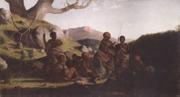
was an Australian colonial artist. Dowling was born in England the youngest son of Rev. Henry Dowling and his wife Elizabeth, nee Darke. He was brought to Launceston, Tasmania with his parents in 1839 in the Janet. He received lessons from Thomas Bock and Frederick Strange, and in 1850 advertised as a portrait painter. In 1856 Dowling left for London partly with the help of friends in Launceston. He exhibited 16 pictures at the Royal Academy between 1859 and 1882 and others at the British Institute. Returning to Launceston he afterwards came to Melbourne and painted portraits of Sir Henry Loch, Dr James Moorhouse, Francis Ormond, and others. He went to London again in 1886 but died shortly after his arrival. Dowling was a conscientious painter of figure subjects, often scriptural or eastern.
|
|
 |
Robert Dodd
|
|
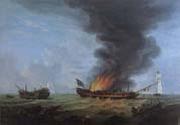
English Painter, 1748-1816, English painter and engraver. He exhibited at the Society of Arts from 1780 and at the Royal Academy, London, from 1782 to 1809. He had gained some reputation as a landscape artist by 1771 but soon concentrated on marine scenes. He became a ship portraitist and above all a prolific recorder of naval actions in the American and French Revolutionary wars such as the Sinking of the 'Vengeur de Peuple' at the Battle of the Glorious First of June, 1794 (1795; London, N. Mar. Mus.). He was also praised for his handling of storm scenes, notably a series depicting the loss of the Ramillies in the West Indies hurricane of September 1782 (1783-5; London, N. Mar. Mus.). His work was engraved by others but he also executed over 100 plates himself, mostly in aquatint, including views of the naval dockyards at Chatham, Woolwich and Deptford and also of the Thames at Blackwall and Greenwich, the last-named based on his oil painting of 1792 (London, N. Mar. Mus.).
|
|
 |
robert delaunay
|
|
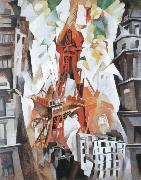
French painter, printmaker and writer. Taking Cubism as one of his points of departure, he first developed a vocabulary of colour planes only distantly dependent on observed motifs, and by the 1930s he had arrived at a purely self-sufficient language of geometric forms. He remained active as a theoretician until the end of his life, leaving a legacy of influential writings on the development of abstract art.
|
|
|
|
 |
Robert Dampier
|
|
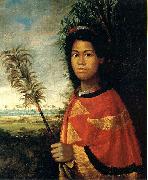
(1799 - 1874) was a British artist and clergyman.
Dampier was born in 1799 at the village of Codford St Peter in Wiltshire, England He was baptised on the 20th of Dec. 1799 (LDS IGI record batch # C014402). He was one of 13 children of Codford St Peter's rector Reverend John Dampier (1763-1839) and his wife Jane. In 1819 he went to Rio de Janeiro in Brazil as a clerk. In 1825, he was picked up in Rio to be the expedition artist on the English ship HMS Blonde under the command of Captain George Anson Byron. The ship was returning the bodies of King Kamehameha II and Queen Kamemalu to the Hawaiian islands (known by the British as "Sandwich Islands"), after both died from measles during a visit to England. Robert Dampier spent 11 weeks in Hawaii painting portraits in oil paint and making pencil drawings of landscapes.
After returning to England, he studied law at Cambridge University and then was ordained in the Church of England. He married Sophia Francis Roberts in 1828. In 1837 he became rector of Langton Matravers church. Circa 1843 they had a daughter Juliana Sophia, His wife Sophia died in 1864, and he married again in 1872. He had a daughter Frederika from the second marriage. Although employed a rector, he continued to sketch until his death in 1874.
Major works by Robert Dampier are held by the Honolulu Academy of Arts and Washington Place, also in Honolulu, Hawaii.
|
|
 |
Ridolfo del Ghirlandaio
|
|
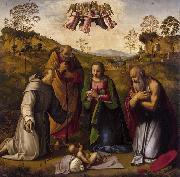
Ridolfo Ghirlandaio (or Ghirlandajo) (14 February 1483 - 6 June 1561) was an Italian painter of the Renaissance, active mainly in Florence, the son of Domenico Ghirlandaio.
He was born in Florence. Being less than eleven years old when his father died, Ridolfo was brought up by his uncle Davide Ghirlandaio, a painter of moderate talents. Vasari states that Ridolfo trained under Fra Bartolomeo.
His works between the dates 1504 and 1508 show a marked influence from Fra Bartolomeo and Raphael, with whom he was friends. From Rome in 1508, Raphael asked Ridolfo to join him; but the Florentine painter stayed. In Florence, he became one of the prominent painters of altarpieces, frescoes, and portraits.
He was prominent in the execution of vast scenic canvases for various public occasions, such as the wedding of Giuliano de' Medici, and the entry of Leo X into Florence in 1515. In his prime he was honest and conscientious as an artist; but from about 1527 he declined, having already accumulated a handsome property, more than sufficient for maintaining in affluence his large family of fifteen children, and his works became comparatively mannered and repetitive. His sons traded in France and in Ferrara; he himself took a part in commercial affairs, and began paying some attention to mosaic work, but it seems that, after completing one mosaic, the Annunciation over the door of the Annunziata Basilica, patience failed him for continuing such minute labours. In his old age Ridolfo was greatly disabled by gout. He appears to have been of a kindly, easy-going character, much regarded by his friends and patrons.
Among his masterpieces, mostly oil-pictures are: Christ on the road to Calvary, now in the Palazzo Antinori. An Annunciation in the Abbey of Montoliveto near Florence, Leonardesque in style. In 1504, he completed the Coronation of the Virgin. He painted a Nativity and a predella in the oratory of the Bigallo, Florence, five panels, representing the Nativity and other subjects. In 1514, on the ceiling of the chapel of St Bernard in the Palazzo Pubblico, Florence, a fresco of the Trinity, with heads of the twelve apostles and other accessories, and the Annunciation; also an Assumption of the Virgin, who bestows her girdle on St Thomas, in the choir loft of Prato cathedral.
|
|
 |
Richard Doyle
|
|
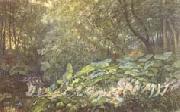
1824-1883
English caricaturist, water colorist, and illustrator. He was the son and pupil of John Doyle, a popular caricaturist. His Journal (British Mus.), a book of sketches done at the age 15, shows his extraordinary precocity. He worked on the staff of Punch (1843?C50),
|
|
|
|
 |
Richard Dadd
|
|
1817-1886
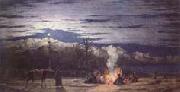
was an English painter of the Victorian era, noted for his depictions of fairies and other supernatural subjects, Orientalist scenes, and enigmatic genre scenes, rendered with obsessively minuscule detail. Most of the works for which he is best known were created while he was incarcerated in a psychiatric hospital. Dadd was born at Chatham, Medway in Kent, England, the son of a chemist. His aptitude for drawing was evident at an early age, leading to his admission to the Royal Academy of Arts at the age of 20. With William Powell Frith, Augustus Egg, Henry O'Neil and others, he founded The Clique, of which he was generally considered the leading talent. In July 1842, Sir Thomas Phillips, the former mayor of Newport, chose Dadd to accompany him as his draftsman on an expedition through Europe to Greece, Turkey, Palestine and finally Egypt. In November of that year they spent a gruelling two weeks in Palestine, passing from Jerusalem to Jordan and returning across the Engaddi wilderness. Toward the end of December, while travelling up the Nile by boat, Dadd underwent a dramatic personality change, becoming delusional and increasingly violent, and believing himself to be under the influence of the Egyptian god Osiris. His condition was initially thought to be sunstroke. On his return in the spring of 1843, he was diagnosed to be of unsound mind and was taken by his family to recuperate in the countryside village of Cobham, Kent. In August of that year, having become convinced that his father was the Devil in disguise, Dadd killed him with a knife and fled for France. En route to Paris Dadd attempted to kill another tourist with a razor, but was overpowered and was arrested by the police. Dadd confessed to the killing of his father and was returned to England, where he was committed to the criminal department of Bethlem psychiatric hospital (also known as Bedlam). Here and subsequently at the newly created Broadmoor, Dadd was cared for (and encouraged to continue painting) by the likes of Drs William Wood and Sir W. Charles Hood, in an enlightened manner. Which condition he suffered from is unclear, but it is usually understood to be a form of paranoid schizophrenia.He appears to have been genetically predisposed to mental illness; two of his siblings were similarly afflicted, while a third had "a private attendant" for unknown reasons.In the hospital he was allowed to continue to paint and it was here that many of his masterpieces were created, including his most celebrated painting, The Fairy Feller's Master-Stroke, which he worked on between 1855 and 1864. Also dating from the 1850s are the thirty-three watercolour drawings titled Sketches to Illustrate the Passions, which include Grief or Sorrow, Love, and Jealousy, as well as Agony-Raving Madness and Murder. Like most of his works these are executed on a small scale and feature protagonists whose eyes are fixed in a peculiar, unfocused stare.
|
|
 |
Richard Dadd
|
|
1817-1886
British
Richard Dadd Location
English painter. He was the fourth of nine children of Robert Dadd, an apothecary and chemist in Chatham. His mother was Mary Ann Martin. Two of his brothers and one sister were, like Dadd himself, to die insane.
|
|
|
|
|
|
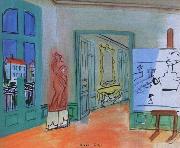 |
raoul dufy
|
|
raoul dufy(1877 to 1953) French painter, printmaker and decorative artist. From the age of 14 he was employed as a book-keeper, but at the same time he developed his innate gift for drawing at evening classes at the Ecole des Beaux-Arts in Le Havre,given by the Neo-classical painter Charles Lhuillier (1824-98). He discovered the work of Eug?ne Boudin, Poussin and Delacroix, whose Justice of Trajan (1840; Rouen, Mus. B.-A.) was 'a revelation and certainly one of the most violent impressions' of his life (Lassaigne, Eng. trans., p. 16). In 1900, with a grant from Le Havre, he joined his friend Othon Friesz in Paris and enrolled at the Ecole Nationale Sup-rieure des Beaux-Arts in the studio of L?on Bonnat. At the Mus?e du Louvre he studied the art of Claude Lorrain, to whom he painted several Homages between 1927 and 1947 (e.g. 1927; Nice, Mus. Mass-na). His encounter with works by van Gogh at the Galerie Bernheim-Jeune and with Impressionism at Durand-Ruel is reflected in such early works as Beach at St Adresse (1904; Paris, Pompidou).
|
|
|
|
|
|
|
|
|
| Wholesale China Oil Painting Wholesale Oil Painting China Xiamen Portrait Reproduction on canvas Chinese Oil Painting Wholesale USA Oil Painting |
|
|
|
|
|