| |
|
Xiamen Oil Paintings, Wholesale Direct!
|
|
100% hand painted, 100% cotton canvas, 100% money back if not satisfaction. |
|
|
|
|
ART WORKS INDEX
A
B
C
D
E
F
G
H
I
J
K
L
M
N
O
P
Q
R
S
T
U
V
W
X
Y
Z
|
|
ARTISTS INDEX
A
B
C
D
E
F
G
H
I
J
K
L
M
N
O
P
Q
R
S
T
U
V
W
X
Y
Z
|
|
|
|
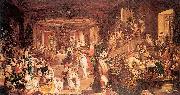 |
Maclise, Daniel
|
|
Irish Painter, 1806-1870
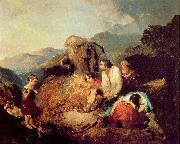
Irish painter, active in England. He grew up in Cork where his father had set up as a shoemaker after discharge from the British army. In 1822 Maclise went to the Cork Institute where he began to draw from the newly arrived collection of casts made after the antique sculpture in the Vatican, laying the foundation of the strong draughtsmanship that characterizes his mature work. Richard Sainthill, antiquary and connoisseur, encouraged Maclise and introduced him to local literary and artistic circles, which were influenced by the Romantic movement and interested in Irish antiquities and oral traditions. Maclise was a central figure in this early phase of the Irish revival, and maintained an interest in Irish subject-matter throughout his career; in 1833 he painted Snap Apple (Mrs Cantor priv. col.), and in 1841 contributed illustrations to Samuel Carter Hall's Ireland: Its Scenery and Character. When Sir Walter Scott visited Cork in 1825, Maclise made a sketch of him that was lithographed, and that inaugurated his public career.
|
|
|
|
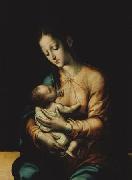 |
Luis de Morales
|
|
(1510 - 9 May 1586) was a Spanish painter born in Badajoz, Extremadura. Known as "El Divino", most of his work was of religious subjects, including many representations of the Madonna and Child and the Passion.
Influenced, especially in his early work, by Raphael Sanzio and the Lombard school of Leonardo, he was called by his contemporaries "The Divine Morales", because of his skill and the shocking realism of his paintings, and because of the spirituality transmitted by all his work.
His work has been divided by critics into two periods, an early stage under the influence of Florentine artists such as Michelangelo and a more intense, more anatomically correct later period similar to German and Flemish renaissance painters
|
|
|
|
|
|
|
|
 |
Ludolf de Jongh
|
|
1616-1679
Dutch
Ludolf de Jongh Galleries
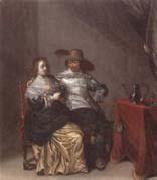
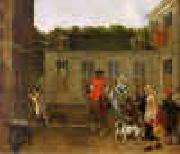
Dutch painter. He was one of the most versatile Dutch painters of the 17th century, producing portraits, genre paintings of both domestic scenes and soldier life, landscapes with hunting scenes and a few historical subjects. According to Houbraken, he studied with Cornelis Saftleven in Rotterdam, Anthonie Palamedesz. in Delft, and Jan van Bijlert in Utrecht. In 1635 he went to France, where he stayed for seven years. His earliest known paintings are portraits and genre subjects that date from after his return to Rotterdam in about 1642 and strongly reflect the style of Palamedesz.'s work. The genre subjects and numerous hunting scenes (e.g. Riders before an Inn; Geneva, Mus. A. & Hist.) painted shortly before the 1650s show the influence of van Bijlert and other Utrecht painters, especially Jacob Duck and Dirck Stoop.
|
|
 |
Lucien Levy-Dhurmer
|
|
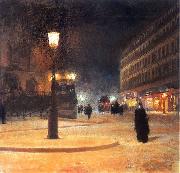
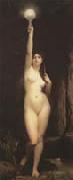
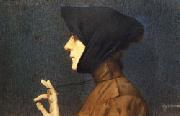
French Art Nouveau Painter, 1865-1953,was a French Symbolist/Art Nouveau painter and potter. He was born Lucien Levy to a Jewish family in Algiers. In 1879 he began studying drawing and sculpture in Paris. In 1887 Levy began making his living in southern France, overseeing the decoration of ceramics. His own tastes in pottery decoration were influenced by Islamic Art. In 1895 he left for Paris to begin a career in painting; around this time he visited Italy and was further influenced by art of the Renaissance. In 1896 he exhibited his first pastels and paintings under the name Lucien Levy-Dhurmer; he'd added the last two syllables of his mother's maiden name (Goldhurmer), likely to differentiate himself from other people named Levy. His paintings soon became popular with the public and among fellow artists as well. He earned high praise for the academic attention to detail with which he captured figures lost in a Pre-Raphaelite haze of melancholy, contrasted with bright Impressionist colouration. His portrait of writer Georges Rodenbach is perhaps the most striking example of this strange and extraordinary synergy.
|
|
 |
Lucas de Heere
|
|
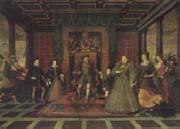
1534-1584,Painter, tapestry designer, draughtsman and poet. He was probably trained by his parents. The suggestion that he became a member of the Ghent Guild of St Luke before 1540 was derived from an incorrect interpretation of the Guild records for 1574-5. Van Mander recorded that, as a boy, de Heere accompanied his father on his trips to the stone-quarries of the Meuse region, where he made topographical drawings. Lucas was sent to Frans Floris's studio c. 1555 or shortly before to complete his training, and he may have collaborated with his master on tapestry cartoons and stained-glass designs, although no cartoons or preparatory drawings survive. During this period de Heere also became noted as a poet in the local rhetoricians' chambers. His father's influence helped him to gain commissions in Ghent from 1555, and, according to Marcus van Vaernewijck (1568), he worked on new stained-glass windows for the St Janskerk in Ghent in the same year.
|
|
|
|
 |
Louis-Edouard Dubufe
|
|
1819-1883 French
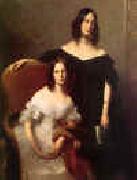
Son of Claude-Marie Dubufe. He was trained by his father and then by Paul Delaroche. He first appeared at the Salon in 1839 with the Annunciation, a Huntress and a portrait, winning a third class medal. He followed this in 1840 with an episode in the life of St Elisabeth of Hungary, which won him a second class medal; in 1844 he won a first class medal with Bathsheba and a genre scene set in the 15th century (all untraced).
|
|
|
|
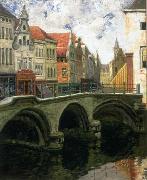 |
Louis Dewis
|
|
(1872-1946) was a Belgian Post-Impressionist painter, who lived most of his adult life in France.
Dewis was born Isidore Louis Dewachter in Mons, Belgium, the son of Isidore Louis Dewachter and Eloise Desmaret Dewachter. He spent his formative years in Liege where his closest boyhood friend was Richard Heintz (fr:Richard Heintz) (1871-1929), who also became an internationally known landscape artist.
Although the name "Dewachter" may have Flemish roots, Dewachter always considered himself a Walloon.
|
|
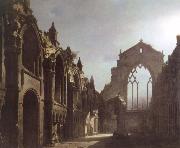 |
louis daguerre
|
|
Louis-Jacques-Mand?? Daguerre (November 18, 1787 ?C July 10, 1851) was a French artist and chemist, recognized for his invention of the daguerreotype process of photography.
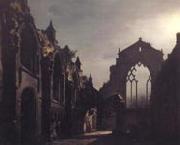
Daguerre was born in Cormeilles-en-Parisis, Val-d'Oise, France. He apprenticed in architecture, theater design, and panoramic painting. Exceedingly adept at his skill for theatrical illusion, he became a celebrated designer for the theater and later came to invent the Diorama, which opened in Paris in July 1822.
In 1827, Joseph Nic??phore Ni??pce produced the world's first permanent photograph (known as a Heliograph). Daguerre partnered with Ni??pce two years later, beginning a four-year cooperation. Ni??pce died suddenly in 1833. The main reason for the "partnership", as far as Daguerre was concerned, was connected to his already famous dioramas. Niepce was a printer and his process was based on a faster way to produce printing plates. Daguerre thought that the process developed by Niepce could help speed up his diorama creation.
Daguerre announced the latest perfection of the Daguerreotype, after years of experimentation, in 1839, with the French Academy of Sciences announcing the process on January 7 of that year. Daguerre's patent was acquired by the French Government, and, on August 19, 1839, the French Government announced the invention was a gift "Free to the World."
Daguerre and Ni??pce's son obtained a pension from the Government in exchange for freely sharing the details of the process. Daguerre died in Bry-sur-Marne, 12 km from Paris. A monument marks his grave there.
|
|
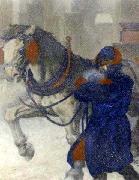 |
Louis D. Fancher
|
|
December 25, 1884-March 2, 1944) was an American artist and illustrator, notable for his drawings that appeared in books, in magazines, and on propaganda posters during World War.
Fancher was born in Minneapolis, Minnesota in 1884 and was a student of Henry Siddons Mowbray, Robert Henri, and Kenyon Cox. He was active in San Francisco as well as in New York, where he lived most of his life.
|
|
|
|
|
|
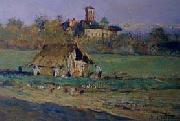 |
Lorenzo Delleani
|
|
(Pollone (Biella), 1840 - Turin, 1908) was an Italian painter.
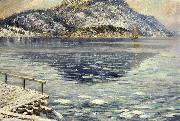
A pupil of Cesare Gamba and Carlo Arienti at the Albertina Academy in Turin, Delleani worked initially in the field of history painting and received various marks of official recognition. He exhibited work at the Paris Salon of 1874 and gradually modernised his means of expression and range of subjects at the end of the decade with a new focus on landscape and painting from life. The early 1880s saw an exclusive focus on painting en plein air, capturing light in thick strokes of colour. His most frequent subjects were views of the Piedmontese and Lombard countryside in changing conditions of light and season. The artistes presentation of some 40 works at the Venice Biennale in 1905 and participation in the International Exhibition in Munich of the same year set the seal on his international success.
|
|
 |
lorens pasch d.y
|
|
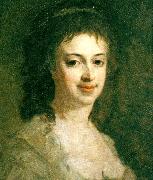
Lorens Pasch d.y., född 1733, död 1805, konstnär; professor vid Konstakademien från 1773. Son till Lorens Pasch d.ä., bror till Ulrika Pasch, brorsson till Johan Pasch. Invald tillsammans med sin syster i Konstakademien 1773.
|
|
 |
lorens pasch d. y
|
|
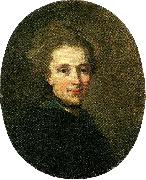
Lorens Pasch d.y., född 1733, död 1805, konstnär; professor vid Konstakademien från 1773. Son till Lorens Pasch d.ä., bror till Ulrika Pasch, brorsson till Johan Pasch. Invald tillsammans med sin syster i Konstakademien 1773.
|
|
 |
Lodewijk de Vadder
|
|
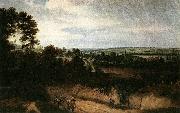
Lodewijk de Vadder (1605, Grimbergen - 1655, Brussels) was a Flemish Baroque landscape painter and engraver.
He became a master of Antwerp's Guild of St. Luke in 1628, and learned painting from his father and brothers. He specialized in landscapes with woods, in the manner of his contemporary Jacques d'Arthois and his pupil Lucas Achtschellinck[1]. They are usually referred to collectively as "The Sonian Forest Painters".
|
|
|
|
|
|
|
|
 |
Levitsky, Dmitry
|
|
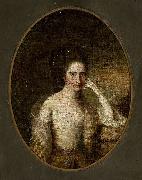
Russian Painter, 1735-1822
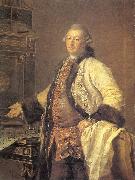
.Russian painter of Ukrainian birth. Together with Fyodor Rokotov and Vladimir Borovikovsky, he ranks foremost among 18th-century Russian portrait painters. He received his first lessons in painting from his father, Grigory Levitsky-Nos (1697-1769), a priest, engraver and painter. He also studied under Aleksey Antropov, who had come to Kiev to decorate St Andrew's church (1752-5). In the late 1750s Levitsky went with Antropov to St Petersburg, where he stayed until 1764; he continued with lessons from Antropov to whom, it appears, he owed the objectivity that was to characterize his work. It is probable that he also studied at the St Petersburg Academy of Arts, attending classes under Louis Lagren?e. Levitsky worked with Antropov on the decoration of triumphal arches in Moscow for Catherine II's coronation in 1762. His first known portraits are rather formal, for example that of the architect Aleksandr Kokorinov (1769; St Petersburg, Rus. Mus.), which won Levitsky the title of Academician in 1770. In such works he made successful use of a compositional structure typical of formal European portrait painting, intended to emphasize the importance of the sitter.
|
|
 |
Leonor de Almeida Portugal
|
|
Leonor de Almeida Portugal de Lorena e Lencastre (Lisboa, 31 de outubro de 1750 - Benfica, 11 de outubro de 1839) foi uma nobre e poetisa portuguesa.
|
|
 |
LEONARDO da Vinci
|
|
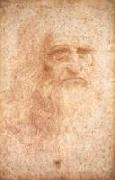
Italian High Renaissance Painter and Inventor, 1452-1519
Italian High Renaissance Painter and Inventor, 1452-1519 Florentine Renaissance man, genius, artist in all media, architect, military engineer. Possibly the most brilliantly creative man in European history, he advertised himself, first of all, as a military engineer. In a famous letter dated about 1481 to Ludovico Sforza, of which a copy survives in the Codice Atlantico in Milan, Leonardo asks for employment in that capacity. He had plans for bridges, very light and strong, and plans for destroying those of the enemy. He knew how to cut off water to besieged fortifications, and how to construct bridges, mantlets, scaling ladders, and other instruments. He designed cannon, very convenient and easy of transport, designed to fire small stones, almost in the manner of hail??grape- or case-shot (see ammunition, artillery). He offered cannon of very beautiful and useful shapes, quite different from those in common use and, where it is not possible to employ cannon ?? catapults, mangonels and trabocchi and other engines of wonderful efficacy not in general use. And he said he made armoured cars, safe and unassailable, which will enter the serried ranks of the enemy with their artillery ?? and behind them the infantry will be able to follow quite unharmed, and without any opposition. He also offered to design ships which can resist the fire of all the heaviest cannon, and powder and smoke. The large number of surviving drawings and notes on military art show that Leonardo claims were not without foundation, although most date from after the Sforza letter. Most of the drawings, including giant crossbows (see bows), appear to be improvements on existing machines rather than new inventions. One exception is the drawing of a tank dating from 1485-8 now in the British Museum??a flattened cone, propelled from inside by crankshafts, firing guns. Another design in the British Museum, for a machine with scythes revolving in the horizontal plane, dismembering bodies as it goes, is gruesomely fanciful. Most of the other drawings are in the Codice Atlantico in Milan but some are in the Royal Libraries at Windsor and Turin, in Venice, or the Louvre and the École des Beaux Arts in Paris. Two ingenious machines for continuously firing arrows, machine-gun style, powered by a treadmill are shown in the Codice Atlantico. A number of other sketches of bridges, water pumps, and canals could be for military or civil purposes: dual use technology. Leonardo lived at a time when the first artillery fortifications were appearing and the Codice Atlantico contains sketches of ingenious fortifications combining bastions, round towers, and truncated cones. Models constructed from the drawings and photographed in Calvi works reveal forts which would have looked strikingly modern in the 19th century, and might even feature in science fiction films today. On 18 August 1502 Cesare Borgia appointed Leonardo as his Military Engineer General, although no known building by Leonardo exists. Leonardo was also fascinated by flight. Thirteen pages with drawings for man-powered aeroplanes survive and there is one design for a helicoidal helicopter. Leonardo later realized the inadequacy of the power a man could generate and turned his attention to aerofoils. Had his enormous abilities been concentrated on one thing, he might have invented the modern glider.
|
|
 |
Leonardo Da Vinci
|
|
Italian High Renaissance Painter and Inventor, 1452-1519
Florentine Renaissance man, genius, artist in all media, architect, military engineer. Possibly the most brilliantly creative man in European history, he advertised himself, first of all, as a military engineer. In a famous letter dated about 1481 to Ludovico Sforza, of which a copy survives in the Codice Atlantico in Milan, Leonardo asks for employment in that capacity. He had plans for bridges, very light and strong, and plans for destroying those of the enemy. He knew how to cut off water to besieged fortifications, and how to construct bridges, mantlets, scaling ladders, and other instruments. He designed cannon, very convenient and easy of transport, designed to fire small stones, almost in the manner of hail??grape- or case-shot (see ammunition, artillery). He offered cannon of very beautiful and useful shapes, quite different from those in common use and, where it is not possible to employ cannon ?? catapults, mangonels and trabocchi and other engines of wonderful efficacy not in general use. And he said he made armoured cars, safe and unassailable, which will enter the serried ranks of the enemy with their artillery ?? and behind them the infantry will be able to follow quite unharmed, and without any opposition. He also offered to design ships which can resist the fire of all the heaviest cannon, and powder and smoke.
The large number of surviving drawings and notes on military art show that Leonardo claims were not without foundation, although most date from after the Sforza letter. Most of the drawings, including giant crossbows (see bows), appear to be improvements on existing machines rather than new inventions. One exception is the drawing of a tank dating from 1485-8 now in the British Museum??a flattened cone, propelled from inside by crankshafts, firing guns. Another design in the British Museum, for a machine with scythes revolving in the horizontal plane, dismembering bodies as it goes, is gruesomely fanciful.
Most of the other drawings are in the Codice Atlantico in Milan but some are in the Royal Libraries at Windsor and Turin, in Venice, or the Louvre and the École des Beaux Arts in Paris. Two ingenious machines for continuously firing arrows, machine-gun style, powered by a treadmill are shown in the Codice Atlantico. A number of other sketches of bridges, water pumps, and canals could be for military or civil purposes: dual use technology.
Leonardo lived at a time when the first artillery fortifications were appearing and the Codice Atlantico contains sketches of ingenious fortifications combining bastions, round towers, and truncated cones. Models constructed from the drawings and photographed in Calvi works reveal forts which would have looked strikingly modern in the 19th century, and might even feature in science fiction films today. On 18 August 1502 Cesare Borgia appointed Leonardo as his Military Engineer General, although no known building by Leonardo exists.
Leonardo was also fascinated by flight. Thirteen pages with drawings for man-powered aeroplanes survive and there is one design for a helicoidal helicopter. Leonardo later realized the inadequacy of the power a man could generate and turned his attention to aerofoils. Had his enormous abilities been concentrated on one thing, he might have invented the modern glider.
|
|
|
|
 |
LEDESMA, Blas de
|
|
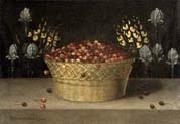
Spanish painter documented 1602-1614 in Granada,Spanish painter. He is known to have worked in Granada from 1602, and in 1614 he designed a stucco vault decoration for the Alhambra. Archival sources testify to his renown as a painter of decorative fresco grotesques (untraced) and still-lifes. His activity as a still-life painter remains debatable, partly because he has been confused with Blas de Prado and also because of Torres Marten's controversial attributions. Ledesma's only unanimously accepted autograph painting is Still-life with Cherries and Flowers (Atlanta, GA, High Mus. A.), signed in Granada. A highly decorative painting, it shows none of the sophistication of still-lifes by Juan Senchez Cot?n, in Granada from 1603. It is painted meticulously and drily. Depicting a severely drawn, rather flat basket on a narrow ledge flanked by flowers behind it, the rigorously symmetrical composition is relieved only by soft lighting and the studied disarray of some fallen cherries. Two other unsigned and poorly preserved still-lifes of analogous subject-matter have been attributed to Ledesma
|
|
 |
le dimanche
|
|
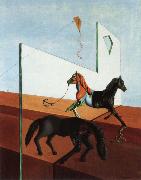
was a Spanish surrealist painter.
Born in San Cristebal de La Laguna on the island of Tenerife, Domenguez spent his youth with his grandmother in Tacoronte and devoted himself to painting at a young age after suffering a serious illness which affected his growth and caused a progressive deformation of his facial bone frame and limbs.
He went to Paris at 21 where he first worked for his father in the central market of Les Halles, and spent his nights drinking in cabarets. He then frequented some art schools, and visited galleries and museums.
Domenguez was rapidly attracted by avant-garde painters, notably Yves Tanguy and Pablo Picasso, whose influences were visible in his first works. At 25 he painted a self-portrait full of premonition as he showed himself with a deformed hand and with the veins of his arm cut. He chose to kill himself 27 years later by cutting his veins.
In 1933 Domenguez met Andre Breton, a theoretician of Surrealism, and Paul Éluard, known as the poet of this movement, and took part a year later in the Surrealist exhibition held in Copenhagen and those of London and Tenerife in 1936.
He took up the Russian-invented technique of decalcomania in 1936, using gouache spread thinly on a sheet of paper or other surface (glass has been used), which is then pressed onto another surface such as a canvas.
|
|
|
|
 |
Laurent de la Hyre
|
|
1606-1656
French Laurent de la Hyre Galleries
He became a pupil of Georges Lallemand and studied the works of Primaticcio at Fontainebleau, but never visited Italy. La Hyre is associated with the transitional period before the introduction of the French Baroque by Simon Vouet.
His picture of Pope Nicholas V opening the crypt in which he discovers the corpse of St. Francis of Assisi standing (located at the Louvre) was executed in 1630 for the Capuchin friars of the Marais; its gravity and sobriety seems to have been influential for the next generation of French painters, particularly Eustache Le Sueur. The Louvre contains eight other works, and paintings by La Hyre are in the museums of Strasburg, Rouen and Le Mans.
Laurent de La Hyre: Perspective (drawing).His drawings, of which the British Museum possesses a fine example, Presentation of the Virgin in the Temple, are treated as seriously as his paintings, and sometimes show simplicity and dignity of effect. The example of the Capuchins, for whom he executed several other works in Paris, Rouen and Fecamp, was followed by the goldsmith's company, for whom he produced in 1635 St. Peter healing the Sick (Louvre) and the Conversion of St Paul in 1637. In 1646, with eleven other artists, he founded the French Royal Academy of Painting and Sculpture.
Richelieu called La Hyre to the Palais Royal; Pierre S??guier, Gedeon Tallemant des R??aux and many others entrusted him with important works of decoration; for the Gobelins he designed a series of large compositions. La Hyre painted also a great number of portraits, and in 1654 united in one work for the town-hall of Paris those of the principal dignitaries of the municipality.
|
|
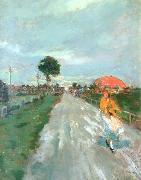 |
Lajos Deak-ebner
|
|
(1850- 1934 ) - Painter
painted On the Road in between 1876(1876) and 1880(1880)
|
|
|
|
 |
Kerstiaen de Keuninck
|
|
1560-1635
Flemish
Kerstiaen de Keuninck Gallery
Flemish painter. Although from Courtrai, from an early age he lived in Antwerp. He was listed in 1577 as one of the recipients of the Poor-box (armenbus) of the Antwerp Guild of St Luke, where he was received as master in 1580. He married in 1585. De Keuninck took on Carel de Ferrara as an apprentice in 1599. His son Kerstiaen de Keuninck the younger (d 1642-3) became a master in 1613. In 1629 Engel Ergo started an apprenticeship with a Kerstiaen de Keuninck: it is not clear whether this refers to father or son.
|
|
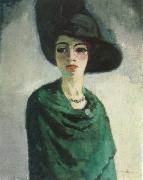 |
kees van dongen
|
|
kees van dongen,(1877 to 1968),French painter and printmaker of Dutch birth. He took evening classes in geometric drawing from 1892 to 1897 at the Akademie voor Beeldende Kunsten in Rotterdam. In 1895 he began working intermittently for the newspaper Rotterdamsche Nieuwsblad, for which he made, among other things, a series of bright watercolour drawings of Rotterdams red-light district and illustrations of Queen Wilhelminas coronation. Van Dongen first paintings used dark tones in imitation of Rembrandt, who remained the most important model for his work; his later book on Rembrandt was, in fact, a projection of his own life. By the mid-1890s he was using more vivid contrasts of black and white, for example in Spotted Chimera (1895; priv. col., see Chaumeil, pl. 1), his palette soon becoming brighter and his line more animated. In Le Muet Windmill (1896; priv. col., see Chaumeil, pl. 7), a red ochre monochrome painting, he successfully enlivened the colour by means of broad, energetic brushstrokes.
|
|
|
|
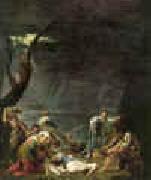 |
Karel Dujardin
|
|
1621-1678
Dutch
Karel Dujardin Locations
Dujardin was born in Amsterdam in 1640. After training with Nicolaes Berchem, he went to Italy when young, and became a member of the Society of Painters at Rome, among whom, he was known as Barba di Becco. In Rome, his works met with general approbation.
According to some sources, on his way back to his native country, he contracted considerable debts at Lyon, to free himself from which, he married his old and rich landlady. He went with her to Amsterdam, where his pictures were valued very highly. He soon secretly left his home in that city, probably from dislike of his wife, and went back to Rome in 1675, where he was welcomed by his old friends and admirers, and lived at great expense. After a vist to Tangier he went to Venice, where he died in 1678.
Most of his paintings are cabinet paintings of Italianate landscapes and or with farm animals and peasants. His landscapes have spirit and harmony, his figures expression, and his colour the brilliancy which distinguishes his school. His paintings are rare and command a high price. He also published fifty-two etchings of simiar subjects, with great spirit and ease.
He painted a single, fine, portrait (probably a self-portrait), and a pair of Baroque religious paintings on the life of St Paul, probably commissioned, as they lie well outside his normal style. One of these, and the portrait, are in the National Gallery, London
|
|
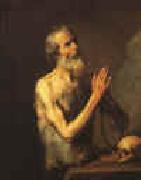 |
Jusepe de Ribera
|
|
1591-1652
Spanish
Jusepe de Ribera Galleries
Jusepe de Ribera (January 12, 1591 - 1652) was a Spanish Tenebrist painter and printmaker, also known as Jos?? de Ribera in Spanish and as Giuseppe Ribera in Italian. He was also called by his contemporaries and early writers Lo Spagnoletto, or "the Little Spaniard". Ribera was a leading painter of the Spanish school, although his mature work was all done in Italy.
In his earlier style, founded sometimes on Caravaggio and sometimes on the wholly diverse method of Correggio, the study of Spanish and Venetian masters can be traced. Along with his massive and predominating shadows, he retained from first to last a great strength in local coloring. His forms, though ordinary and sometimes coarse, are correct; the impression of his works gloomy and startling. He delighted in subjects of horror. In the early 1630s his style changed away from strong contrasts of dark and light to a more diffused and golden lighting. Salvator Rosa and Luca Giordano were his most distinguished followers, who may have been his pupils; others were also Giovanni Do, Enrico Fiammingo, Michelangelo Fracanzani, and Aniello Falcone, who was the first considerable painter of battle-pieces.
Among Ribera's principal works could be named "St Januarius Emerging from the Furnace" in the cathedral of Naples; the "Descent from the Cross" in the Certosa, Naples, the "Adoration of the Shepherds" (a late work, 1650), now in the Louvre; the "Martyrdom of St Bartholomew" in the Prado; and the "Pieta" in the sacristy of San Martino, Naples. His mythologic subjects are often as violent as his martyrdoms: for example, "Apollo and Marsyas", with versions in Brussels and Naples, or the "Tityus" in the Prado . The Prado and Louvre contain numbers of his paintings; the National Gallery, London, three. He executed several fine male portraits and a self-portrait. He was an important etcher, the most significant Spanish printmaker before Goya, producing about forty prints, nearly all in the 1620s.
|
|
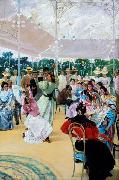 |
Julio Romero de Torres
|
|
was a Spanish painter.
He was born and died in Cerdoba, Spain, where he lived most of his life. His father was the famous painter Rafael Romero Barros and his mother was Rosario de Torres Delgado. Julio learned about art from his father who was the director, curator and founder of Cerdoba's Museo Provincial de Bellas Artes and an impressionist painter. He took an interest in art at a young age and started studying at the School of Fine Arts when he was 10. He went to Madrid to work and study in 1906. He also traveled all over Europe to study and he picked up a symbolist style, for which he is best known. A museum dedicated to the work of de Torres is situated at Plaza del Potro 1 Cordoba 14002.
He spent most of his life living in Cerdoba and Madrid and both places had influences on his paintings. He combined many different styles when he painted because he had many different influences including realism, which was a popular style at that time and impressionism, which he picked up from living in Cerdoba and from his father. While in Cerdoba he became part of the late 19th century intellectual movement that was based on the Royal Academy of Science, Arts and Literature. Julio Romero also won many awards in his lifetime. In 1895 he won an honorable mention at the National Exhibition and later won third place in 1899 and 1904.
El Retablo del Amor by Julio Romero de Torres, painted in 1910.In 1914 he relocates to Madrid, where he makes contact with the intellectual and artistic environment of the time together with his brother Enrique. He became a regular at the cafe Nuevo Levante and his paintings began to reflect the philosophical currents of the times, represented by such writers of the times as Ramen del Valle-Inclen and Ruben Dareo. When the war broke out in 1914 Julio Romero fought for the allies as a pilot
|
|
|
|
 |
julian alden weir
|
|
American Impressionist Painter, 1852-1919
.American painter. He studied with his father Robert Walter Weir, a landscape painter of the Hudson River school, at the National Academy; and with Görôme in Paris. He was one of the earliest American impressionist painters. Subtle gradations of light and tone characterize his work. He was a founder of the Society of American Artists (1877), a member of the National Academy (1886), and its president (1915 C17). When the Ten American Artists formed a separate group (1898), he joined them. His works include Idle Hours, The Green Bodice, and The Red Bridge; a portrait and Autumn ; and Midday Rest in New England.
|
|
|
|
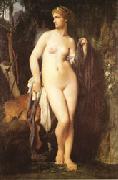 |
Jules Elie Delaunay
|
|
Nantes 1828 - Paris 1891.
French Neoclassical Painter.
Studied under Hippolyte Flandrin.
French Neoclassical Painter. Studied under Hippolyte Flandrin. French painter. He entered the Ecole des Beaux-Arts in Paris on 7 April 1848, where he was a pupil of Joachim Sotta (1810-77), Hippolyte Flandrin and Louis Lamothe (1822-69). He became a disciple of Flandrin, and, though making his debut in the Salon in 1853 with the Saltworkers of Guerande (Nantes, Mus. B.-A.), he soon concentrated on history painting. In 1856 he won the Prix de Rome with the Return of the Young Tobias (Paris, Ecole N. Sup. B.-A.) and left Paris to study at the Academie de France in Rome. His work is imbued with a deep religious sentiment cast in the restrained, controlled style and formal repertoire of Neo-classicism. From early in his career he produced many easel and wall paintings on religious subjects, such as Jesus Healing the Lepers (1850; Le Croisic,). In 1854 he received a commission to produce four fresco decorations for the church of the monastery of the Visitation-Ste-Marie in Nantes, which he completed the following year. In 1865 he returned to the monastery to decorate the chapel of St-Francois de Sales with scenes from that saint's life.
|
|
 |
Juan van der Hamen y Leon
|
|
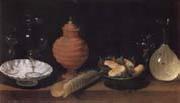
Spanish Baroque Era Painter, 1596-1631, was a Spanish painter, a master of the still life paintings, also called bodegones. During his lifetime, he was prolific and versatile, painting allegories, landscapes, and large-scale works for churches and convents. However, today he is remembered mostly for his still lifes. In the 1620s, He popularized still life painting in Madrid.Juan van der Hamen y (Gemez de) Leen was born in Madrid in 1596 but he was baptized late on April 8, 1596 in Madrid, therefore, he must had been born there just days before that date. He was the son of Jehan van der Hamen, a Flemish courtier, who had moved to Madrid from Brussels before 1586, and Dorotea Whitman Gemez de Leen, a half-Flemish mother of noble Toledan ancestry [1]. Van der Hamen and his two brothers Pedro and Lorenzo (both of whom were writers) emphasized their Spanish roots by using all or part of their maternal grandmother's family name, Gemez de Leen.. The painter's father, Jan van der Hamen, had come to Spain, as an archer, to the court of Philip II were he settled, married, and his children were born. According to 18th-century sources, the artist's father had also been a painter, but there is no evidence for this. Juan van der Hamen inherited his father's honorary positions at court and also served as unsalaried painter of the king. Van der Hamen's artistic activity in the service of the crown is first recorded on 10 September 1619, when he was paid for painting a still-life for the country palace of El Pardo, to the north of Madrid.
|
|
 |
Juan Pantoja de la Cruz
|
|
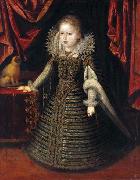
(Valladolid, 1553 - 26 October 1608, Madrid) Spanish painter, one of the best representatives of the Spanish school of court painters. He worked for Philip II and Philip III. The Museo del Prado contains examples of his severe portraiture style.
Juan Pantoja de La Cruz was, born 1553 in Valladolid. Very little is known of his formative years as a painter. He was a pupil of the court painter Alonso Senchez Coello in Madrid and he must have assisted his master in complying with his duties as painter of the Spanish King, Philip II. Pantoja probably continued to work in his master studio after completing his training. He married in 1585 beginning to paint for the court around that time. After Sanchez Coello's death in 1588, Pantoja took over his master workshop and became court painter to Philip II of Spain.
Pantoja kept working for the court and the nobility, painting portraits of Prince Philip, the future Philip III, in 1592 and 1594. Among his most well known works is the portrait of Philip II wearing a cape and hat all in black, painted around 1594 for the Escorial. This portrait is one of the best representations of the idea of Spanish majesty, based on the remoteness of the monarch. On Philip II's death in 1598, Philip III confirmed Pantoja's status as court painter. When the court settled in Valladolid in 1601, Pantoja moved to the new capital, remaining in this city, several years.
|
|
 |
Juan Fernandez de Navarrete
|
|
Spanish painter
1526-1579
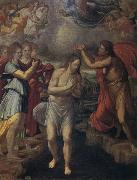
was a Spanish Mannerist painter, born at Logroño. An illness in infancy deprived Navarrete of his hearing, but at a very early age he began to express his wants by sketching objects with a piece of charcoal. He received his first instructions in art from Fray Vicente de Santo Domingo, a Hieronymite monk at Estella, and also with Becerra. He visited Naples, Rome, Florence and Milan. Pellegrino Tibaldi met him in Rome in 1550. According to most accounts he was for a considerable time the pupil and assistant of Titian at Venice. In 1568 Philip II of Spain summoned him to Madrid with the title of king's painter and a salary, and employed him to execute pictures for the Escorial. During the 1560s and 1570s the huge monastery-palace of El Escorial was still under construction and Philip II was experiencing difficulties in finding good artists for the many large paintings required to decorate it. Titian was very old, and died in 1576, and Tintoretto, Veronese and Anthonis Mor all refused to come to Spain. Philip had to rely on the lesser talent of Navarrete, whose gravedad y decoro ("seriousness and decorum") the king approved. For eleven years until his death Navarrete worked largely on El Escorial. The most celebrated of the works he produced there are a "Nativity" (in which, as in the well-known work on the same subject by Correggio, the light emanates from the infant Saviour), a "Baptism of Christ" (now Prado), and "Abraham Receiving the Three Angels" (one of his last works, dated 1576).
|
|
|
|
|
|
|
|
|
|
|
|
|
| Wholesale China Oil Painting Wholesale Oil Painting China Xiamen Portrait Reproduction on canvas Chinese Oil Painting Wholesale USA Oil Painting |
|
|
|
|
|