| |
|
Xiamen Oil Paintings, Wholesale Direct!
|
|
100% hand painted, 100% cotton canvas, 100% money back if not satisfaction. |
|
|
|
|
ART WORKS INDEX
A
B
C
D
E
F
G
H
I
J
K
L
M
N
O
P
Q
R
S
T
U
V
W
X
Y
Z
|
|
ARTISTS INDEX
A
B
C
D
E
F
G
H
I
J
K
L
M
N
O
P
Q
R
S
T
U
V
W
X
Y
Z
|
|
|
|
 |
John Greenhill
|
|
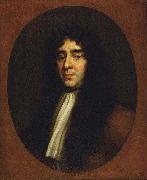
(c. 1644 -19 May 1676) was an English portrait painter, a pupil of Peter Lely, who approached his teacher in artistic excellence, but whose life was cut short by a dissolute lifestyle.
Greenhill was born at Salisbury, Somerset (now Wiltshire) around 1644, the eldest son of John Greenhill, registrar of the diocese of Salisbury, and Penelope Champneys, daughter of Richard Champneys of Orchardleigh, Somerset. His grandfather was Henry Greenhill of Steeple Ashton in Wiltshire. His father was connected through his brothers with the East India trade.
Greenhill's first attempt was a portrait of his paternal uncle, James Abbott of Salisbury, whom he is said to have sketched surreptitiously, as the old man would not sit for him. About 1662 he moved to London, and became a pupil of Sir Peter Lely. His progress was rapid, and he acquired some of Lely's skill and method. He carefully studied Vandyck's portraits, and George Vertue commented that he copied so closely Vandyck's portrait of "Thomas Killigrew and his dog" that it was difficult to know which was the original. Vertue also says that his progress excited Lely's jealousy.
Greenhill was at first industrious, and married early. But a taste for poetry and drama, and living in Covent Garden in the vicinity of the theatres, led him to associate with many members of the free-living theatrical world, and he fell into "irregular habits". On 19 May 1676, while returning from the "Vine Tavern" (in Holborn) in a state of intoxication, he fell into the gutter in Long Acre, and was carried to his lodgings in Lincoln's Inn Fields, where he died the same night. He was buried in St Giles in the Fields church. He left a widow and family, to whom Lely gave an annuity.
|
|
 |
John Gould
|
|
1804 - 1881. (Born Sept. 14, 1804, Lyme Regis, Dorsetshire, England. Died Feb. 3, 1881, London)
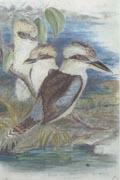
was an English ornithologist. The Gould League in Australia was named after him. His identification of the birds now nicknamed "Darwin's finches" was pivotal in the inception of Darwin's theory of evolution by natural selection, though they are barely mentioned in Charles Darwin's book, On the Origin of Species.Gould was born in Lyme Regis, Dorset, the son of a gardener, and the boy probably had a scanty education. Shortly afterwards his father obtained a position on an estate near Guildford, Surrey, and then in 1818 became foreman in the Royal Gardens of Windsor. The young Gould started training as a gardener, being employed under his father at Windsor from 1818 to 1824, and he was subsequently a gardener at Ripley Castle in Yorkshire. He became an expert in the art of taxidermy and in 1824 he set himself up in business in London as a taxidermist,
|
|
 |
John glover
|
|
English-born Australian Painter, 1767-1849
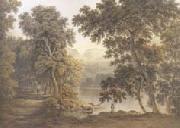
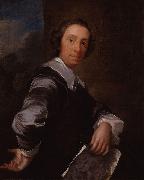
English painter. He was employed first as a schoolteacher at Appleby (Cumbria) and after 1794 as a drawing-master at Lichfield (Staffs), from where he sent drawings to London each year; on his occasional visits to the capital he received lessons from William Payne and was clearly influenced by him. In the 1790s he also began to practise in oils, some of which were exhibited at the Royal Academy from 1795 onwards. At the first exhibition of the Society of Painters in Water-Colours (April-June 1805) Glover's pictures were priced more highly than those of any other exhibitor; he was elected President of the Society in 1807 and again in 1814-15. A typical watercolour is his Landscape with Waterfall (U. Manchester, Whitworth A.G.).
|
|
 |
John Giles Eccardt
|
|
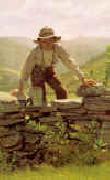
John Giles Eccardt (1720 - 1779) was a German-born British portrait painter. He came to England in the company of the French painter Jean-Baptiste van Loo for whom he worked as an assistant. When Van Loo departed the country, Eccardt remained and set up a portrait-painting business. In the following years he did portraits of a number of leading members of British society including twenty six of his chief patron Horace Walpole. He died in 1779.
|
|
 |
John George Brown
|
|
1831-1913
John George Brown Galleries
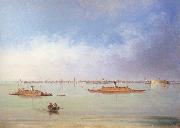
John George Brown (November 11, 1831 - February 8, 1913), American painter, was born in Durham, England, on 11 November 1831. He studied at Newcastle-on-Tyne, in the Edinburgh Academy, and after moving to New York City in 1853, he studied with Thomas Seir Cummings at the schools of the National Academy of Design, of which he became a member in 1863.New International Encyclopedia He was its vice-president, 1899-1904, and originated the idea of the removal of the Academy to a new site in 110th Street.
In 1866 he became one of the charter members of the Water-Color Society, of which he was president from 1887 to 1904. He generally confined himself to representations of street child life, bootblacks, newsboys, etc.; his Passing Show (Paris, Salon, 1877) and Street Boys at Play (Paris Exhibition, 1900) are good examples of his popular talent. Brown's art is best characterized as British genre paintings adapted to American subjects. Essentially literary, it is executed with precise detail, but is poor in color, and more popular with the general public than with connoisseurs.
|
|
|
|
 |
John Gadsby Chapman
|
|
American Painter, 1808-1889,was an American artist famous for The Baptism of Pocahontas, which was commissioned by the United States Congress and hangs in the United States Capitol rotunda. John Chapman was born in 1808 in Alexandria, Virginia. Chapman began his study of art in Philadelphia for two years, then departed for Europe where he eventually spent time in Italy. In 1831, Chapman returned to his hometown of Alexandria, and exhibited his artwork in the nearest metropolitan areas, such as Washington, D.C., Richmond, and Philadelphia. He specialized in landscapes and portraits. By 1834, Chapman had moved to New York City and become a member of the National Academy of Design, and found work as an illustrator. In New York, Chapman embarked on a series of historic paintings, such as Landing at Jamestown and the Crowning of Powhatan. The success of these paintings helped Chapman land a commission from the United States Congress in February 1837 to paint a historical scene for the rotunda of the Capitol building. For this work, Chapman received a total payment of $10,000. On November 30th, 1840, The Baptism of Pocahontas was formally unveiled in the Capitol rotunda. On the swell of this success, Chapman moved his family to Rome, and made an earnest living selling paintings of rural Campagna to American visitors. However, at the onset of the American Civil War, the tourist industry dried up, affecting Chapman fortunes greatly. In addition, Chapman own son, Conrad Chapman, returned to America to fight on the side of the Confederate States of America. The economic deprivation inflicted on Chapman during the 1860s became insurmountable. In Rome, he was forced to live off the kindness of fellow expatriates, and finally returned to America, sick and poor, to spend his last days with another son, John Linton Chapman, in Brooklyn, New York. It was there, in 1889, that he died a pauper.
|
|
 |
John Atkinson Grimshaw
|
|
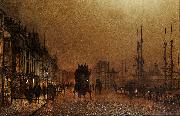
(6 September 1836 - 13 October 1893) was a Victorian-era artist, a "remarkable and imaginative painter" known for his city night-scenes and landscapes.
His early paintings were signed "JAG," "J. A. Grimshaw," or "John Atkinson Grimshaw," though he finally settled on "Atkinson Grimshaw."
John Atkinson Grimshaw was born 6 September 1836 in Leeds. In 1856 he married his cousin Frances Hubbard (1835-1917). In 1861, at the age of 24, to the dismay of his parents, he left his job as a clerk for the Great Northern Railway to become a painter. He first exhibited in 1862, mostly paintings of birds, fruit and blossom, under the patronage of the Leeds Philosophical and Literary Society. He became successful in the 1870s and rented a second home in Scarborough, which became a favourite subject.
Several of his children, Arthur Grimshaw (1864-1913), Louis H Grimshaw (1870-1944), Wilfred Grimshaw (1871-1937) and Elaine Grimshaw (1877-1970) became painters.
|
|
|
|
 |
Johann Wolfgang von Goethe
|
|
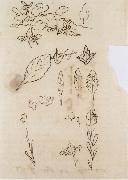
Frankfurt 1749-1832 Weimar,was a German writer and according to George Eliot, "Germany's greatest man of letters and the last true polymath to walk the earth." Goethe's works span the fields of poetry, drama, literature, theology, humanism and science. Goethe's magnum opus, lauded as one of the peaks of world literature, is the two-part drama Faust. Goethe's other well-known literary works include his numerous poems, the Bildungsroman Wilhelm Meister's Apprenticeship and the epistolary novel The Sorrows of Young Werther. Goethe was one of the key figures of German literature and the movement of Weimar Classicism in the late 18th and early 19th centuries; this movement coincides with Enlightenment, Sentimentality (Empfindsamkeit), Sturm und Drang and Romanticism. The author of the scientific text Theory of Colours, he influenced Darwin with his focus on plant morphology. He also served at length as the Privy Councilor ("Geheimrat") of the duchy of Weimar. Goethe is the originator of the concept of Weltliteratur ("world literature"), having taken great interest in the literatures of England, France, Italy, classical Greece, Persia, Arabic literature, amongst others. His influence on German philosophy is virtually immeasurable, having major effect especially on the generation of Hegel and Schelling, although Goethe himself expressly and decidedly refrained from practicing philosophy in the rarefied sense. Goethe's influence spread across Europe, and for the next century his works were a major source of inspiration in music, drama, poetry and philosophy. Goethe is considered by many to be the most important writer in the German language and one of the most important thinkers in Western culture as well.
|
|
|
|
 |
Johann Gottfried Steffan
|
|
1815-1905
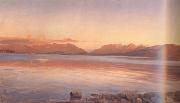
Swiss painter. He moved to Munich in 1833 after an apprenticeship as a lithographer in Wedenswil. He studied at the Akademie der Bildenden Kenste and the Polytechnikum in Munich. He was impressed by Carl Rottmann's Italian landscapes and decided to devote himself to landscape painting. He travelled to Italy in 1845 and to Paris in 1855; he subsequently began to concentrate on painting lake and mountain scenes, for example Lake Starnberg in a Storm (1873; Zurich, Ksthaus), at which he was highly successful. He undertook numerous study-visits to Bavaria and Switzerland, often accompanied by his pupils Traugott Schiess (1834-69) and Otto Frölicher. In Munich Steffan became friendly with Rudolf Koller, Johann Caspar Bosshardt (1823-87) and Arnold Becklin, and under his leadership the 'Schweizer', as these artist-friends were known collectively, formed their own group.
|
|
 |
Johann Gottfried Schadow
|
|
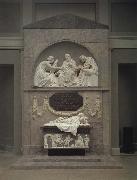
1764-1850 Berlin, He was a German sculptor. He was born in Berlin, where his father was a poor tailor. Friederike von Preuben.His first teacher was an inferior sculptor, Tassaert, patronized by Frederick the Great; the master offered his daughter in marriage, but the pupil preferred to elope with a girl to Vienna, and the father-in-law not only condoned the offence but furnished money wherewith to visit Italy. Three years' study in Rome formed his style, and in 1788 he returned to Berlin to succeed Tassaert as sculptor to the court and secretary to the Academy. Over half a century he produced upwards of two hundred works, varied in style as in subjects.
|
|
 |
Johann Gottfried Auerbach
|
|
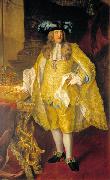
Johann Gottfried Auerbach (October 28, 1697 -August 5, 1753), was an Austrian painter and etcher.
Auerbach painted primarily portraits and battle genre works. Some of his works can be found at the Kunsthistorisches Museum.
|
|
|
|
 |
Johann Georg Ziesenis
|
|
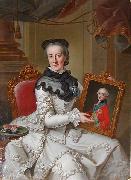
(b Copenhagen, 1716; d Hannover, 4 March 1776). German painter of Danish birth. He trained with his father, Johann Georg Ziesenis (1681-1748); he became a German citizen in 1743 and subsequently was appointed court painter to Herzog Christian von Pfalz-Zweibrecken in Zweibrecken and, later, Mannheim. In the early 1750s he overcame his technical shortcomings by studying Flemish art, particularly the work of Rubens and van Dyck. He also introduced a new genre, the private court portrait. His portrait of Karl Philipp Theodor, Kurferst von der Pfalz (1757; Munich, Alte Pin.) is original in its intimate view of a nobleman posed at leisure in casual dress, seated in his private study.
|
|
|
|
|
|
 |
Johann Georg von Dillis
|
|
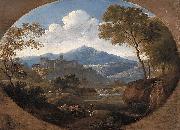
(born Gmain, December 26, 1759 - died Munich, September 28, 1841) was a German painter. Son of a gamekeeper and forester, he was educated in Munich with support from the prince-elector of Bavaria. Initially he was trained for the priesthood, but by 1786 his real interest, art, was beginning to be developed, and he taught drawing both at court and to private families. In 1790 he was appointed inspector of the Hofgarten Galerie, the princely collection. He continued in a curatorial role for the Bavarian court for much of the rest of his career; this allowed him some freedom to travel and expand his knowledge of European art. In 1792 he traveled to Dresden, Prague, and Vienna, and in 1794 he made his first trip to Italy, where he made watercolor studies from nature. A further trip to Italy followed in 1805, and brought him to Rome, where he met Pierre-Henri de Valenciennes, who introduced him to the idea of painting in open air. He studied the work of Simon Denis and Joseph Mallaord William Turner, and encountered Washington Allston. The next year, in Paris, he saw oil sketches by Jean-Joseph-Xavier Bidauld, and with Ludwig, the crown prince visited the Musee Napoleon; he would later advise the prince on collecting and other matters artistic, remaining in this capacity for the rest of his life. He also made several trips to Italy to purchase art for the royal collection. In 1816 he was made responsible for packing and returning to Munich from Paris art stolen from Bavaria by Napoleon. In the fall of 1817 he and Ludwig traveled to Sicily before spending four months in Rome. Dillis helped to shape the collections of the Alte Pinakothek, which opened in 1836. He died in Munich in 1841.
|
|
 |
Johann Georg Meyer
|
|
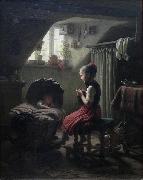
Johann Georg Meyer (28 October 1813 Bremen, Germany - 4 December 1886 Berlin), commonly known as Meyer von Bremen, was a German painter who specialized in Biblical, peasant, and family scenes.
In his 2lst year, he went to Desseldorf and began his studies at the Academy of Art there, which was led by Friedrich Wilhelm Schadow, the son of sculptor Johann Gottfried Schadow. In 1841, Meyer opened a studio of his own, but moved to Berlin as his fame increased (1853). While scenes from the Bible were first the subjects of his brush, he later turned his attention to incidents from popular life, especially among the Hessian peasantry, and finally to the portrayal of family life in its pathetic aspect. Such pictures as eThe Jubilee of a Hessian Pastore (1843), hristmas Eve,e eBlindman's Buff,e eThe Soldier's Return,e eThe Inundatione (1846), eThe Repentant Daughtere (1852, in the gallery at Bremen), are full of intense sympathy with the esimple annals of the poor.e After taking up his residence at Berlin, he chose especially scenes from child life, which he rendered with spirited humor. Among his pictures of this kind are eThe Fairy Tale,ehildren Playing Blindman's Buff,e eGrandfather and Grandchild,e and others. A third group of his pictures includes those of young women, as single figures or in groups, such as eThe Tryste and eThe Love Letter.e An example of his work, eThe Lettere (1873), is in the Metropolitan Museum of Art in New York City.
|
|
|
|
|
|
 |
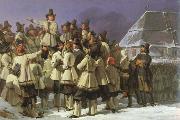
Johan Vilhelm Gertner
|
|
(10 March 1818 - 28 March 1871) was a Danish painter, best known for his portraiture. One of the last students of Christoffer Wilhelm Eckersberg, who was known as the father of the Golden Age of Danish Painting, Gertner belonged to the tail end of the Golden Age, a period during which Danish art moved towards a more realistic style, relying on inspiration both from French Realism and emerging photographic techniques.
Gertner was born on 10 March 1818 to a craftsman at the Holmen naval base. He attended the Royal Danish Academy of Fine Arts from 1831 to 1837 where he was one of Christoffer Wilhelm Eckersberg, known as the farther of Goldn Age of Danish Painting. Eckersberg taught him a naturalistic approach to painting, but Gertner went much further with inspiration from French art and the emerging techniques of photography.
His virtuosity in producing almost photographically precise portraits impressed many; in particular, his ability to reproduce textures and materials e crisp silk dresses, lustrous medals and jewellery, dark mahogany furniture, silky wallpapers, and soft carpets e won him much acclaim. Others, such as the influential art historian and critic Niels Lauritz Høyen, who opposed any foreign influence on Danish painting, disapproved of his style, preferring more sincere and sensitive portrayals. He was a professor at the Academy from 1858.
|
|
|
|
 |
johan gustaf sandberg
|
|
Johan Gustaf Sandberg, född 1782, död 1854, var målare; han var professor i teckning vid Konstakademien från 1828, och direktör där 1845?C1853.
Sandberg ägnade sig främst åt historiemåleri, med motiv ur nordisk mytologi och svensk historia. Hans främsta verk inom detta område är kalkmålningarna över Gustav Vasa i Uppsala domkyrka. Han målade också en mängd porträtt.
Sandberg blev 1794 elev i konstakademins principskola och 1801 i antikskolan, lärde samtidigt musik och klaverspelning och tjänade pengar genom lektioner och genom arbete på kungliga teaterns dekorationsmålarverkstad. Under den följande tiden slöt han sig till den opposition mot akademin, som hade sin medelpunkt i "Sällskapet för konststudium". Tvisten med akademin lade sig snart, Sandberg valdes till ledamot 1821 och blev ordinarie professor 1828. Däremot hade han aldrig tillfälle att göra den för äldre tiders konstnärer obligatoriska studieresan till södern.
Han utförde teckningarna till praktverket "Ett år i Sverige" (1827 -35) med bilderna graverade under Christian Didrik Forssells ledning och texten skriven av Anders Abraham Grafström. Under upprepade sommarvistelser på Säfstaholms slott målade Sandberg folktyper och folkdräkter.
Åtskilliga porträtt utförde Sandberg för det praktfulla "Galleri af utmärkta svenska lärde, vetenskapsidkare och konstnärer", som han utgav 1835?C42 (100 porträtt, litograferade av J. Cardon).
|
|
|
|
 |
Joaquin Torres-Garcia
|
|
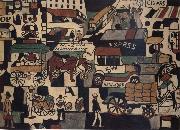
Uruguayan Painter and Sculptor, 1874-1949,was a Uruguayan artist (in a variety of media) and art theorist, also known as the founder of Constructive Universalism. Born in Montevideo, Torres Garcia later travelled extensively, and lived for some time in Barcelona, New York, Paris, and Madrid. He returned to Uruguay in 1934.
|
|
|
|
 |
Jehan Georges Vibert
|
|
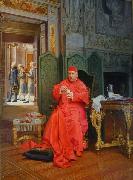
Jehan Georges Vibert (30 September 1840 - 28 July 1902) was a French academic painter.
He was born in Paris. He began his artistic training at a young age under the instruction of his maternal grandfather, engraver Jean-Pierre-Marie Jazet. Vibert was more interested in painting than engraving and entered the studio of Felix-Joseph Barrias and eventually the École des Beaux-Arts when he was sixteen. He remained at the École for six years under the instruction of historic painter François-Edouard Picot.
Vibert debuted at the Salon of 1863 with La Sieste (The Siesta) and Repentir (Repentance).
During the Franco-Prussian War, Vibert became a sharpshooter and was wounded at the battle of Malmaison in October 1870. He was awarded the Legion deHonneur and became a Chevalier de la Legion deHonneur in recognition of his sacrifice. He became an Officer of the Legion deHonneur in 1882.
|
|
 |
Jean-Pierre Norblin de La Gourdaine
|
|
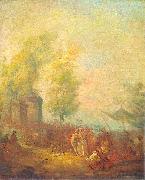
(in Polish, Jan Piotr Norblin; 15 July 1745 - 23 February 1830) was a French-born painter, draughtsman, engraver, drawing artist and caricaturist. From 1774 to 1804 he resided in the Polish-Lithuanian Commonwealth, where he obtained citizenship.
He is considered one of the most important painters of the Polish Enlightenment. He achieved great success in Poland. Given many commissions from some of the most notable families of the Polish-Lithuanian Commonwealth, he stayed there for many years, not returning to Paris until the early 19th century. His style showed the influence of Antoine Watteau, and combined the Rococo tradition of charming fates galantes and fetes champetres with a panorama of daily life and current political events, captured with journalistic accuracy. He created a gallery of portraits of representatives of all social classes in the last years of the Polish-Lithuanian Commonwealth.
|
|
 |
Jean-Leon Gerome
|
|
French Academic Painter and Sculptor, 1824-1904
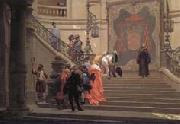
was a French painter and sculptor in the style now known as Academicism. The range of his oeuvre included historical painting, Greek mythology, Orientalism, portraits and other subjects, bringing the Academic painting tradition to an artistic climax. Born at Vesoul (Haute-Saône), he went to Paris in 1840 where he studied under Paul Delaroche, whom he accompanied to Italy (1843-1844). He visited Florence, Rome, the Vatican and Pompeii, but he was more attracted to the world of nature. Taken by a fever, he was forced to return to Paris in 1844. On his return he followed, like many other students of Delaroche, into the atelier of Charles Gleyre and studied there for a brief time. He then attended the Ecole des Beaux-Arts. In 1846 he tried to enter the prestigious Prix de Rome, but failed in the final stage because his figure drawing was inadequate. He tried to improve his skills by painting The Cockfight (1846), an academic exercise depicting a nude young man and a lightly draped girl with two fighting cocks and in the background the Bay of Naples. He sent this painting to the Salon of 1847, where it gained him a third-class medal. This work was seen as the epitome of the Neo-Grec movement that had formed out of Gleyre's studio (such as Henri-Pierre Picou (1824-1895) and Jean-Louis Hamon), and was championed by the influential French critic Theophile Gautier. G??rôme abandoned his dream of winning the Prix de Rome and took advantage of his sudden success. His paintings The Virgin, the Infant Jesus and St John (private collection) and Anacreon, Bacchus and Cupid (Mus??e des Augustins, Toulouse, France) took a second-class medal in 1848. In 1849 he produced the paintings Michelangelo (also called In his studio) (now in private collection) image of the painting and A portrait of a Lady (Mus??e Ingres, Montauban). In 1851 he decorated a vase, later offered by Emperor Napoleon III of France to Prince Albert, now part of the Royal Collection at St. James's Palace, London. He exhibited Bacchus and Love, Drunk, a Greek Interior and Souvenir d'Italie, in 1851; Paestum (1852); and An Idyll (1853). In 1852 G??rôme received a commission by Alfred Emilien Comte de Nieuwerkerke, Surintendant des Beaux-Arts to the court of Napoleon III, for the painting of a large historical canvas, the Age of Augustus image of the painting. In this canvas he combines the birth of Christ with conquered nations paying homage to Augustus. Thanks to a considerable down payment, he was able to travel in 1853 to Constantinople, together with the actor Edmond Got. This would be the first of several travels to the East : in 1854 he made another journey to Turkey and the shores of the Danube, where he was present at a concert of Russian conscripts, making music under the threat of a lash. In 1854 he completed another important commission of decorating the Chapel of St. Jerome in the church of St. S??verin in Paris. His Last communion of St. Jerome in this chapel reflects the influence of the school of Ingres on his religious works. To the exhibition of 1855 he contributed a Pifferaro, a Shepherd, A Russian Concert, The Age of Augustus and Birth of Christ.
|
|
 |
Jean-Germain Drouais
|
|
1763-1788
French
Jean Germain Drouais Locations
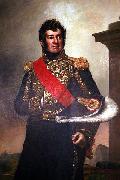
Son of Francois-Hubert Drouais. He trained first with his father and in 1778 enrolled at the Academie Royale, becoming a pupil of Nicolas-Guy Brenet. Around 1781 he entered Jacques-Louis David studio as one of his first pupils. The following year, though not officially entered for the competition, he painted that year Prix de Rome subject, the Return of the Prodigal Son (Paris, St Roch), presumably as a trial for his own edification. The picture has a friezelike composition and reveals both the influence of Jean-Francois Peyron and David as well as debts to Poussin and Italian 17th-century sources. In 1783 Drouais reached the Prix de Rome final with the Resurrection of the Son of the Widow of Nain (Le Mans, Mus. Tesse) but was eliminated from the competition in extraordinary circumstances: impatient to know his master opinion, Drouais cut a section off the canvas and smuggled it out of the competition rooms. David acknowledged it to be the best thing his favourite pupil had yet done, but by his hasty action Drouais had disqualified himself. However, the following year he won the prize, and great acclaim, with the Woman of Canaan at the Feet of Christ (Paris, Louvre), an extremely accomplished piece influenced by Poussin work and David Belisarius (Lille, Mus. B.-A.).
|
|
 |
Jean-Baptiste Paulin Guerin
|
|
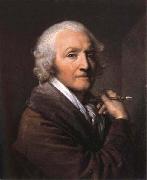
(March 25, 1783 - January 19, 1855), French painter, was born at Toulon, of poor parents.
As a young man, he learned his father's trade of locksmithing, whilst at the same time he followed the classes of the free school of art. Having sold some copies to a local amateur, Guerin started for Paris, where he came under the notice of Vincent, whose counsels were of material service.
In 1810 Guerin made his first appearance at the Salon with some portraits, which had a certain success. In 1812 he exhibited "Cain after the murder of Abel" (formerly in Luxembourg), and, on the return of the Bourbons, was much employed in works of restoration and decoration at Versailles.
|
|
 |
Jean-Baptiste Greuze
|
|
French Rococo Era Painter, 1725-1805
French painter and draughtsman. He was named an associate member of the Academie Royale de Peinture et de Sculpture, Paris, in 1755 on the strength of a group of paintings that included genre scenes, portraits and studies of expressive heads (tetes d'expression). These remained the essential subjects of his art for the next 50 years, except for a brief, concentrated and unsuccessful experiment with history painting in the late 1760s, which was to affect his later genre painting deeply. Though his art has often been compared with that of Jean-Simeon Chardin in particular and interpreted within the context of NEO-CLASSICISM in general, it stands so strikingly apart from the currents of its time that Greuze's accomplishments are best described, as they often were by the artist's contemporaries, as unique. He was greatly admired by connoisseurs, critics and the general public throughout most of his life. His pictures were in the collections of such noted connoisseurs as Ange-Laurent de La Live de Jully, Claude-Henri Watelet and Etienne-Franeois, Duc de Choiseul. For a long period he was in particular favour with the critic Denis Diderot, who wrote about him in the Salon reviews that he published in Melchior Grimm's privately circulated Correspondance litt?raire. His reputation declined towards the end of his life and through the early part of the 19th century, to be revived after 1850, when 18th-century painting returned to favour, by such critics as Theophile Thore, Arsene Houssaye and, most notably, Edmond and Jules de Goncourt in their book L'Art du dix-huitieme siecle. By the end of the century Greuze's work, especially his many variations on the Head of a Girl, fetched record prices, and his Broken Pitcher (Paris, Louvre) was one of the most popular paintings in the Louvre.
|
|
|
|
 |
Jean Leon Gerome Ferris
|
|
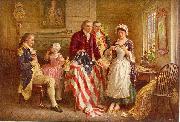
(August 18, 1863 - March 18, 1930) was an American painter best known for his series of 78 scenes from American history, entitled The Pageant of a Nation, the largest series of American historical paintings by a single artist.
He was born in Philadelphia, Pennsylvania, the son of Stephen James Ferris, a portrait painter and a devotee of Jean-L??on G??rôme (after whom he was named) and Mariano Fortuny.He grew up around art, having been trained by his father and having two acclaimed painters, Edward Moran and Thomas Moran, as uncles.
Ferris enrolled in the Pennsylvania Academy of the Fine Arts in 1879 and trained further at the Acad??mie Julian beginning in 1883 under William-Adolphe Bouguereau.He also met his namesake G??rôme, who greatly influenced Ferris's decision to paint scenes from American history. As Ferris wrote in his unpublished autobiography, "[G??rôme's] axiom was that one would paint best that with which he is most familiar".
However, initially his subjects were Orientalist in nature, that movement having been in vogue when he was young. Some of his material was original, some of it took after Fortuny, but he was skilled enough, despite never having had any experience with Asia. In 1882, he exhibited a painting entitled Feeding the Ibis, which was valued at $600.
By 1895, Ferris had gained a reputation as a historical painter, and he embarked on his dream of creating a series of paintings that told a historical narrative. In 1898 he sold one of these, General Howe's Levee, 1777, but he later regretted it, realizing that such a series could not be complete if the separate paintings could not be kept together. As such, he never sold another one of those, but he did sell the reproduction rights to various publishing companies. This later would have the effect of greatly popularizing his work, as these companies made prints, postcards, calendars and blank-backed trade cards use in advertisements. Laminated cards of these works were still being sold as late as 1984.
The Landing of William PennThe paintings showed idealized portrayals of famous moments from American history, but were often historically inaccurate. The Landing of William Penn, for example, shows Penn being greeted at New Castle by American Indians who are clothed in the tradition of tribes from the Great Plains. In The First Thanksgiving 1621, the black outfits the Pilgrims are shown wearing are wrong, and the Wampanoag did not wear feathered war bonnets, nor would they have been sitting on the ground.
The complete series was shown at Independence Hall in Philadelphia from 1913 to 1930, then moved next door to Congress Hall. In later years it was shown in a number of locations, including the Smithsonian Institution, before being returned to the Ferris family.
|
|
 |
Jean Leon Gerome
|
|
French
1824-1904
Jean Leon Gerome Galleries
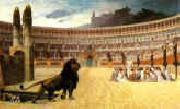
French painter, sculptor, and teacher. Son of a goldsmith, he studied in Paris and painted melodramatic and often erotic historical and mythological compositions, excelling as a draftsman in the linear style of Jean-Auguste-Dominique Ingres. His best-known works are scenes inspired by several visits to Egypt. In his later years he produced mostly sculpture. He exerted much influence as a teacher at the Ecole des Beaux-Arts; his pupils included Odilon Redon and Thomas Eakins. A staunch defender of the academic tradition, he tried in 1893 to block the government acceptance of the Impressionist works bequeathed by Gustave Caillebotte.
|
|
 |
Jean Greuze
|
|
French 1725-1805
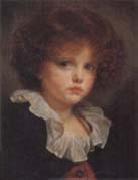
French painter and draughtsman. He was named an associate member of the Acad?mie Royale de Peinture et de Sculpture, Paris, in 1755 on the strength of a group of paintings that included genre scenes, portraits and studies of expressive heads (t?tes d'expression). These remained the essential subjects of his art for the next 50 years, except for a brief, concentrated and unsuccessful experiment with history painting in the late 1760s, which was to affect his later genre painting deeply. Though his art has often been compared with that of Jean-Sim?on Chardin in particular and interpreted within the context of NEO-CLASSICISM in general, it stands so strikingly apart from the currents of its time that Greuze's accomplishments are best described, as they often were by the artist's contemporaries, as unique. He was greatly admired by connoisseurs, critics and the general public throughout most of his life. His pictures were in the collections of such noted connoisseurs as Ange-Laurent de La Live de Jully, Claude-Henri Watelet and Etienne-Fran?ois, Duc de Choiseul. For a long period he was in particular favour with the critic Denis Diderot, who wrote about him in the Salon reviews that he published in Melchior Grimm's privately circulated Correspondance litt?raire. His reputation declined towards the end of his life and through the early part of the 19th century, to be revived after 1850,
|
|
 |
Jean Baptiste Greuze
|
|
1725-1805
French
Jean Baptiste Greuze Galleries
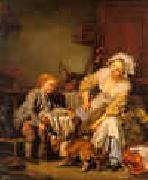
French painter and draughtsman. He was named an associate member of the Academie Royale de Peinture et de Sculpture, Paris, in 1755 on the strength of a group of paintings that included genre scenes, portraits and studies of expressive heads (t?tes d'expression). These remained the essential subjects of his art for the next 50 years, except for a brief, concentrated and unsuccessful experiment with history painting in the late 1760s, which was to affect his later genre painting deeply. Though his art has often been compared with that of Jean-Simeon Chardin in particular and interpreted within the context of NEO-CLASSICISM in general, it stands so strikingly apart from the currents of its time that Greuze's accomplishments are best described, as they often were by the artist's contemporaries, as unique. He was greatly admired by connoisseurs, critics and the general public throughout most of his life. His pictures were in the collections of such noted connoisseurs as Ange-Laurent de La Live de Jully, Claude-Henri Watelet and Etienne-Francois, Duc de Choiseul. For a long period he was in particular favour with the critic Denis Diderot, who wrote about him in the Salon reviews that he published in Melchior Grimm's privately circulated Correspondance litteraire. His reputation declined towards the end of his life and through the early part of the 19th century, to be revived after 1850, when 18th-century painting returned to favour, by such critics as Th?ophile Thore, Arsene Houssaye and, most notably, Edmond and Jules de Goncourt in their book L'Art du dix-huiti?me siecle. By the end of the century Greuze's work, especially his many variations on the Head of a Girl, fetched record prices, and his Broken Pitcher (Paris, Louvre) was one of the most popular paintings in the Louvre. The advent of modernism in the early decades of the 20th century totally obliterated Greuze's reputation. It was only in the 1970s, with Brookner's monograph, Munhall's first comprehensive exhibition of the artist's work, increased sale prices, important museum acquisitions and fresh analyses of his art by young historians, that Greuze began to regain the important place that he merits in the history of French art of the 18th century.
|
|
|
|
|
|
 |
Jan van Goyen
|
|
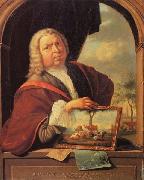
Dutch Baroque Era Painter, 1596-1656
Jan van Goyen was born in Leiden on Jan. 13, 1596. Apprenticed from the age of 10, he had several masters. About 1617 he went to Haarlem to study with Esaias van de Velde, an important innovator in the Haarlem movement of realistic landscape painting. Van Goyen's works between 1621 and 1625 are sometimes hard to distinguish from those of his teacher. They are colorful, detailed views of villages and roads, usually busy with people, as in Winter (1621). It was Van Goyen's usual practice to sign or monogram and date his paintings. He traveled extensively through the Netherlands and beyond, recording his impressions in sketchbooks, occasionally with dates and often depicting recognizable scenes. Thus the chronology of his development is clear. His paintings of the late 1620s show a steady advance from the strong colors and scattered organization of his early works toward tonality and greater simplicity and unity of composition. By 1630 he was painting monochromes in golden brown or pale green; he played a leading part in the tonal phase of Dutch landscape painting. In 1631 Van Goyen settled in The Hague, where he became a citizen in 1634. The simplicity, airiness, and unification of his compositions continued to increase in his abundant production of dune landscapes, river views, seascapes, town views, and winter landscapes. The River View (1636) displays a river so open and extensive as to suggest the sea, with reflections that prolong the vast and luminous sky. In its monumentalization of humble structures and its composition built on a firm scaffolding of horizontal and vertical forces, it forecast at this early date developments that dominated landscape painting in the 1650s and later. In the Village and Dunes (1647) the traditional double-diagonal composition still exists, but it is dominated by horizontal and vertical accents. Stronger contrasts of light and dark replace the earlier tonality. In the last year of his life Van Goyen produced an eloquent new style, in which powerful forms stand out against the radiant sky and water in an exquisitely balanced composition (Evening Calm; 1656). The commission in 1651 to paint a panoramic view of The Hague for the Burgomaster's Room shows the high regard in which Van Goyen was held. He was enormously productive; well over 1,000 of his paintings still exist, and almost as many drawings.
|
|
 |
Jan van Gool
|
|
Johan, or Jan van Gool (1685 - 1763) was a Dutch painter and writer from The Hague, now remembered mainly as a biographer of artists from the Dutch Golden Age.
According to the RKD he learned to paint from Simon van der Does and Mattheus Terwesten. He became a member of the Confrerie Pictura in 1711. He was first regent, and then five years later became director, of the Hague Drawing School from 1720-1734. He spent most of his time in the Hague, but travelled to England twice and is recorded there in 1711. He specialized in Italianate landscapes.
He is best known today for his book of artist biographies, otherwise known as the "Nieuw Schouburg". The full title is De Nieuwe Schouburg der Nederlantsche kunstschilders en schilderessen: Waer in de Levens- en Kunstbedryven der tans levende en reets overleedene Schilders, die van Houbraken, noch eenig ander schryver, zyn aengeteekend, verhaelt worden. (The Hague, 1750).
|
|
 |
Jan van Goyen
|
|
1596-1656
Dutch
Jan van Goyen Galleries
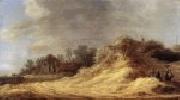
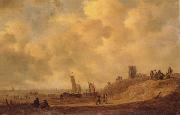
Dutch landscape painter. He studied at Leiden and Haarlem. In 1631 he settled at The Hague. His typically Dutch landscapes of harbors, canals, riverbanks, and winter scenes with skaters and sleighs are naturalistically painted in a grayish-green tonality. He was one of the first landscape painters to sacrifice minute detail for atmospheric effect and space, and he had a considerable influence on later Dutch landscapists. His paintings are in many collections in Europe and the United States. Famous examples are Panorama of The Hague (The Hague); Banks of a Canal (Louvre); and View of Dordrecht (Rijks Mus.). The Metropolitan Museum has five of van Goyen's works, and the Pennsylvania Academy, two.
|
|
 |
Jan josephsz van goyen
|
|
Dutch , Leyden 1596-The Hague 1656
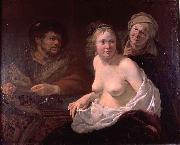
was a Dutch landscape painter. Van Goyen was an extremely prolific artist; approximately twelve hundred paintings and more than one thousand drawings by him are known. Jan van Goyen was the son of a shoemaker and started as an apprentice in Leiden. Like many Dutch painters of his time, Jan van Goyen studied art in the town of Haarlem with Esaias van de Velde. At age 35, he established a permanent studio at Den Haag (The Hague). Crenshaw tells (and mentions the sources) that Van Goyen's landscape paintings rarely fetched high prices, but he made up for the modest value of individual pieces by increasing his production, painting thinly and quickly with a limited palette of inexpensive pigments. Despite his market innovations, he always sought more income, not only through related work as an art dealer and auctioneer but also by speculating in tulips and real estate. Although the latter was usually a safe avenue of investing money, in Van Goyen's experience it led to enormous debts. Paulus Potter rented one of his houses. Nicolaes van Berchem became his pupil. In 1652 and 1654 he was forced to sell his collection of paintings and graphic art, and he subsequently moved to a smaller house. He died in 1656, still unbelievably 18,000 guilders in debt, forcing his widow to sell their remaining furniture and paintings.
|
|
|
|
 |
Jan Gerritsz. van Bronckhorst
|
|
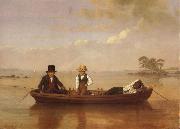
(1603-1661) was a Dutch Golden Age painter and engraver. He is considered today to be a minor member of the Utrecht Caravaggisti group.
According to Houbraken, van Bronckhorst apprenticed as an eleven-year-old with the glass engraver Verburgh in Utrecht. He worked with him for 6 months and worked with two other Utrecht glassworkers before embarking on a Grand Tour in 1620. He did not get far before he was offered work in Arras by the glassworker Peeter Matthys. After six months, he continued on to Paris in 1620, where he worked with the glassworker Chamu. He returned to Utrecht in 1622, where Cornelis Poelenburg taught him to paint. He married Catalijntje van Noort in 1626. He frequented the studio of Gerard van Honthorst. In 1647 he moved to Amsterdam where he created the stained glass windows and the organ doors (almost the only area in a Calvinist church where figurative painting was sometimes allowed) of the Nieuwe Kerk (finished in 1655). He has been described as the last of the great stained glass painters in Holland.. Unlike his work for churches, his secular paintings show the influence of Caravaggio, and also show a striking appeal to sensuality. Among his pupils are counted his sons Jan Jansz and Gerrit Jansz, and Cesar van Everdingen.
|
|
 |
James-Goodwyn Clonney
|
|
British/American, 1812-1867, American painter. He was one of the first generation of American genre painters. His earliest datable work includes two lithographs of urban views and images of birds and animals published in New York between 1830 and 1835. He studied at the National Academy of Design, New York, and exhibited there periodically between 1834 and 1852. The first genre painting he exhibited at the National Academy was Militia Training (1841; Philadelphia, PA Acad. F.A.), although another example, In the Woodshed (1838; Boston, MA, Mus. F.A.), predates it. He also exhibited at the Pennsylvania Academy of Fine Arts (1845 and 1847) and at the Apollo Association and American Art-Union (1841-50).
|
|
 |
James Guthrie
|
|
Scottish Painter, 1859-1930
Sir James Guthrie (June 10 1859?CSeptember 6 1930) was a Scottish painter known, later on in his career, for his portraiture, although primarily known for his work in the realm of Scottish Realism.
Born in Greenock, Guthrie, the son of a clergyman, originally enrolled at Glasgow University to study law, but abandoned this in favour of painting in 1877. Unlike many of his contemporaries he did not study in Paris, being mostly self-taught, although he was mentored for a short time by James Drummond in Glasgow and then John Pettie in London. He lived most of his life in the Scottish Borders, most notably in Cockburnspath, Berwickshire, where he painted some of his most important works, including A Hind Daughter (1883), and Schoolmates. He was strongly influenced by the French Realists, especially Jules Bastien-Lepage, and was associated with the Glasgow Boys.
He was elected an associate of the Royal Scottish Academy in 1888, and a full member in 1892. In 1902 he succeeded Sir George Reid as RSA president in 1902, and he was knighted the following year. He died in Rhu, Dunbartonshire in 1930
|
|
|
|
|
|
|
|
|
|
|
| Wholesale China Oil Painting Wholesale Oil Painting China Xiamen Portrait Reproduction on canvas Chinese Oil Painting Wholesale USA Oil Painting |
|
|
|
|
|