| |
|
Xiamen Oil Paintings, Wholesale Direct!
|
|
100% hand painted, 100% cotton canvas, 100% money back if not satisfaction. |
|
|
|
|
ART WORKS INDEX
A
B
C
D
E
F
G
H
I
J
K
L
M
N
O
P
Q
R
S
T
U
V
W
X
Y
Z
|
|
ARTISTS INDEX
A
B
C
D
E
F
G
H
I
J
K
L
M
N
O
P
Q
R
S
T
U
V
W
X
Y
Z
|
|
|
|
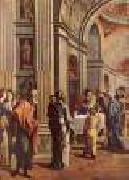 |
SCOREL, Jan van
|
|
Dutch Northern Renaissance Painter, 1495-1562
North Netherlandish painter and ecclesiastic. He was one of the first north Netherlandish artists to visit Italy, and his return to Utrecht in 1524 can be regarded as a turning-point in the history of painting in the northern Netherlands. The important role Scorel played in introducing Italian art in the north was recognized even by contemporary writers and was reiterated slightly later by van Mander
|
|
|
|
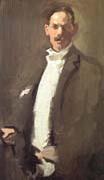 |
Samuel John Peploe
|
|
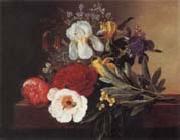
Scottish Painter, 1871-1935,Scottish painter. He studied at the Royal Scottish Academy schools from 1893 to 1894, and then at the Academie Julian and Acad?mie Colarossi in Paris, where he shared rooms with Robert Brough. The influence of the rustic realism of French painters and of the Glasgow Boys is clear in landscape drawings and paintings executed in Edinburgh from the mid-1890s. His still-life studies reveal the influence of the work of both Manet and Hals, which he saw in European galleries, with their combinations of thick impasto and fluid brushwork, dark background, strong lighting and meticulous handling of tones. Between 1900 and c. 1910, when he moved to Paris, he painted in Edinburgh, on sketching holidays in Scotland and in northern France with John Duncan Fergusson, and exhibited in Edinburgh, Glasgow and London.
|
|
|
|
|
|
|
|
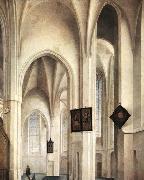 |
SAENREDAM, Pieter Jansz
|
|
Dutch Baroque Era Painter, 1597-1665,Painter and draughtsman, son of Jan Saenredam. His paintings of churches and the old town halls in Haarlem, Utrecht and Amsterdam must have been appreciated by contemporary viewers principally as faithful representations of familiar and meaningful monuments. Yet they also reveal his exceptional sensitivity to aesthetic values; his paintings embody the most discriminating considerations of composition, colouring and craftsmanship. His oeuvre is comparatively small, the paintings numbering no more than 60, and each is obviously the product of careful calculation and many weeks of work. Their most striking features, unusual in the genre, are their light, closely valued tonalities and their restrained, restful and delicately balanced compositions. These pictures, always executed on smooth panels, are remarkable for their sense of harmony and, in some instances, serenity. Here, perhaps, lies a trace of filial fidelity to the Mannerist tradition of refinement and elegance, of lines never lacking in precision and grace. But Mannerist figures and the more comparable components of strap- and scrollwork embellishment lack the tension and clarity of Saenredam's designs, which also have a completeness reminiscent of the fugues of Gerrit Sweelinck (1566-?1628).
|
|
|
|
|
|
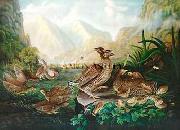 |
Robert Havell Jr Prints
|
|
1793-1878
Engraver and painter, cousin of William Havell. He learnt the art of aquatint engraving from his father, Robert Havell I. He worked first in the family engraving business and then c. 1825-7 with Colnaghi in London. In 1827 he undertook the execution in aquatint of the plates for John James Audubon Birds of America, published in parts in London between 1827 and 1838. Havell engraved 425 of the plates and reworked the ten that had been engraved by William Home Lizars in Edinburgh. Havell father printed and coloured some of the double elephant folio sheets in 1827-8 after which Havell took on those tasks himself, establishing himself as a master of aquatint. Among his other important works in the medium are the plates for Mrs E. Bury Selection of Hexandrian Plants (London, 1831-4). In 1839, at Audubon invitation, Havell moved with his family to New York and embarked on a new career as a landscape painter in the style of the Hudson River school, while also working as an engraver. He settled in the Hudson River villages of Ossining (1841) and Tarrytown (1857) but painted throughout north-eastern America. View of Deerfield, Massachusetts (1847; Hist. Deerfield, MA) is characteristic of his quietly romantic idealization of his subjects. Niagara Falls from the Chinese Pagoda (1845; New York, Pub. Lib.), engraved by Havell after one of his paintings, is among the best known of his American aquatints. Though his reputation rests largely on his work for Audubon, his original subjects gave him greater opportunities to display the full range of his aquatint technique.
Part of the Havell family
|
|
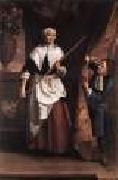 |
RILEY, John
|
|
English Baroque Era Painter, 1646-1691
English painter. He was the son of John Riley of St Botolphs, Bishopsgate, and a pupil of Isaac Fuller and Gerard Soest. He is said to have worked independently for some years, but he made no impact before Lely's death in 1680. Riley maintained a prolific and successful practice as a portrait painter over the next decade against keen foreign competition.
|
|
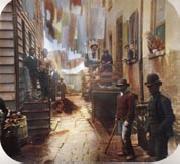 |
Riis Jacob August
|
|
Danish-American journalist and social reformer.
b.1849 d.1914
American photographer of Danish birth. The son of a school-teacher and editor, he was well-educated when he came to the USA in 1870. He was a self-taught photographer and worked at a variety of jobs before becoming a journalist, and he understood the power of the written and illustrated word. Riis's work in journalism began in 1873 when he was employed by the New York News Association. By 1874 he was editor and then owner of the South Brooklyn News.
|
|
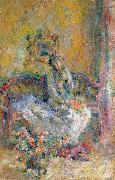 |
Rihard Jakopic
|
|
Rihard Jakopic
Rihard Jakopič (12 April 1869 - 21 April 1943) was a Slovenian painter. He was the leading Slovenian Impressionist painter and theoretician. Together with Matej Sternen, Matija Jama and Ivan Grohar, he is considered the pioneer of Slovenian impressionist painting.
|
|
|
|
|
|
|
|
|
|
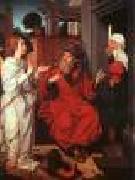 |
PROVOST, Jan
|
|
Flemish Northern Renaissance Painter, 1465-1529
|
|
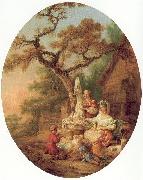 |
Prince, Jean-Baptiste le
|
|
French Painter, 1734-1781
was an important French etcher and painter. Le Prince first studied painting techniques in his native Metz. He then travelled to Paris around 1750 and became a leading student of the great painter, Francois Boucher (1703-1770). Le Prince's early paintings in both theme and style are comparable to his master's rococo techniques. In 1758 Le Prince journeyed to Russia to work for Catherine the Great at the Imperial Palace, St. Petersburg. He remained in Russia for five years and also travelled extensively throughout Finland, Lithuania and even Siberia. When Le Prince returned to Paris in December, 1763, he brought with him an extensive collection of drawings which he employed as the basis for a number of fine paintings and etchings. J. B. Le Prince was elected a full member of the Academie de peinture et de sculpture in 1765. Le Prince's graphic art of Russia and its peoples is significant in that he based his compositions entirely upon his own designs, lending a much more realistic portrayal to his views than other eighteenth century contemporaries. He is also credited with being the first artist (in 1768) to introduce aquatint into his etched and engraved plates. He may even have been the inventor of aquatint, the tonal graphic art that would later be so skillfully used by such masters as Goya,
|
|
|
|
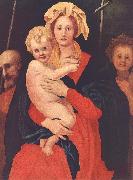 |
Pontormo, Jacopo
|
|
b Pontormo, nr Empoli, 26 May 1494; d Florence, 31 Dec 1556).
Italian painter and draughtsman. He was the leading painter in mid-16th-century Florence and one of the most original and extraordinary of Mannerist artists. His eccentric personality, solitary and slow working habits and capricious attitude towards his patrons are described by Vasari; his own diary, which covers the years 1554-6, further reveals a character with neurotic and secretive aspects. Pontormo enjoyed the protection of the Medici family throughout his career but, unlike Agnolo Bronzino and Giorgio Vasari, did not become court painter. His subjective portrait style did not lend itself to the state portrait. He produced few mythological works and after 1540 devoted himself almost exclusively to religious subjects. His drawings, mainly figure studies in red and black chalk, are among the highest expressions of the great Florentine tradition of draughtsmanship; close to 400 survive, forming arguably the most important body of drawings by a Mannerist painter. His highly personal style was much influenced by Michelangelo
|
|
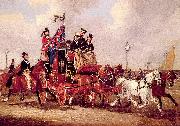 |
Pollard, James
|
|
English, 1792-1867
Painter and etcher, son of Robert Pollard. His early career was spent in the shadow of his father, for whom he worked as an etcher of miscellaneous sporting subjects before establishing himself c. 1820 as a sporting painter in his own right. A typical example is Doncaster Races: Horses Starting for the St Leger (1831; Paul Mellon priv. col.). Following a commission from the King's Printseller, Edward Orme, for an inn signboard showing a coach and horses, Pollard began to specialize in coaching scenes.
|
|
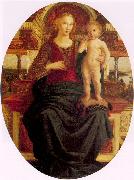 |
Pollaiuolo, Jacopo
|
|
Approx. 1441-1496
Painter, brother of Antonio Pollaiuolo. He was described as a painter in the membership records of the Compagnia di S Luca, which he joined in 1472. According to tradition, he initially trained under Andrea del Castagno. In his 1480 tax return Piero reported that he had a small house adjoining the family home '...which I use when I have painting to do'. He produced many paintings for the Florentine workshop,
|
|
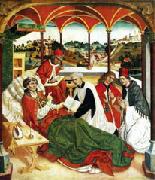 |
POLACK, Jan
|
|
Polish Northern Renaissance Painter, died 1519
|
|
 |
Pieter Jansz. Saenredam
|
|
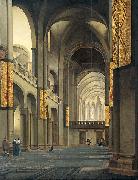
(June 9 1597 - buried May 31 1665) was a painter of the Dutch Golden Age, known for his distinctive paintings of whitewashed church interiors.
Saenredam was born in Assendelft, the son of the Northern Mannerist printmaker and draughtsman Jan Pietersz Saenredam (1565-1607), a follower of Goltzius whose sensuous naked goddesses are in great contrast with the work of his son. In 1612 he moved to Haarlem, where he became a pupil of Frans de Grebber and lived for the rest of his life. In 1614 he became a member of the Haarlem Guild of St. Luke. He died in Haarlem.
A contemporary of the painter-architects Jacob van Campen, Salomon de Bray, and Pieter Post, he is noted for his surprisingly modern paintings of church interiors, the great bulk of his production. Saenredam achieved this modern look by using very even light, subtlely modulated, and by removing detailed depiction of textures, in meticulously measured and drawn sketches. He would make these sketches in pencil, pen, and chalk, then and add in watercolor to help give the sketch texture and color. The sketches are detailed, conveying the interior atmosphere through the clever use of light and graduated shadows. Saenredam often deliberately omitted people and church furniture from work, thus focusing more attention on buildings and their architectural forms. Only after having made precise measurements, and precise sketches and drawings of the churches, he would take them to his studio where he started to create his paintings, often after a delay of many years. His emphasis on even light and geometry is brought out by comparing his works with those of the rather younger Emanuel de Witte, who included people, contrasts of light and such clutter of church furniture as remained in Calvinist churches, all usually ignored by Saenredam. Unlike de Witte's, Saenredam's views are usually roughly aligned with a main axis of the church.
|
|
 |
Pieter Jansz Saenredam
|
|
1597-1665
Dutch
Pieter Jansz Saenredam Gallery
Saenredam was the son of the print maker and draughtsman Jan Pietersz Saenredam (1565-1607), who was born in Zaandam or, in those days, Saenredam. In 1612 he moved to Haarlem, where he became a pupil of Frans de Grebber and lived the rest of his life.
A contemporary of Rembrandt, he is noted chiefly for his surprisingly modern paintings of churches. Saenredam achieved this modern look by meticulously measuring and making sketches of the churches he wanted to paint. He would make these sketches in pencil, pen, and chalk, then and add in water colors to help give the sketch texture and color. The sketches are very architectural in detail, they convey the interior atmosphere through the clever use of light and graduated shadows. Saenredam often deliberately left people out of his work, thus also focusing more attention on buildings and their architectural forms. Only after having made precise measurements, and precise sketches and drawings of the churches, he would take them to his studio where he started to create his paintings.
The Reformation led to a rise in Protestant art, of which Saenredam??s Interior of the St. Martin's Dom in Utrecht is an example. As a Catholic church the Dom had been built with adornments. Then, in the epoch of the Eighty Years War and with the church getting in Protestant hands, it was ??cleaned?? of Catholic influences. The altarpieces and statuary were removed, and the walls and ceiling were white washed. The painting shows the church not long after its make-over. The sparse interior with illuminated corridors reflect Protestant ideals, new for Saenredam's time.
Alternatively, the paintings of church interiors by Saenredam and other 17th century Dutch painters have been interpreted as having less to do with religion and more with the new-found interest in perspective and with the Dutch interpretation (known as Dutch Classicism) of Palladio??s theories of proportion, balance and symmetry.
In any case, Saenredam wanted to memorialize his country during this time of change by documenting many of the country??s buildings. Many artists before him had specialized in imaginary and fanciful architecture, but Saenredam was the first to focus on existing buildings. According to the J. Paul Getty Trust ??Saenredam??s church paintings??owe their poetry to his remarkable blend of fact and fiction. He began by making site drawings of buildings that record measurements and detail with archaeological thoroughness.?? This meticulous preparation helped him to create such accurate and enchanting paintings. The measurements aided him in using scientific linear perspective, just like Andrea Pozzo. He was able to use his measurements to create a realistic image with depth.
The Utrecht Archives houses a large number of Saenredam's drawings. In the season 2000-2001 the Centraal Museum at Utrecht held a major exhibition of his drawings and paintings. Perhaps his best known works are a pair of oil paintings both titled Interior of the Buurkerk, Utrecht. One hangs in London's National Gallery, the other in the Kimbell Art Museum in Fort Worth, Texas. In their simplicity and semi-abstract formalism, they foreshadow more modern works such as those of Mondrian and Feininger.
|
|
|
|
|
|
|
|
 |
Pierre-Jacques Cazes
|
|
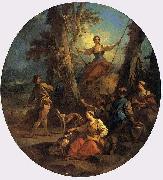
(1676-1754) was a French historical painter, known as the teacher of, among others, Chardin. In 1703, he became part of the Academie, was named as director in 1743 and chancellor in 1746. He also worked in the Galerie d'Apollon in the Louvre in 1727 and produced a large number of religious paintings for churches in Paris and Versailles. His historical painting is in the same academic tradition as the French painters Charles Le Brun and Charles de Lafosse. He also painted paintings with mythological motifs and genre scenes. A portrait the artist wearing a wig and holding a portfolio was presented to the Academie Royale in 1734 by Chardin's friend Joseph Aved.
|
|
 |
PIENEMAN, Jan Willem.
|
|
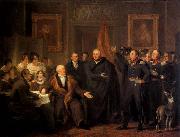
b. 1779, Abcoude, d. 1853, Amsterdam,Painter, teacher, engraver and museum director. He trained with a wallpaper painter in Amsterdam, and at the same time he followed courses at the Amsterdam Stadstekenacademie, where he soon distinguished himself. His artistic and didactic gifts were recognized by the Napoleonic government, which in 1805 appointed him professor of drawing at the artillery and engineering school in Amersfoort. In 1816 he was appointed assistant director of the Mauritshuis at The Hague by William I. He frequently spent time at the Dutch court, where he gave painting lessons to Queen Wilhelmina and painted many portraits of members of the royal family. He also produced a few engravings.
|
|
|
|
 |
Philip James de Loutherbourg
|
|
1740-1812
French (Resident in UK)
Philip James de Loutherbourg Gallery
Philip James de Loutherbourg, also seen as Philippe-Jacques and Philipp Jakob and with the appellation the Younger (31 October 1740 ?C 11 March 1812) was an English artist of French origin.
He was born in Strasbourg, where his father, the representative of a Polish family, practised miniature painting; but he spent the greater part of his life in London, where he was naturalized, and exerted a considerable influence on the scenery of the English stage, as well as on the artists of the following generation. De Loutherbourg was intended for the Lutheran ministry, and was educated at the University of Strasbourg.
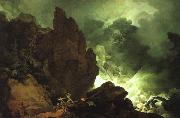
As the calling, however, was foreign to his nature, he insisted on being a painter, and placed himself under Charles-Andr?? van Loo in Paris. The result was an immediate and precocious development of his powers, and he became a figure in the fashionable society of that day. In 1767 he was elected into the French Academy below the age required by the law of the institution, and painted landscapes, sea storms, battles, all of which had a celebrity above those of the specialists then working in Paris. His debut was made by the exhibition of twelve pictures, including Storm at Sunset, Night, Morning after Rain.
He is next found travelling in Switzerland, Germany and Italy, distinguishing himself as much by mechanical inventions as by painting. One of these, showing quite new effects produced in a model theatre, was the wonder of the day. The exhibition of lights behind canvas representing the moon and stars, the illusory appearance of running water produced by clear blue sheets of metal and gauze, with loose threads of silver, and so on, were his devices. In 1771 he came to London, and was employed by David Garrick, who offered him £500 a year to apply his inventions to Drury Lane, and to superintend the scene-painting, which he did with complete success, making a new era in the adjuncts of the stage. Garrick's own piece, the Christmas Tale, and the pantomime, 1781-1782, introduced the novelties to the public, and the delight not only of the masses, but of Reynolds and the artists, was unbounded. The green trees gradually became russet, the moon rose and lit the edges of passing clouds, and all the world was captivated by effects we now take little notice of. A still greater triumph awaited him on his opening an entertainment called the Eidophusikon, which showed the rise, progress and result of a storm at sea that which destroyed the great Indiaman, the Halsewell,and the Fallen Angels raising the Palace of Pandemonium. De Loutherbourg has been called the inventor of the panorama, but this honor does not belong to him, although it first appeared about the same time as the eidophusicon. The first panorama was painted and exhibited by Scottish painter Robert Barker.
|
|
 |
Peto, John Frederick
|
|
American, 1854-1907
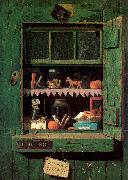
American painter. He trained at the Pennsylvania Academy of Fine Arts (1877-8), Philadelphia, where he became a friend of William Michael Harnett whose work was a dominant influence on his oeuvre. Peto maintained a studio in Philadelphia, exhibiting at the Academy from 1879 to 1887; he earned a living through occasional work as a photographer, sculptor and painter. After moving to Island Heights, NJ, in 1889,
|
|
 |
Peter Johannes Brandl
|
|
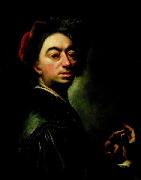
Petr Brandl (Peter Johannes Brandl or Jan Petr Brandl) (October 24, 1668 - September 24, 1735) was a painter of the late Baroque, famous in his time but - due to isolation behind the Iron Curtain - rather forgotten until recently. He was of German-speaking Austrian descent in the bilingual kingdom of Bohemia. His mother was from Czech peasant family, that lived in Přestanice (a village in Bohemia, now part of Hlavnovice). According to the Grove Dictionary of Art and other sources, Brandl was born into a craftsmanes family (his father seems to have been a goldsmith) and apprenticed around 1683 - 1688 to Kristien Schröder (1655 - 1702).
Brandl employed strong chiaroscuro, areas of heavy impasto and very plastic as well as dramatic figures. The major art museum in Prague, called the National Gallery, has an entire hall devoted to the artist's works, including the wonderful "Bust of an Apostle" from some time before 1725.
|
|
|
|
 |
PERRONNEAU, Jean-Baptiste
|
|
French Rococo Era Painter, ca.1715-1783
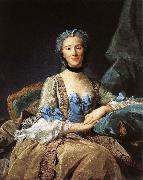
French pastellist, painter and engraver. He was, with his older contemporary Maurice Quentin de La Tour, the most important pastel artist and portrait painter in 18th-century France. Perronneau trained first with the engraver Laurent Cars and then with the successful portrait painter Hubert Drouais. His work as an engraver, which includes prints after Charles-Joseph Natoire, Fran?ois Boucher, Edme Bouchardon and Carle Vanloo (see Vaillat and Ratouis de Limay,), did not continue beyond the 1730s. Nevertheless, his involvement with Cars, much of whose work consisted in the reproduction of portraits by artists such as Hyacinthe Rigaud, left its mark on the composition of his pastels, most of which employ the bust-length format, often within a feigned stone oval typical of 17th- and 18th-century engraved portraits. His early pastel portrait of Mme Desfriches (1744; France, A.M. Ratouis de Limay priv. col.), mother of his friend and patron, the Orl?ans collector Aignan-Thomas Desfriches,
|
|
|
|
 |
Peale, James
|
|
American, 1749-1831
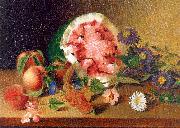
Painter, brother of Charles Willson Peale. Charles encouraged him to become a painter; James also worked as a frame-maker for his brother until the Revolution, in which he served as a lieutenant. From 1779 James shared Charles's practice, specializing in miniatures. His early work, occasionally confused with Charles's, shows his brother's influence. After 1794, his style became clearly his own: more delicate with subtle colour harmonies, softened outlines and free handling; it may be distinguished by a faint violet tone in the shadows and the inconspicuous signature 'IP'. His miniatures of male subjects are frequently superior to his portraits of women, for example Benjamin Harwood (1799; Baltimore, Mus. & Lib. MD Hist.), but his meticulous attention to costume and his success in imparting colour and sparkle to skin and eyes,
|
|
|
|
|
|
|
|
 |
Pater, Jean-Baptiste
|
|
French Rococo Era Painter, 1695-1736
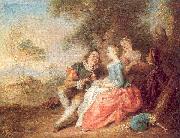
French painter and draughtsman. He was taught in Valenciennes by Jean-Baptiste Guid? (master 1697; d 1711) and also by his father, Antoine Pater (1670-1747), a sculptor whose portrait was painted by Antoine Watteau (Valenciennes, Mus. B.-A.), who was also a native of Valenciennes. He probably followed Watteau to Paris after the short stay that the latter made in Valenciennes around 1710. Pater thus became a pupil of Watteau. Watteau's difficult character led to Pater's dismissal. He then spent a few hard years on his own in Paris, before returning to Valenciennes around 1715 or 1716. He tried to work independently of the local corporation of St Luc, of which he was not a member; a number of comical legal difficulties ensued, and Pater returned to Paris in 1718. There he must have been in contact with Watteau, since he worked for some of the latter's clients, such as the dealers Pierre Sirois and Edm?-Fran?ois Gersaint, and the collector Jean de Jullienne. In the spring of 1721 the dying Watteau called Pater to him at Nogent, near Paris, apparently full of remorse for his previous attitude and wishing to instruct him in the basic tenets of his painting,
|
|
|
|
|
|
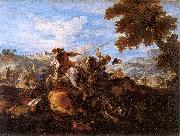 |
Parrocel, Joseph
|
|
French, 1646-1704
He studied with his father Barthelemy Parrocel (1595-1660) and then with his elder brother Louis Parrocel (1634-94). He went to Paris for four years to perfect his work and then, c. 1667, to Rome, where he became the pupil of the battle painter Jacques Courtois and was influenced by Salvator Rosa. He remained in Italy for eight years and stayed for a time in Venice, before returning to settle in Paris in 1675. He was approved (agree) by the Academie Royale de Peinture et de Sculpture in February 1676 and received as a full member in November of the same year, presenting the Siege of Maastricht (Draguignan, Mus. Mun.). His painted oeuvre consists principally of military scenes, particularly battles, and he received numerous royal commissions. In the period 1685-8 he executed 11 paintings for the Salle du Grand Couvert at the cheteau of Versailles (nine in situ; one in Tours, Mus. B.-A.; one in Dijon, Mus. B.-A.); in 1699 he painted the Crossing of the Rhine (Paris, Louvre.) for the cheteau of Marly, Yvelines, and in 1700 he executed the Fair at Bezons (Tours, Mus. B.-A.), anticipating the fetes galantes of Antoine Watteau. He was also the author of a number of hunting scenes . His most important religious paintings were the May of Notre-Dame de Paris of 1694, St John the Baptist Preaching (Arras, Mus. B.-A.) and St Augustin Succouring the Sick (c. 1703; Nantes, Mus. B.-A.), which was intended for the monastery in the Place des Victoires in Paris. He also contributed battle scenes to the backgrounds of portraits by Hyacinthe Rigaud and by Gabriel Blanchard. His technique was highly original in the context of his time; he employed a very free style of execution and used thick impasto and intense colours. He was also a prolific engraver, producing around 100 plates,
|
|
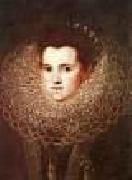 |
PANTOJA DE LA CRUZ, Juan
|
|
Spanish Painter, 1553-1608
Spanish painter. He must have moved to Madrid when he was very young, receiving his training in the workshop of Alonso S?nchez Coello, painter to Philip II. On numerous occasions he declared himself to be a follower of S?nchez Coello, in whose workshop he was an oficial, and he probably collaborated to a considerable degree on many of his master's mature works. There are very few signed works by Pantoja from before the death of S?nchez Coello, although some anonymous paintings from the workshop are probably by him. In Madrid in 1587 Pantoja married a woman of some means, and by the following year, when S?nchez Coello died, he was an independent painter, aspiring to his master's position. Documentation exists from 1590 concerning portraits by Pantoja of members of the royal family including one of Don Felipe, the future Philip III (1593; Vienna, Ksthist. Mus.). On Philip's accession to the throne in 1598 Pantoja painted another portrait of him (Vienna, Ksthist. Mus.) and became the official portrait painter for the court and for the nobility of Madrid; there is detailed documentation for his work from this time. He painted clothing and jewels with precision, in minute detail and with a dry objectivity in the Flemish tradition. His treatment of faces, however, clearly reveals his study of Venetian portraiture, and in particular that of Titian, as well as sharp psychological penetration. In his portraits of royal children he maintained, albeit with a certain rigidity, the charm that S?nchez Coello in his paintings had given these infant figures tightly swathed in official robes
|
|
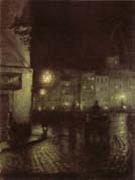 |
Pankiewicz, Jozef
|
|
1866-1940
Jozef Pankiewicz (Lublin November 29 1866 - July 4 1940) was a Polish painter, graphic artist, and pedagogue. In his summer years he studied under Wojciech Gerson and Alexander Kaminski. He travelled to Saint Petersburg with Władysław Podkowinski after winning a scholarship to the Imperial Academy of Arts there. In 1889, both artists left for Paris.
|
|
|
|
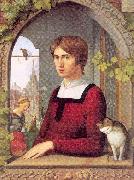 |
Overbeck, Johann Friedrich
|
|
German Painter, 1789-1869
German religious painter. Expelled from the Vienna Academy because of his opposition to its classicism, he went to Rome and with Peter von Cornelius, Veit, Schadow-Godenhaus, and others, formed the group known as the Nazarenes. His first real successes were his frescoes for the Casa Bartholdy (now in Berlin) and for the Villa Massimo. Among his notable paintings are Christ's Entry into Jerusalem and Christ's Agony in the Garden. Overbeck sought to make his art serve religion.
|
|
|
|
|
|
|
|
|
| Wholesale China Oil Painting Wholesale Oil Painting China Xiamen Portrait Reproduction on canvas Chinese Oil Painting Wholesale USA Oil Painting |
|
|
|
|
|