| |
|
Xiamen Oil Paintings, Wholesale Direct!
|
|
100% hand painted, 100% cotton canvas, 100% money back if not satisfaction. |
|
|
|
|
ART WORKS INDEX
A
B
C
D
E
F
G
H
I
J
K
L
M
N
O
P
Q
R
S
T
U
V
W
X
Y
Z
|
|
ARTISTS INDEX
A
B
C
D
E
F
G
H
I
J
K
L
M
N
O
P
Q
R
S
T
U
V
W
X
Y
Z
|
|
|
|
 |
Juan Rizi
|
|
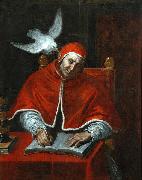
was a Spanish painter of the Baroque period. He was born in Madrid in 1600. He was a brother of Francisco Rizi, and a pupil of Juan Bautista Mayno. In 1628 he entered the Benedictine Order, studied in Salamanca, and became Abbot of the Medina del Campo in Madrid (?).
He painted several works for St. Juan Bautista in Burgos, St. Martin in Madrid, and Monte Cassino in Italy. In the Madrid Museum is a St. Francis of Assisi by him (?). He afterwards went to Rome, where he was made an Archbishop (?) by pope Clement X. He died at Monte Cassino in 1681.
|
|
 |
Juan Ribalta
|
|
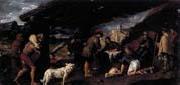
b. 1597, Madrid, d. 1628, Valencia,was a Spanish painter of the Baroque period. Born and died in Valencia. His father, Francisco Ribalta, was a famous painter, active in the style of Caravaggio. Juan's works and style are similar to that of his father.
|
|
 |
Juan Pantoja de la Cruz
|
|
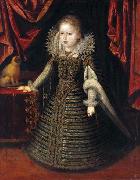
(Valladolid, 1553 - 26 October 1608, Madrid) Spanish painter, one of the best representatives of the Spanish school of court painters. He worked for Philip II and Philip III. The Museo del Prado contains examples of his severe portraiture style.
Juan Pantoja de La Cruz was, born 1553 in Valladolid. Very little is known of his formative years as a painter. He was a pupil of the court painter Alonso Senchez Coello in Madrid and he must have assisted his master in complying with his duties as painter of the Spanish King, Philip II. Pantoja probably continued to work in his master studio after completing his training. He married in 1585 beginning to paint for the court around that time. After Sanchez Coello's death in 1588, Pantoja took over his master workshop and became court painter to Philip II of Spain.
Pantoja kept working for the court and the nobility, painting portraits of Prince Philip, the future Philip III, in 1592 and 1594. Among his most well known works is the portrait of Philip II wearing a cape and hat all in black, painted around 1594 for the Escorial. This portrait is one of the best representations of the idea of Spanish majesty, based on the remoteness of the monarch. On Philip II's death in 1598, Philip III confirmed Pantoja's status as court painter. When the court settled in Valladolid in 1601, Pantoja moved to the new capital, remaining in this city, several years.
|
|
 |
Juan Martin Cabezalero
|
|
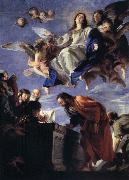
1633-1673
was a Spanish draftsman and painter. Born in Almaden, he studied under Juan Carreno de Miranda, court painter to Charles II of Spain; Cabezalero lived at Carreno de Miranda's house until 1666. Both he and Carreno were influenced by Van Dyck. Few works by Cabezalero have survived. His surviving works include his St Jerome (1666, Meadows Museum, Southern Methodist University, Dallas) and the Assumption of the Virgin (ca. 1670; Madrid, Prado). The latter had been formerly attributed to Mateo Cerezo, also a pupil of Carreno de Miranda. Antonio Palomino praises Cabezalero's modest, studious nature and laments that he died young.
|
|
 |
Juan Manuel Blanes
|
|
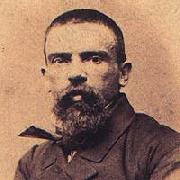
(June 8, 1830 - April 15, 1901) was a noted Uruguayan painter of the Realist school.
Blanes was born in Montevideo, Uruguay, in 1830. He was raised by his mother, with whom he relocated to the countryside in his early teens. Blanes took an interest in drawing at this point, and shortly afterwards, was hired as an illustrator for a Montevideo newsdaily, El Defensor de la Independencia Americana. Earning extra income with watercolors, he returned to his mother and, in 1854, established his first atelier.
He married Marea Linari, and in 1855, the couple settled in Salto, where he worked as a portrait painter. They relocated to Concepcien del Uruguay (across the Uruguay River, in Argentina) in 1857, and Blanes was commissioned by Argentine President Justo Jose de Urquiza to complete a number of portraits, allegories and landscapes to grace his nearby estancia, the Palacio San Jose. Returning to Montevideo in 1861, the talented painter obtained a scholarship from the Uruguayan government, and with it, traveled with his family to Florence, Italy, where he studied under Antonio Ciseri until 1864.
The experience became a valuable calling card for Blanes, who became of Uruguay's most sought-after portraiteurs. The 1871 outbreak of a yellow fever epidemic in Buenos Aires inspired his first renowned work, which he exhibited to acclaim in the recovering city. His 1872 portrait of the Argentine War of Independence hero, General Jose de San Marten (The Review in Rancagua), was also a success in Buenos Aires, and Blanes was invited to Chile to display the historic depiction.
|
|
 |
Juan Luna
|
|
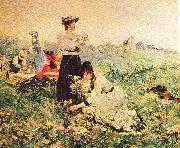
Juan Luna y Novicio (October 23, 1857 - December 7, 1899) was an Ilocano Filipino painter, sculptor and a political activist of the Philippine Revolution during the late 19th century. He became one of the first recognized Philippine artists.
His winning the gold medal in the 1884 Madrid Exposition of Fine Arts, along with the silver win of fellow Filipino painter Felix Resurreccien Hidalgo, prompted a celebration which was a major highlight in the memoirs of members of the Propaganda Movement, with the fellow Ilustrados toasting to the two painters' good health and citing their win as evidence that Filipinos and Spaniards were equals.
Regarded for work done in the manner of the Spanish and French academies of his time, Luna painted literary and historical scenes, some with an underscore of political commentary.
|
|
|
|
 |
Juan Gris
|
|
1887-1927
Born in Madrid, he studied mechanical drawing at the Escuela de Artes y Manufacturas in Madrid from 1902 to 1904, during which time he contributed drawings to local periodicals. From 1904 to 1905 he studied painting with the academic artist Jose Maria Carbonero.
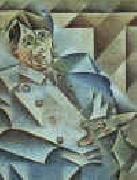
In 1906 he moved to Paris and became friends with Henri Matisse, Georges Braque, Fernand Leger, and in 1915 he was painted by his friend, Amedeo Modigliani. In Paris, Gris followed the lead of another friend and fellow countryman, Pablo Picasso. His portrait of Picasso in 1912 is a significant early Cubist painting done by a painter other than Picasso or Georges Braque. (Although he regarded Picasso as a teacher, Gertrude Stein acknowledged that Gris "was the one person that Picasso would have willingly wiped off the map.")
Portrait of Picasso, 1912, The Art Institute of Chicago.Although he submitted darkly humorous illustrations to journals such as Le Rire, L'assiette au beurre, Le Charivari, and Le Cri de Paris, Gris began to paint seriously in 1910. By 1912 he had developed a personal Cubist style.
At first Gris painted in the analytic style of Cubism, but after 1913 he began his conversion to synthetic Cubism, of which he became a steadfast interpreter, with extensive use of papier coll??. Unlike Picasso and Braque, whose Cubist works were monochromatic, Gris painted with bright harmonious colors in daring, novel combinations in the manner of his friend Matisse.
In 1924, he first designed ballet sets and costumes for Sergei Diaghilev and the famous Ballets Russes.
Gris articulated most of his aesthetic theories during 1924 and 1925. He delivered his definitive lecture, Des possibilit??s de la peinture, at the Sorbonne in 1924. Major Gris exhibitions took place at the Galerie Simon in Paris and the Galerie Flechtheim in Berlin in 1923, and at the Galerie Flechtheim in D??sseldorf in 1925.
He died in Boulogne-sur-Seine (Paris) in the spring of 1927 at the age of forty, leaving a wife, Josette, and a son, Georges.
|
|
 |
Juan Fernandez de Navarrete
|
|
Spanish painter
1526-1579
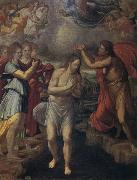
was a Spanish Mannerist painter, born at Logroño. An illness in infancy deprived Navarrete of his hearing, but at a very early age he began to express his wants by sketching objects with a piece of charcoal. He received his first instructions in art from Fray Vicente de Santo Domingo, a Hieronymite monk at Estella, and also with Becerra. He visited Naples, Rome, Florence and Milan. Pellegrino Tibaldi met him in Rome in 1550. According to most accounts he was for a considerable time the pupil and assistant of Titian at Venice. In 1568 Philip II of Spain summoned him to Madrid with the title of king's painter and a salary, and employed him to execute pictures for the Escorial. During the 1560s and 1570s the huge monastery-palace of El Escorial was still under construction and Philip II was experiencing difficulties in finding good artists for the many large paintings required to decorate it. Titian was very old, and died in 1576, and Tintoretto, Veronese and Anthonis Mor all refused to come to Spain. Philip had to rely on the lesser talent of Navarrete, whose gravedad y decoro ("seriousness and decorum") the king approved. For eleven years until his death Navarrete worked largely on El Escorial. The most celebrated of the works he produced there are a "Nativity" (in which, as in the well-known work on the same subject by Correggio, the light emanates from the infant Saviour), a "Baptism of Christ" (now Prado), and "Abraham Receiving the Three Angels" (one of his last works, dated 1576).
|
|
|
|
 |
Juan de Valdes Leal
|
|
Seville 1622-1690
was a Spanish painter of the Baroque era. He was born at Seville in 1622, and distinguished himself as a painter, sculptor, and architect. He worked for a time under Antonio del Castillo. Among his works are a History of the Prophet Elias for the church of the Carmelites; a Martyrdom of St. Andrew for the church of San Francesco at Cerdoba; and a Triumph of the Cross for la Caridad at Seville. He was one of the founders of the Seville Academy along with his friend, Bartolome Esteban Murillo. He died at Seville. His wife (daughter of Antonio Palomino), Isabella Carasquilla, was also a painter. She died at Seville as late as 1730. Their children were artists, including Lucas, Juan, Maria, and Laura de Valdes. His daughters specialized in portrait miniatures.
|
|
|
|
 |
Juan de Juanes
|
|
1523-1579
Spanish
Juan de Juanes Gallery
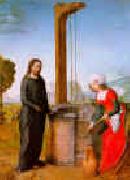
Born in Bocairent and was considered the premier painter of the Valencian school of painters, and often called "the Spanish Raphael", was born at La Font de la Figuera in the province of Valencia. He is said to have studied his art for some time in Rome, with which school his affinities are closest, but he greater part of his professional life was spent in the city of Valencia, where most of the extant examples of his work are now to be found. All relate to religious subjects, and are characterized by dignity of conception, accuracy of drawing, ruth and beauty of color, and minuteness of finish. He died at Bocairent (near X??tiva) while engaged upon an altarpiece in the church there.
Since his name Macip made him sound like a laborer (macero), he adopted the name of Juanes or de Juan, and the heraldy of that family of nobility. He painted a Raphaelesqe Holy Family for the sacristy in the Cathedral of Valencia. He never painted a profane subject, and emulated Luis de Cargas and Fra Angelico de Fiesole, in never painting unless he had underwent holy communion. Painting for him was a solemn exercise, an oratory process, full of prayers and fasts. He never lacked church patronage; the archbishop of Valencia, St. Thomas of Villanova, ordered a set of cartoon panels about the Life of the Virgin to model for some tapestries. He also painted for the churches of the Jesuits, Domicans, Minims, Augustinians, Franciscans, and for the churches of San Nicol??s , Santa Cruz , Carmen Calzado, St Esteban, Corona, Temple, San Andr??s, San Bartolom?? and San Miguel de los Reyes. Among his best works is the Immaculate Conception painted for the Jesuit church, supposedly inspired by a revelation undergone by the painter's confessor, Father Martin Alberto, confesor del pintor. Macip also painted portraits. His son, Juan Vicente Joanes, imitated his style. His two daughters, Dorotea and Margarita were also painters. Him most prominent pupil was Nicolas Borras.
|
|
 |
Juan de Flandes
|
|
Flemish-born Spanish Northern Renaissance Painter, ca.1460-1519
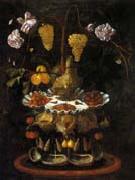
South Netherlandish painter, active in Spain. Nothing is known of his life or work before he went to Spain, where he is first mentioned in a document of 1496 as Juan de Flandes, a painter in the service of Queen Isabella of Castile. Treasury accounts confirm that he held this position until the Queen death in 1504. On arriving in Spain, he must have lived in Burgos, where he certainly met MICHEL SITTOW, another painter in the Queen service, who had been at the Castilian court since 1492.
|
|
 |
Juan de Espinosa
|
|
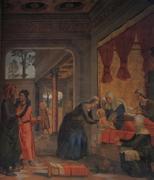
Spanish Baroque Era Painter, ca.1590-1641, Spanish painter. Details of his life are scarce. He is documented in Madrid and Toledo between 1612 and 1626, and while he is recorded as having painted religious pictures and portraits (untraced), he is only known today for his still-life paintings. Documents relating to another artist of the same name, known as Juan de Espinosa, dating from 1645 to 1677, concern a different painter.
|
|
 |
Juan de Borgona
|
|
Spanish Painter,
ca.1470-1534
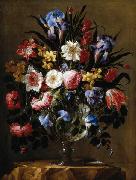
was a High Renaissance painter who was born in the Duchy of Burgundy, probably just before it ceased to exist as an independent state, and was active in Spain from about 1495 to 1534. His earliest documented work was painted in 1495 for the cloister of the Cathedral of Toledo. Borgoña??s compositions are well balanced with finely drawn figures in elegant, tranquil poses. They are set either against open spaces leading on to craggy landscapes or against gold embroidered drapery. There were a number of foreign painters active in Spain in this period, including Juan de Flandes. Borgona??s students include Pedro de Cisneros the Elder (died 1546), Antonio de Comontes (ca. 1500-1519),
|
|
 |
Juan de Arellano
|
|
(3 August 1701 - 13 October 1776) was a Spanish painter of the Baroque era who specialized in floral still life paintings.
Born in Santorcaz, near Madrid, where he died. He was a pupil of Juan de Solis. Heavily influenced by Flemish and Italian painters (such as Mario Nuzzi), Juan de Arellano was considered to be exceptional in this thematic. According to one of his colleagues, de Arellano decided to focus exclusively on floral paintings because it offered more pay while requiring less work . Some of de Arellano's most famous pieces include Bouquet of Flowers (c.1660), and Garland of Flowers, Birds and Butterfly, currently on display at the Louvre. He also painted for the sacristy of the church of San Jerenimo el Real of Madrid. See Bodegen for a description of one style of Spanish still life painting.
|
|
 |
Juan de Espinosa
|
|
Spanish Baroque Era Painter, ca.1590-1641
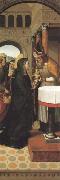
Spanish painter. Details of his life are scarce. He is documented in Madrid and Toledo between 1612 and 1626, and while he is recorded as having painted religious pictures and portraits (untraced), he is only known today for his still-life paintings. Documents relating to another artist of the same name, known as Juan de Espinosa, dating from 1645 to 1677, concern a different painter.
|
|
 |
Juan Correa de Vivar
|
|
Spanish , c.1510-1566
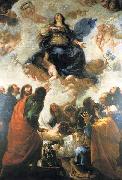
was a Spanish painter,Correa's date of birth has been determined to be around 1510. Records show he grew up wealthy. When Juan was 17 or 18 years old he joined an artist workshop in Burgundy where he met with many other Spanish artists at the time, including Pedro de Cisneros whom he befriended. Juan's brother Eufrasia and Eufrasia's son Rodrigo also grew up to be artists. Rodrigo was apprenticed with his uncle, and continued some of his uncle's works after his death. In Mascaraque, Juan was a substantial landowner with a nice house where he did much of his painting. He took frequent trips but always stayed in the Toledo area. Juan was married and a religious man. It can be seen in his testament: a copy was found in the church files of Mascaraque. When he died, Juan split all his possessions between his nephew Rodrigo and the church of Mascaraque. Juan was a well-regarded painter during his life, but many records were lost. His works and life were brought to light again when the researcher and art historian Ceen Bermudez in 1800 published a dictionary of famous artists and included a brief article about his works and Italian influences. The full reconstruction of its biography has been primarily accomplished in the 20th century. Records show Juan died on April 16, 1566 in San Miguel. Juan's body was taken back to Mascaraque where he was buried, in the same plot where his parents were laid to rest. Many members of the artistic community came to the funeral service,
|
|
 |
Juan Carreno de Miranda
|
|
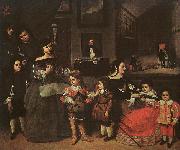
English: Juan Carreño de Miranda (March 1614-September 1685) was a Spanish painter of the Baroque period.
Español: Juan Carreño de Miranda (Aviles, 1614 - Madrid, 1685) fue un pintor español del siglo XVII, que destace en la Corte española de Felipe IV, y, sobre todo, Carlos II.
|
|
 |
Juan Bautista Martinez del Mazo
|
|
1612-1667
Spanish
Juan Bautista Martinez del Mazo Gallery
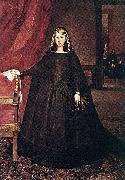
Mazo??s works owe credit above all to Vel??zquez, whose style he was long compelled to emulate in court portraits. However, Mazo shows in his paintings a personality of his own. His portraits exhibit startling naturalism and marvelously executed. Mazo was specially skillful in painting small figures, a cardinal element in both his hunting scenes and the landscapes he painted as in his most celebrate work View of Saragossa.
Mazo??s palette was rather like that of Vel??zquez, except for a penchant often shown for stressing blue or bluish tints. .The departure from his master style was in his way of shaping people and things by highlights which flash the pictorial image towards the surface of the painting, even from the background.. As a counterbalance, an explicit, even emphatic, perspective design marks out the spatial confines of the composition, making it appear squarish.. A further departure from Velazquez is his luxurious depiction of detail or incident, which he achieved with brilliant, depthless strokes, whether on the figure of a sitter, a curtain on a wall, a floor, the surface of a river, or plain grounds. .These stylistic traits reveal Mazo??s own personality as an artist. .For centuries, Mazo??s paintings were attributed to Vel??zquez, but modern art criticism, techniques and knowledge have been able to separate their works.
|
|
 |
Juan Bautista del Mazo
|
|
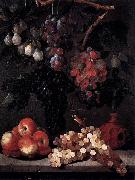
Juan Bautista Martenez del Mazo (c.1612 - 10 February 1667) was a Spanish Baroque portrait and landscape painter, the most distinguished of the followers of Velezquez, whose style he imitated more closely than did any other artist. A fine painter himself, Mazo was a master of landscape, as proven by his most celebrated work View of Saragossa.
|
|
 |
Juan Bautista de Espinosa
|
|
(1590-1641, Madrid) was a Spanish still life painter.
More paintings remain of him than biographical data and there is only one known painting remaining.
It is only known that he worked in Toledo and Madrid from 1612 to 1626 and, judging by his style, he was trained in Holland. De Espinosa's style is judged to be the transition from Flemish Baroque to Spanish Baroque.
Several mural paintings in Spanish churches are also attributed to him; one of these is in Alcaudete.
|
|
 |
Juan Antonio Ribera Y Fernandez
|
|
1779-1860
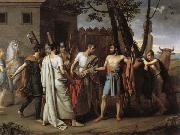
was a Spanish painter, born at Madrid. He first studied under Francisco Bayeu and enrolled into the Royal Academy of San Fernando, but afterwards went to Paris and become the pupil of Jacques-Louis David. There he painted his Cincinnatus which is now in the Prado Museum. In course of time he went to Rome, and in 1811 was appointed painter to Carlos IV and member of the Academy of St. Luke; and in 1820, honorary member of the Academy of San Fernando. In 1838 he was made professor, and two years afterwards Director of the Prado. He died at Madrid.
|
|
 |
Juan Antonio Escalante
|
|
Spanish Baroque Era Painter, 1633-1670
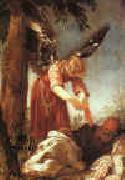
Spanish painter. He was an outstanding figure in decorative Baroque art. When quite young he moved from Andalusia to Madrid, where he apparently worked with and was influenced by Francisco Rizi. His artistic development reveals an increasing admiration for Veronese, Tintoretto and Titian, although elements of the style of Alonso Cano persist. Among his first works is Andromeda and the Dragon (c. 1659; Madrid, Prado), whose mannerist elements derive from an engraving of the subject by Agostino Carracci. The two brilliant works St Catherine of Alexandria (Madrid, Las Maravillas) and Road to Calvary (Madrid, Real Acad. S Fernando), signed and dated 1660, are executed with an agile and self-assured technique, in colours that stem from Venetian painting. Like other Spanish painters of the period, he painted numerous versions of the Immaculate Conception (e.g. 1660, Colegio de Villafranca de los Barros; 1663, Budapest, Mus. F.A.; c. 1666, Benedictine monastery of Lumbier, Navarre), which are more Baroque in style and expression than those of Jose Antolenez and Mateo Cerezo. In these the faces, surrounded by luxuriant hair, is expressed an innocent candour that contrasts with the turbulent appearance of the cherubs. Also characteristic of his style are the versions of the Annunciation (1653; New York, Hisp. Soc. America Mus; B?ziers, Mus. B.-A.). He treated the theme of St Joseph with great nobility, as in the Dream of St Joseph (1666; New York, Chrysler Col.). His deep lyrical feelings pervade the various paintings of the Infant St John (Madrid, Prado).
|
|
 |
Jozsef Rippl-Ronai
|
|
Hungarian Painter, 1861-1927
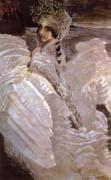
After his studies at the highschool in Kaposvar he went to study to Budapest, where he got a degree in pharmacy. In 1884 he travels to Munich to study painting at the Academy. 2 years later he gets a grant and that makes him able to move to Paris and study by Munkacsy. In 1888 he meets with the members of Les Nabis and under their influence he paints his first important work The Inn at Pont-Aven, a very deep paining with dark atmosphere. His first big success was the paining My Grandmother (1894).
Later he travels back to Hungary, first the critics does not accept him very warmly, but finally he celebrates a success with the exhibition Rippl-Ronai Impressions 1890-1900. He believes that for an artist there is important not only his work, but also how he lives and what he wears. That is why he becomes also a designer (Andrassy dining room and the window-pane in the Ernst Museum). His exhibitions in Frankfurt, Munich and Vienna have got a great success in 1911-1913. He paints his last big work in 1919 (portrait of his friend Zorka) and in 1927 dies in his villa Roma in Kaposvar.
|
|
|
|
 |
Jozef Simmler
|
|
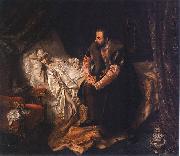
Jozef Simmler (March 14, 1823 - March 1, 1868) was a Polish painter known for his classical style and his Polish subjects.
Perhaps his most famous work is Death of Barbara Radziwillowna. an oil on canvas work completed in 1860. It now hangs in the National Museum, Warsaw. His daughter's brother-in-law was Eduard Strasburger, the famous Polish-German botanist. One of Simmler's grandsons was Henryk Leon Strasburger, a Polish delegate to the League of Nations
|
|
 |
Jozef Peszka
|
|
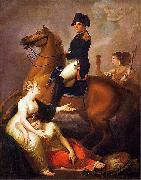
(1767 in Krakew - 1831 in Krakew) was a Polish painter.
He studied painting in Warsaw under Franciszek Smuglewicz. From 1815 he was a professor of painting in Krakew Academy of Arts (Akademia Sztuk Pięknych w Krakowie).
He painted portraits and larger paintings with historical or mythological themes.
|
|
 |
jozef marian chelmonski
|
|
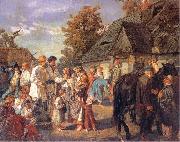
Jozef Marian Chełmoski (November 7, 1849 -- April 6, 1914) was a Polish painter.
Chełmoski was born in the village of Boczki near Łowicz in central Congress Poland, Russian Empire. His first drawing teacher was his father (a small leaseholder and administrator of Boczki village). After finishing high school in Warsaw, he studied in Warsaw Drawing Class (1867C1871) and took private lessons from Wojciech Gerson. From 1871 to 1874 Chełmoski lived in Munich. He worked with Polish painters assembled around Jozef Brandt and Maksymilian Gierymski. He also had studied for a few months at the academy of H. Anschutz and A. Strahuber. In 1872 and 1874 Chełmoski visited the Polish territories (Poland as a country did not exist then), Tatra Mountains and Ukraine.
His first paintings were done under the influence of Gerson. The works that followed were landscapes and villages. In 1875 Chełmoski went to Paris, where he had many important exhibitions and became known to the art scene. With many orders, the artistic level of his paintings decreased.
From 1878 to 1887 Chełmoski visited Poland, Vienna and Venice. In 1887 he returned to Poland and in 1889 settled in Kuklewka Zarzeczna village. Contact with his homeland and nature revealed quality in his artworks. From that time are the best liked Chełmoski's paintings such as Partridge on the Snow, The Storks or Before Thunderstorm.
Chełmoski represented the trend in art called "Polish Patriotic Painting".
He died in Kuklewka near Grodzisk Mazowiecki in 1914.
|
|
|
|
Jozef Marian Chelmonski
|
|
(November 7, 1849 - April 6, 1914) was a Polish painter.
Chełmoeski was born in the village of Boczki near Łowicz in central Congress Poland, Russian Empire. His first drawing teacher was his father (a small leaseholder and administrator of Boczki village). After finishing high school in Warsaw, Jozef studied in Warsaw Drawing Class (1867-1871) and took private lessons from Wojciech Gerson. From 1871 to 1874 Chełmoeski lived in Munich. He worked with Polish painters assembled around Jozef Brandt and Maksymilian Gierymski. There, he also studied for a few months at the academy of H. Anschutz and A. Strahuber. In 1872 and 1874 Chełmoeski visited the Polish Territories (Poland, as an independent country, did not exist during this time), Tatra Mountains and Ukraine.
His first paintings were done under the influence of Gerson. The works that followed were landscapes and villages. In 1875 Chełmoeski went to Paris, where he had many important exhibitions and became known to the art scene. With many orders, the artistic level of his paintings decreased.
From 1878 to 1887 Chełmoeski visited Poland, Vienna and Venice. In 1887 he returned to Poland and in 1889 settled in the village of Kuklewka Zarzeczna. Contact with his homeland and nature are qualities revealed in his artworks. From that time are the best liked, or the most beloved of Chełmoeski's paintings are paintings such as Partridge on the Snow, The Storks or Before Thunderstorm.
|
|
 |
Jozef Israels
|
|
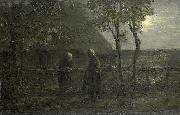
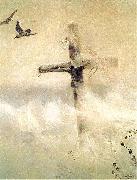
(27 January 1824, Groningen - 12 August 1911, Scheveningen) was a Dutch painter, and "the most respected Dutch artist of the second half of the nineteenth century".
|
|
 |
Jozef Chelmonski
|
|
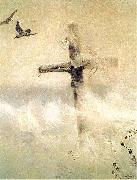
(November 7, 1849 -- April 6, 1914) was a Polish painter.
Chełmonski was born in the village of Boczki near Łowicz in central Congress Poland, Russian Empire. His first drawing teacher was his father (a small leaseholder and administrator of Boczki village). After finishing high school in Warsaw, he studied in Warsaw Drawing Class (1867--1871) and took private lessons from Wojciech Gerson. From 1871 to 1874 Chełmonski lived in Munich. He worked with Polish painters assembled around Jozef Brandt and Maksymilian Gierymski. He also had studied for a few months at the academy of H. Anschutz and A. Strahuber. In 1872 and 1874 Chełmonski visited the Polish territories (Poland as a country did not exist then), Tatra Mountains and Ukraine.
His first paintings were done under the influence of Gerson. The works that followed were landscapes and villages. In 1875 Chełmonski went to Paris, where he had many important exhibitions and became known to the art scene. With many orders, the artistic level of his paintings decreased.
From 1878 to 1887 Chełmonski visited Poland, Vienna and Venice. In 1887 he returned to Poland and in 1889 settled in Kuklawka Zarzeczna village. Contact with his homeland and nature revealed quality in his artworks. From that time are the best liked Chełmonski's paintings such as Partridge on the Snow, The Storks or Before Thunderstorm.
Chełmonski represented the trend in art called "Polish Patriotic Painting".
He died in Kuklawka near Grodzisk Mazowiecki in 1914.
|
|
 |
Jozef Chelmonski
|
|
(November 7, 1849 - April 6, 1914) was a Polish painter.
Chełmoski was born in the village of Boczki near Łowicz in central Congress Poland, Russian Empire. His first drawing teacher was his father (a small leaseholder and administrator of Boczki village). After finishing high school in Warsaw, he studied in Warsaw Drawing Class (1867-1871) and took private lessons from Wojciech Gerson. From 1871 to 1874 Chełmoski lived in Munich. He worked with Polish painters assembled around Jozef Brandt and Maksymilian Gierymski. He also had studied for a few months at the academy of H. Anschutz and A. Strahuber. In 1872 and 1874 Chełmoski visited the Polish territories. Tatra Mountains and Ukraine.
His first paintings were done under the influence of Gerson. The works that followed were landscapes and villages. In 1875 Chełmoski went to Paris, where he had many important exhibitions and became known to the art scene. With many orders, the artistic level of his paintings decreased.
From 1878 to 1887 Chełmoski visited Poland, Vienna and Venice. In 1887 he returned to Poland and in 1889 settled in Kuklewka Zarzeczna village. Contact with his homeland and nature revealed quality in his artworks. From that time are the best liked Chełmoski's paintings such as Partridge on the Snow, The Storks or Before Thunderstorm.
|
|
|
|
Jozef Chelmonski
|
|
(November 7, 1849 - April 6, 1914) was a Polish painter.
Chełmoki was born in the village of Boczki near Łowicz in central Congress Poland, Russian Empire. His first drawing teacher was his father (a small leaseholder and administrator of Boczki village). After finishing high school in Warsaw, Jozef studied in Warsaw Drawing Class (1867-1871) and took private lessons from Wojciech Gerson. From 1871 to 1874 Chełmoki lived in Munich. He worked with Polish painters assembled around Jozef Brandt and Maksymilian Gierymski. There, he also studied for a few months at the academy of H. Anschutz and A. Strahuber. In 1872 and 1874 Chełmoki visited the Polish Territories (Poland, as an independent country, did not exist during this time), Tatra Mountains and Ukraine.
His first paintings were done under the influence of Gerson. The works that followed were landscapes and villages. In 1875 Chełmoki went to Paris, where he had many important exhibitions and became known to the art scene. With many orders, the artistic level of his paintings decreased.
From 1878 to 1887 Chełmoki visited Poland, Vienna and Venice. In 1887 he returned to Poland and in 1889 settled in the village of Kuklewka Zarzeczna. Contact with his homeland and nature are qualities revealed in his artworks. From that time are the best liked, or the most beloved of Chełmoki's paintings are paintings such as Partridge on the Snow, The Storks or Before Thunderstorm.
Chełmoki represented the trend in art called "Polish Patriotic Painting".
He died in Kuklewka near Grodzisk Mazowiecki in 1914.
|
|
 |
jozef brandt
|
|
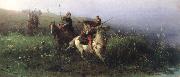
Jozef Brandt (b. Szczebrzeszyn, 1841 - Radom, 1915) was a Polish painter, best known for his paintings of battles.
Brandt studied in Warsaw in the school of J.N. Leszczynski and at the Noblemen Institute. In 1858 he left for Paris to study at the Ecole centrale Paris but was persuaded by Juliusz Kossak to abandon engineering in favor of painting. At one point he studied as a painter under Franz Adam.
|
|
 |
Jozef Israels
|
|
1824-1911
Dutch
Jozef Israels Gallery
Israels has often been compared to Jean-François Millet. As artists, even more than as painters in the strict sense of the word, they both, in fact, saw in the life of the poor and humble a motive for expressing with peculiar intensity their wide human sympathy; but Millet was the poet of placid rural life, while in almost all Israels' pictures there is some piercing note of woe. Edmond Duranty said of them that they were painted with gloom and suffering.
He began with historical and dramatic subjects in the romantic style of the day. By chance, after an illness, he went to recruit his strength at the fishing-town of Zandvoort near Haarlem, and there he was struck by the daily tragedy of life. Thenceforth he was possessed by a new vein of artistic expression, sincerely realistic, full of emotion and pity.
Among his more important subsequent works are The Zandvoort Fisherman (in the Amsterdam gallery), The Silent House (which gained a gold medal at the Brussels Salon, 1858) and Village Poor (a prize at Manchester).
In 1862 he achieved great success in London with his Shipwrecked, purchased by Mr Young, and The Cradle, two pictures that the Athenaeum magazine described as the most touching pictures of the exhibition.
|
|
 |
JOUVENET, Jean-Baptiste
|
|
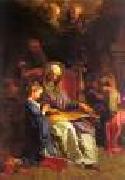
French painter (b. 1644, Rouen, d. 1717, Paris).
French painter, one of a family of painters. He worked in Paris in the studio of Charles Le Brun, whose manner he acquired and whose favor at court he shared. He is best known for his religious paintings; the most important are the series of four canvases for St. Martin des Champs, including the Miraculous Draught of Fishes
|
|
 |
Jost Amman
|
|
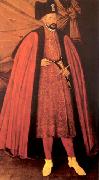
(June 13, 1539, Zerich - March 17, 1591, Nuremberg, Bavaria) was a Swiss artist, celebrated chiefly for his woodcuts, done mainly for book illustrations.
Amman was born in Zurich, the son of a professor of Classics and Logic. He was himself well-educated. Little of his personal history is known beyond the fact that he moved to Nuremberg in 1560, where he continued to reside until his death in March 1591. He worked initially with Virgil Solis, then a leading producer of book illustrations. His productiveness was very remarkable, as may be gathered from the statement of one of his pupils, that the drawings he made during a period of four years would have filled a hay wagon. A large number of his original drawings are in the Berlin print room. About 1,500 prints are attributed to him. He was one of the last major producers of woodcuts for books, as during his career engravings were gradually taking over that role. Although like most artists for woodcut he normally let a specialist formschneider cut the block to his drawing, he sometimes included both a cutter's knife and a quill pen in his signature on prints, suggesting he sometimes cut his own blocks.
A series of engravings by Amman of the kings of France, with short biographies, appeared in Frankfurt in 1576. He also executed many of the woodcut illustrations for the Bible published at Frankfurt by Sigismund Feierabend. Another serial work, the Panoplia Omnium Liberalium Mechanicarum et Seden-tariarum Artium Genera Continens, containing 115 plates, is of great value. Amman's drawing is correct and spirited, and his delineation of the details of costume is minute and accurate. Paintings in oil and on glass are attributed to him, but none have been identified.
|
|
 |
Josse Lieferinxe
|
|
active in Provence 1493-1505/08
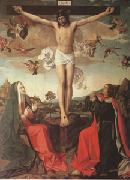
was a South Netherlandish painter, formerly known by the pseudonym the Master of St. Sebastian. Originating in the diocese of Cambrai in Hainaut, then part of the territories ruled by the Dukes of Burgundy. Josse Lieferinxe was documented as a "Picard" in the regions of Avignon and Marseille at the end of the fifteenth and in the early sixteenth centuries. He was first mentioned in Provence in 1493. Thus he figures among the painters of the Provençal school, whose most prominent members in an earlier generation had also been from the far north of the French-speaking world Barth lemy d'Eyck and Enguerrand Quarton. In 1503 he married Michelle, a daughter of Jean Changenet, the most prominent painter of Avignon, in whose atelier Lieferinxe may have matured his style. He was last mentioned living in 1505, and in 1508 as deceased. Before he was identified by Charles Sterling who linked his work with a document, his artistic personality was recognized, as the "Master of St. Sebastian", through a former retable of eight scenes depicting the acts and miracles of Saint Sebastian and Saint Roch, protectors against the plague, which was commissioned in 1497 for the church of Nôtre Dame des Accoul's in Marseille. Bernardino Sismondi, who originally received the commission, died, however, before he could finish the work.
|
|
 |
Josip Racic
|
|
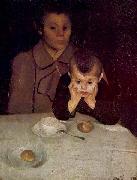
(1885 - 1908) was a Croatian painter in the early 20th century. Although he died very young (he was only 23), and his work was mostly created when a student, he is one of the best known of the modern Croatian painters. Today, Račić is regarded as one of the most important representatives of Croatian modern painting.
He studied lithography in Zagreb, and 1904 he went to Vienna and Munich, where he studied for a year at the school of the Slovene painter and teacher Anton Ažbe, followed by 3 years at the prestigious Academy of Arts. There, Racic, along with Oskar Herman, Vladimir Becić and Miroslav Kraljević formed the group known as the Croatian School. In 1908, he went to Paris where he painted a series of watercolors and oils depicting Parisian bridges, avenues and parks. He died of a gunshot wound in a Paris hotel room in June 1908, having committed suicide.
Josip Račić is one of the founders of modern Croatian art, the first to bring the concept of self-awareness and artistic integrity to his life and works, "pure painting", as he called it. A particular feature of his paintings is the strong dark realms of human spirituality. A retrospective of his work was held in the Modern Gallery in Zagreb and Dubrovnik in 2008-2009, to mark the 100th anniversary of the artist's death.
|
|
 |
Joshua Johnson
|
|
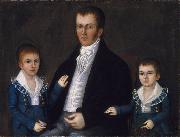
(c.1763-c.1824) was an American biracial painter from the Baltimore area. Johnson, often viewed as the first person of color to make a living as a painter in the United States, is known for his naïve paintings of prominent Maryland residents.
It was not until 1939 that the identity of the painter of elite 19th century Baltimoreans was shed to light by art historian and genealogist J. Hall Pleasants, who believed that thirteen portraits were painted by one Joshua Johnson. Pleasants attempted to put the puzzle of Johnson's life together, however, questions on Johnson's race, life dates and even his last name (Johnson or Johnston) remained. These questions remained up until the mid-1990s, when the Maryland Historical Society released newly found manuscripts regarding Johnson's life
|
|
|
|
|
|
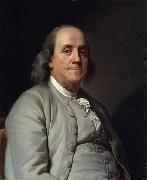 |
Joseph-Siffred Duplessis
|
|
(22 September 1725 - 1 April 1802) was a French painter, known for the clarity and immediacy of his portraits.
He was born in Carpentras, near Avignon, into a family with an artistic bent and received his first training from his father, a surgeon and talented amateur, then with Joseph-Gabriel Imbert (1666-1749), who had been a pupil of Charles Le Brun. From 1744-47 or later he worked in Rome, in the atelier of Pierre Subleyras, who was also from the south of France, who died in 1749. In Italy Duplessis became fast friends with Joseph Vernet, another Occitan.
He returned to Carpentras, spent a brief time in Lyon then arrived about 1752 in Paris, where he was accepted into the Academie de Saint-Luc and exhibited some portraits, which were now his specialty, in 1764, but did not achieve much notice until his exhibition of ten paintings at the Paris salon of 1769, very well received and selected for special notice by Denis Diderot; the Academie de peinture et de sculpture accepted him in the category of portraitist, considered a lesser category at the time. He continued to exhibit at the Paris salons, both finished paintings and sketches, until 1791, and once more, in 1801.
His portrait of the Dauphine in 1771 and his appointment as a peintre du Roi assured his success: most of his surviving portraits date from the 1770s and 1780s. He received privileged lodgings in the Galeries du Louvre. In the Revolution, he withdrew to safe obscurity at Carpentras during the Reign of Terror. Afterwards, from 1796, he served as curator at the newly-founded museum formed at Versaillles, so recently emptied of its furnishings at the Revolutionary sales. His uncompromising self-portrait at this time of his life is at Versailles, where he died.
|
|
 |
Joseph-Siffred Duplessis
|
|
1725-1802
French
Joseph Siffred Duplessis Locations
French painter. He trained with his father, an amateur painter, and then with Joseph-Gabriel Imbert (1666-1749), a pupil of Charles Le Brun. In 1744 he went to Rome and worked with Pierre Subleyras. He remained there until at least 1747 and possibly until the death of his master in 1749. He must have learnt portrait painting in Rome, but he also painted landscapes, because Joseph Vernet advised him to specialize in this genre.
|
|
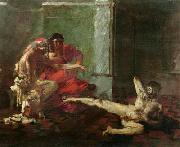 |
Joseph-Noel Sylvestre
|
|
(1847-1926) was a French artist, notable for his studies of classic scenes from antiquity. He was born in Beziers in South-West France on 24 June 1847, training as an artist first in Toulouse under Thomas Couture, then at the École des Beaux-Arts in Paris under Alexandre Cabanel. He was an exponent of the romantic Academic art style, also known as art pompier (fireman's art), examples of which are the Death of Seneca (1875), The Gaul Ducar decapitates the Roman general Flaminus at the Battle of Trasimene (1882), The Sack of Rome by the barbarians in 410 (1890) and François Rude working on the Arc de Triomphe (1893).
|
|
|
|
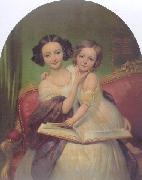 |
Joseph-Desire Court
|
|
a painter of historical subjects and portraits, was born at Rouen in 1797. He became a pupil at the École des Beaux-Arts under Gros, and after carrying off the principal honours there pursued his studies still further at Rome. High expectations were formed of him when he exhibited in 1827 'The Death of Caesar,' a work manifesting earnest thought, and a conscientious handling of the facts of history. This is now preserved in the Louvre. Having shown himself in this and other works a vigorous painter, capable of seizing a subject with a masterly grasp, and having also in the region of portrait painting proved himself an artist of no common merit, he eventually dissipated his talents in the production of a series of empty official pictures painted by order of Louis Philippe. He died in Paris in 1865. The Bordeaux Museum has a portrait of Henri Fonfrede by him; that of Lyons, a 'Scene in the Deluge'; that of Rouen,
|
|
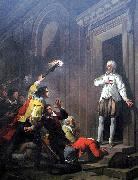 |
Joseph-Benoit Suvee
|
|
(3 January 1743 - 9 February 1807) was a Flemish painter strongly influenced by French neo-classicism.
He was born in Bruges. Initially a pupil of Matthias de Visch, he came to France aged 19 and became a pupil of Jean-Jacques Bachelier. In 1771, he won the Prix de Rome. In Rome from 1772 to 1778, he prolonged the usual duration allowed to pensionaries of the French Academy in Rome. He was named an academician on his return to Paris and he opened an art school for young women at the Louvre. He emulated and competed with Jacques-Louis David, earning his enduring hatred.
Named the French Academy in Rome's director in 1792, replacing François-Guillaume Menageot, he was imprisoned for a while in the Prison Saint-Lazare and only able to take up the post in 1801. After a brilliant career, and a six years' stay in Rome as the Academy's Director, he died there suddenly.
His works include Achilles depositing the body of Hector at the feet of the body of Patroclus, (1769, Louvre), and Cornelia, mother of the Gracchi, (1795, Louvre).
|
|
|
|
|
|
|
|
|
| Wholesale China Oil Painting Wholesale Oil Painting China Xiamen Portrait Reproduction on canvas Chinese Oil Painting Wholesale USA Oil Painting |
|
|
|
|
|