| |
|
Xiamen Oil Paintings, Wholesale Direct!
|
|
100% hand painted, 100% cotton canvas, 100% money back if not satisfaction. |
|
|
|
|
ART WORKS INDEX
A
B
C
D
E
F
G
H
I
J
K
L
M
N
O
P
Q
R
S
T
U
V
W
X
Y
Z
|
|
ARTISTS INDEX
A
B
C
D
E
F
G
H
I
J
K
L
M
N
O
P
Q
R
S
T
U
V
W
X
Y
Z
|
|
|
|
 |
proverb
|
|
1150 - 80. In North America the best-known collection is probably Poor Richard's, an almanac published 1732 - 57 by Benjamin Franklin. In North America may be the most famous collection of Richard are poor, and the publication of one year from 1732 to 1757 by Benjamin Franklin.
|
|
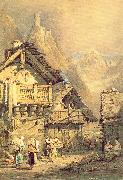 |
Prout, Samuel
|
|
English Painter, 1783-1852
Painter, draughtsman and writer. Together with his fellow pupil Benjamin Robert Haydon, Prout was encouraged to study drawing by the headmaster of his grammar school in Plymouth. In 1801 he met the topographer and antiquarian John Britton, who, impressed with his work, invited him to London the following year to make drawings of antiquarian subjects and copy works of other artists, including Thomas Hearne, William Alexander and J. M. W. Turner.
|
|
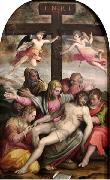 |
Prospero Fontana
|
|
(1512 - 1597) was an Italian painter of the late Renaissance.
Fontana was born in Bologna, and became a pupil of Innocenzo da Imola. He afterwards worked for Perin del Vaga in the Palazzo Doria in Genoa. Towards 1550, it is reported that Michelangelo introduced him to Pope Julius III as a portrait-painter; and he was pensioned at the pontifical court. He later joined Vasari's studio in Florence, and worked in frescoes at the Palazzo Vecchio (1563-65). He is an early representative of the Bolognese school of painting. Sabbatini, Sammachini and Passerotti were three of his principal pupils or colleagues. His daughter, Lavinia Fontana, was also a prominent painter of mostly conventional religious canvases.
Returning to Bologna, after doing some work in Fontainebleau (France) and in Genoa, he opened a school of art, in which he became briefly the preceptor of Lodovico and Agostino Carracci. He has left a large quantity of work in Bologna. His altarpiece of the Adoration of the Magi, in the church of Santa Maria delle Grazie, being considered his masterpiece. It is not unlike the style of Paul Veronese. He died in Rome in 1597.
|
|
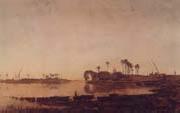 |
Prosper Marilhat
|
|
French Academic Painter, 1811-1847, French painter. He painted his first landscapes and family portraits at Thiers and in the Auvergne before moving to Paris in 1829. After working as the pupil of Camille Roqueplan he was engaged by Baron Karl von H?gel for an expedition to the Near East (1831-3), from which he brought back numerous studies. He visited Greece, Syria, Lebanon and Palestine, stayed in Egypt from October 1831 to May 1833 and returned by way of Rhodes and Corfu. Cairo, the villages of the Delta and Upper Egypt proved to be sources of inspiration for later works.
|
|
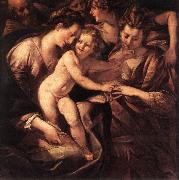 |
PROCACCINI, Giulio Cesare
|
|
Italian Baroque Era Painter and Sculptor, 1574-1625
..Painter and sculptor, son of Ercole Procaccini. Having moved to Milan with the rest of the family in the mid-1580s, he trained as a sculptor, perhaps in the workshop of Francesco Brambilla, and then worked (1591-9) for the workshop of Milan Cathedral. The results of this work are difficult to identify, and the most secure attribution is the left term on the altar of St Joseph. There followed a period (1597-1602) of intense sculptural activity for the church of S Maria presso S Celso, for the fa?ade of which he executed two high reliefs in marble, the Visitation and Birth of the Virgin. In 1597 he may have accompanied his brother Camillo to Reggio Emilia, where Camillo added to his earlier fresco decorations for S Prospero. Between 1597 and 1600 Giulio Cesare is documented as working as a sculptor for Cremona Cathedral, to which two sculptures, St Matthew and St John, were delivered, after many delays, in 1625. He also produced the gilded wood Guardian Angel (1597; Cremona, Mus. Civ. Ala Ponzone) for S Monica, Cremona. From Cremona he travelled to Parma,
|
|
|
|
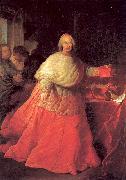 |
Procaccini, Andrea
|
|
Italian, 1671-1734
Italian painter, draughtsman and architect. A pupil of Carlo Maratti, he is first documented in 1702, among the restorers of Raphael's fresco decorations (1511-14) in the Vatican. His Tarquinius and Lucretia (c. 1705; Holkham Hall, Norfolk) has cold colours and unnatural gestures that recall Guido Reni. Appointed by Pope Clement XI, between 1710 and 1717 Procaccini supervised the tapestry factory in S Michele a Ripa: the Purification of the Virgin (Rome, Vatican, Consistory Hall) is the only extant tapestry made from a cartoon (untraced) by Maratti and an oil painting (untraced) by Procaccini. The Baptism of Cornelius Centurion (1711; Urbino, S Francesco) for the Baptism Chapel in St Peter's, Rome, was previously attributed to Maratti or Giuseppe Bartolomeo Chiari, but Procaccini apparently based it on sketches supplied by Maratti, who also supervised and revised the work before it was displayed.
|
|
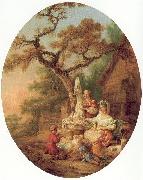 |
Prince, Jean-Baptiste le
|
|
French Painter, 1734-1781
was an important French etcher and painter. Le Prince first studied painting techniques in his native Metz. He then travelled to Paris around 1750 and became a leading student of the great painter, Francois Boucher (1703-1770). Le Prince's early paintings in both theme and style are comparable to his master's rococo techniques. In 1758 Le Prince journeyed to Russia to work for Catherine the Great at the Imperial Palace, St. Petersburg. He remained in Russia for five years and also travelled extensively throughout Finland, Lithuania and even Siberia. When Le Prince returned to Paris in December, 1763, he brought with him an extensive collection of drawings which he employed as the basis for a number of fine paintings and etchings. J. B. Le Prince was elected a full member of the Academie de peinture et de sculpture in 1765. Le Prince's graphic art of Russia and its peoples is significant in that he based his compositions entirely upon his own designs, lending a much more realistic portrayal to his views than other eighteenth century contemporaries. He is also credited with being the first artist (in 1768) to introduce aquatint into his etched and engraved plates. He may even have been the inventor of aquatint, the tonal graphic art that would later be so skillfully used by such masters as Goya,
|
|
 |
PRETI, Mattia
|
|
Italian Baroque Era Painter, 1613-1699
Italian painter and draughtsman. Although he was trained and had his first success as a painter in Rome during the 1630s and 1640s, he is traditionally associated with the Neapolitan school. It was in Naples between 1653 and 1660 that he made his most lasting mark (see fig. 1), contributing to the evolution of the exuberant late Baroque style and providing an important source of inspiration to later generations of painters, notably to Francesco Solimena. From 1661 he was based in Malta, where his most substantial undertaking was the decoration of St John's, Valletta. Preti's mature style is intensely dramatic and unites a Caravaggesque realism and expressive chiaroscuro with the grandeur and theatricality of Venetian High Renaissance painting.
|
|
|
|
|
|
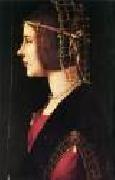 |
PREDIS, Ambrogio de
|
|
Italian Early Renaissance Painter, ca.1455-1508
Painter and illuminator, half-brother of Cristoforo de Predis. He began his career as an illuminator, working with Cristoforo. His first documented works are seven miniatures for a Book of Hours (1472; destr.) for Vitaliano Borromeo (1451-95) and a Book of Hours for Francesco Borromeo. He was paid for the latter in 1474, and the codex can probably be identified with the Horae Beatae Virginis Mariae (ex-H. P. Kraus, New York, 1987; Suida, 1959). From 1479 he artist worked in the Milanese mint, together with his brother Bernardino. For some years Giovanni Ambrogio also worked at the court of Ludovico Sforza ('il Moro'), especially as a portrait painter. This is borne out by the charcoal drawing of Bianca Maria Sforza (1492; Venice, Accad.), which dates from a period before her marriage to Emperor Maximilian I. The portrait was ordered by her future husband, through Frederick III, Duke of Saxony, to give him an idea of her appearance. It was favourably received, and later a painting of the same subject (Washington, DC, N.G.A.) was commissioned from Giovanni Ambrogio.
|
|
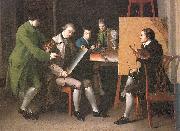 |
Pratt, Matthew
|
|
American Colonial Era Painter, 1734-1805
.American painter. One of ten children of a goldsmith, he was apprenticed at 15 to his uncle, James Claypoole. He spent almost seven years as an apprentice and eight as a painter of portraits and signs for taverns, shops and counting houses. In 1764 he went to England,
|
|
|
|
|
|
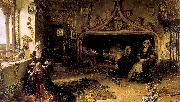 |
Pradilla, Francisco
|
|
Spanish, 1848-1921
Spanish painter and museum official. He first studied in Saragossa with the stage designer Mariano Pescador (d 1886), and in 1866 moved to Madrid where he began to work with the stage designers and decorators Ferri and Busato. He entered the Escuela Superior de Pintura, Escultura y Grabado and also attended the Academia de Acuarelistas. In 1873 Pradilla and his fellow student Casto Plasencia (1846-90) won history painting scholarships to study at the newly founded Academia Espaola de Bellas Artes in Rome. In 1874 he sent from Rome a copy of Raphael's Dispute over the Holy Sacrament, a work Pradilla completed in collaboration with Alejandro Ferrant (b 1844), another Spanish scholarship holder. During Pradilla's second and third years abroad he travelled through France, visiting the Paris Exposition Universelle of 1875, and Italy, where he was particularly impressed by Venice and the works of Veronese, Titian and Jacopo Tintoretto. Pradilla won a major prize in 1878 at the Exposicien Nacional de Bellas Artes in Madrid; as a result of this success he received the commission for another large picture on a historical theme, the Surrender of Granada (1882; in situ) for the Palacio del Senado (now Pal. de las Cortes) in Madrid. This work shows Pradilla's concern to paint from life in his treatment of the landscape of Granada. He produced other paintings on related subjects, including Mad Queen Joanna Imprisoned at Tordesillas (priv. col., see Pardo Canalis, pl. xviii) and the Sigh of the Moor (Madrid, Rodriguez Bauze priv. col., Pardo Canalis, pl. xvii). Pradilla also painted lively scenes of local life and colour. The years of his stay in Rome, where he was director of the Academia Espa?ola between 1881 and 1883,
|
|
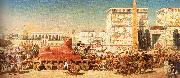 |
Poynter, Sir Edward John
|
|
English Classicist Painter, 1836-1919
English painter, draughtsman, decorative designer and museum official. He came from an artistic family: his great-grandfather was Thomas Banks the sculptor, and Ambrose Poynter, his father, was an architect and watercolour painter. Edward began studying art in 1852 under Thomas Shotter Boys, a friend of his father. In 1853-4 Poynter visited Rome, where he was greatly impressed by the large-scale academic painting of Frederic Leighton. Returning to London, he studied at Leigh's Academy and the studio of William Dobson (1817-1898). Poynter entered the Royal Academy Schools in 1855 but his admiration for French painting led him to Charles Gleyre's studio in Paris the following year. He remained there until 1859, with fellow students George Du Maurier, Thomas Armstrong and Whistler; their activities are described in Du Maurier's novel Trilby (1894). At this time Poynter received his first commissions for decorative work. He began designing stained glass and painting furniture and, after his return to England, he was employed by his friend the architect William Burges to decorate the ceiling of Waltham Abbey, Essex, in 1860.
|
|
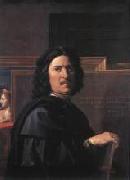 |
POUSSIN, Nicolas
|
|
French Baroque Era Painter, 1594-1665
French painter and draughtsman, active in Italy. His supreme achievement as a painter lies in his unrivalled but hard-won capacity to subordinate dramatic narrative and the expression of extreme states of human passions to the formal harmony of designs based on the beauty and precision of abstract forms. The development of his art towards this end was focused on the search for a point of equilibrium and synthesis between the forces of the Classical and the Baroque around which most critical debate in Rome was concentrated during the 1630s. Poussin did not aspire to the classicism of Raphael's idealized human forms or Michelangelo's re-embodiment of the physical splendours of the antique world, nor did he attempt to vie with the bravura and energy of Annibale Carracci's treatment of Classical mythology in the Galleria of the Palazzo Farnese in Rome. Equally he was not concerned with the illusionistic effects and heightened emotionalism of Baroque artists such as Pietro da Cortona and Lanfranco. He was concerned above all with interpreting his subject-matter, whether Classical or religious, and telling a story with the greatest possible concentration of emotional response,
|
|
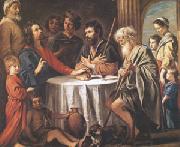 |
Poussin
|
|
Les Andelys 1594 - Rome 1665
|
|
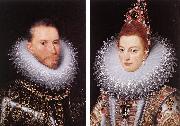 |
POURBUS, Frans the Younger
|
|
Flemish painter (b. 1569, Antwerpen, d. 1622, Paris).
was a Flemish painter, son of Frans Pourbus the Elder and grandson of Pieter Pourbus. He was born in Antwerp and died in Paris. He is also referred to as "Frans II". Pourbus worked for many of the highly influential people of his day, including the Brussels-based Spanish Regents of the Netherlands, the Duke of Mantua and Marie de' Medici, Queen of France. Works of his can be found in the Louvre, the Prado, the Rijksmuseum, the Royal College of Art,
|
|
 |
POURBUS, Frans the Elder
|
|
Netherlandish painter (b. 1545, Bruges, d. 1581, Antwerpen).
was a Flemish Renaissance painter. He was known primarily for his religious and portrait painting and worked mainly in Antwerp. His father was painter Pieter Pourbus and his son was painter Frans Pourbus the younger.
|
|
 |
POTTER, Paulus
|
|
Dutch Baroque Era Painter, 1625-1654
Son of Pieter Potter. He was related through his mother, Aechtie Pouwels (d 1636), to the wealthy and powerful von Egmont and Semeyns families, who held important offices in Enkhuizen and at the court in The Hague. He worked in his father's studio in Amsterdam during the 1630s and, like him, painted history subjects that show the strong influence of Claes Moeyaert, with whom Paulus may also have studied. In the painting Abraham Returning from Canaan he adapted the landscape setting from an etching by Moses van Uyttenbroeck and the figures from works by Moeyaert from over ten years earlier. Significantly, however, he redistributed the numerous animals and figures that Moeyaert had aligned evenly across the frontal plane; Potter placed them to one side, permitting a view into the deep distance where other animals can be seen. Potter followed his father more than Moeyaert in searching for ways to integrate his figures with the landscape,
|
|
|
|
|
|
 |
POST, Frans
|
|
Dutch Baroque Era Painter, 1612-1680
Painter and draughtsman, brother of Pieter Post. He was one of the first trained European landscape artists to paint in the New World. His paintings and drawings without exception depict Brazilian scenery with exotic buildings, plants, animals and natives. He probably received his early training from his father and was also influenced by his brother's early landscapes, although no works exist from this period. When Johan Maurits, Count of Nassau-Siegen went to Brazil as Governor General of the Dutch colony in the north-east in October 1636, Frans Post, together with ALBERT ECKHOUT, was among the artists and scientists on board to record various aspects of Brazilian life, landscape,
|
|
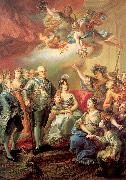 |
Portana, Vicente Lopez
|
|
Spanish Painter, 1772-1850
was a Spanish painter, considered the best portrait painter of his time. Vicente Lepez y Portaña was born in Valencia on September 19, 1772. His parents were Cristebal Lepez Sanchordi and Manuela Portaña Meer. Vicente Lepez began formally studying painting in Valencia at the age of thirteen, he was a disciple of father Antonio de Villanueva, a Franciscan monk, and he studied at the Academy of San Carlos in his native city. He was seventeen when he won first price in drawing and coloring receiving a scholarship to study in the prestigious Academia Real de Bellas Artes de San Fernando in Madrid. For the following three years in Madrid, he apprenticed with the Valencian painter, Mariano Salvador Maella. Vicente Lepez returned to Valencia in 1794 and subsequently became vice-director of painting at the Academy where he had studied as a boy.
|
|
|
|
|
|
|
|
|
|
 |
POORTER, Willem de
|
|
Dutch Baroque Era Painter, 1608-ca.1648
Dutch painter. His father, Pieter, came from Flanders to Haarlem, where in 1631 works by Willem were recorded for the first time. In 1634 Willem was registered in Haarlem as a master painter, and in 1635 Pieter Casteleijn was named as his pupil. As late as 1643 Pieter Abrams Poorter and Claes Coenraets began their studies with him in Haarlem. Willem is mentioned for the last time in the archives of the Haarlem Guild of St Luke in 1645, the year he left for Wijk bij Heusden. He supposedly studied under Rembrandt, together with his fellow townsman Jacob de Wet. There is no documentation to support this assumption, but a number of de Poorter's small-scale biblical and history paintings bear such a striking likeness to Rembrandt's biblical compositions of c. 1630 that the two hands are often confused. Rembrandt's Presentation in the Temple (1631; The Hague, Mauritshuis; see REMBRANDT VAN RIJN) was copied (Dresden, Gemeldegal. Alte Meister) by de Poorter, who also painted his own version (Kassel, Schloss Wilhelmsh?he). The lighting in de Poorter's Entombment (Guernsey, D. Cevat priv..) was also apparently inspired by Rembrandt's example. Since de Poorter's paintings were first reported in Haarlem in 1631, the year that Rembrandt moved from Leiden to Amsterdam, it seems likely that de Poorter received his training in the Leiden workshop, where Gerrit Dou had also been working since 1628.
|
|
|
|
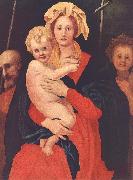 |
Pontormo, Jacopo
|
|
b Pontormo, nr Empoli, 26 May 1494; d Florence, 31 Dec 1556).
Italian painter and draughtsman. He was the leading painter in mid-16th-century Florence and one of the most original and extraordinary of Mannerist artists. His eccentric personality, solitary and slow working habits and capricious attitude towards his patrons are described by Vasari; his own diary, which covers the years 1554-6, further reveals a character with neurotic and secretive aspects. Pontormo enjoyed the protection of the Medici family throughout his career but, unlike Agnolo Bronzino and Giorgio Vasari, did not become court painter. His subjective portrait style did not lend itself to the state portrait. He produced few mythological works and after 1540 devoted himself almost exclusively to religious subjects. His drawings, mainly figure studies in red and black chalk, are among the highest expressions of the great Florentine tradition of draughtsmanship; close to 400 survive, forming arguably the most important body of drawings by a Mannerist painter. His highly personal style was much influenced by Michelangelo
|
|
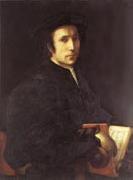 |
Pontormo
|
|
Italian Mannerist Painter, 1494-ca.1556
Italian painter and draughtsman. He was the leading painter in mid-16th-century Florence and one of the most original and extraordinary of Mannerist artists. His eccentric personality, solitary and slow working habits and capricious attitude towards his patrons are described by Vasari; his own diary, which covers the years 1554-6, further reveals a character with neurotic and secretive aspects. Pontormo enjoyed the protection of the Medici family throughout his career but, unlike Agnolo Bronzino and Giorgio Vasari, did not become court painter. His subjective portrait style did not lend itself to the state portrait. He produced few mythological works and after 1540 devoted himself almost exclusively to religious subjects. His drawings, mainly figure studies in red and black chalk, are among the highest expressions of the great Florentine tradition of draughtsmanship; close to 400 survive, forming arguably the most important body of drawings by a Mannerist painter.
|
|
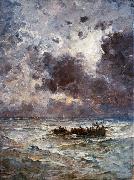 |
Pompeo Mariani
|
|
(Monza, Province of Milan 1857 - Bordighera, Province of Imperia, 1927) was an Italian painter.
The nephew of Mose Bianchi, Mariani abandoned a career in banking to devote himself entirely to painting. His apprenticeship began in 1879 under the guidance of the painter Eleuterio Pagliano, who introduced him to life studies. A trip to Egypt with Uberto DelleOrto in 1881 provided subjects for the works shown at the Brera exhibitions of the next two years. He focused on landscape painting and began to specialise in seascapes in 1883, when he first stayed on the coast of Liguria. The first views of the Zelata area outside Pavia appeared in 1894. His art is characterised by subtle sensitivity in the investigation of the reflection of light on water, captured in different seasons and times of the day to achieve highly atmospheric effects. In was at the beginning of the new century that he began to combine naturalistic landscapes with depictions of the elegant world of high society in fashionable gatherings and cafes. His vast production of landscapes and portraits was regularly presented at the major national and international exhibitions and won numerous official awards.
|
|
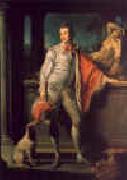 |
Pompeo Batoni
|
|
Italian
1708-1787
Pompeo Batoni Location
Italian painter and draughtsman. In his day he was the most celebrated painter in Rome and one of the most famous in Europe. For nearly half a century he recorded the visits to Rome of international travellers on the GRAND TOUR in portraits that remain among the most memorable artistic accomplishments of the period. He was equally gifted as a history painter, and his religious and mythological paintings were sought after by the greatest princes of Europe.
|
|
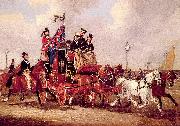 |
Pollard, James
|
|
English, 1792-1867
Painter and etcher, son of Robert Pollard. His early career was spent in the shadow of his father, for whom he worked as an etcher of miscellaneous sporting subjects before establishing himself c. 1820 as a sporting painter in his own right. A typical example is Doncaster Races: Horses Starting for the St Leger (1831; Paul Mellon priv. col.). Following a commission from the King's Printseller, Edward Orme, for an inn signboard showing a coach and horses, Pollard began to specialize in coaching scenes.
|
|
|
|
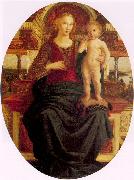 |
Pollaiuolo, Jacopo
|
|
Approx. 1441-1496
Painter, brother of Antonio Pollaiuolo. He was described as a painter in the membership records of the Compagnia di S Luca, which he joined in 1472. According to tradition, he initially trained under Andrea del Castagno. In his 1480 tax return Piero reported that he had a small house adjoining the family home '...which I use when I have painting to do'. He produced many paintings for the Florentine workshop,
|
|
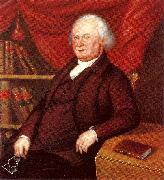 |
Polk, Charles Peale
|
|
American, 1767-1822
American painter. Orphaned as a child, he was raised in Philadelphia, PA, by his uncle, Charles Willson Peale, who taught him to paint. In 1791 Polk moved to Baltimore, MD, where he achieved limited success as a portrait painter. Seeking commissions, he moved to Frederick, MD, in 1796. Over the next five years during travels as an itinerant limner through western Maryland and Virginia he reached his mature style. Abandoning his academic training, Polk developed a distinctive but naive artistic vocabulary with a heightened palette, electric highlights and an exaggerated attenuation of the human form. The portraits of Isaac Hite and his wife Eleanor Madison Hite, as well as James Madison sr and Eleanor Conway Madison (all Middletown, VA, Belle Grove), were commissioned in 1799 and are accepted as his masterpieces. Isaac Hite also commissioned the quintessentially 'republican' portrait of Thomas Jefferson (New York, Victor Spark priv. col.), executed at Monticello in 1799. In 1801 Polk moved to Washington, DC, working as a clerk in the Treasury. During the next 16 years he painted few portraits in oil
|
|
 |
Polenov, Vasily
|
|
Russian, 1844-1927
He began a systematic study of drawing in 1856, first with the landscape painter Pavel Cherkasov (1834-1900), then from 1859 to 1861 with Pavel Chistyakov (1832-1919). He also took lessons with Chistyakov, whom he considered his most important teacher, in 1871 and early 1872, after finishing his academic course. From 1863 to 1871 Polenov studied at the St Petersburg Academy of Art, where he met members of the progressive wing of the Russian artistic intelligentsia, and occasionally in the faculty of law at St Petersburg University. The classical education he received at home, his academic training and lessons with Chistyakov led Polenov towards an 'exalted' history painting, although he personally inclined towards landscape. This dualism remained in Polenov's work for the duration, and not until the late 1880s and early 1890s did he achieve a stable relationship between the two forms. The whole of his student career and the initial postgraduate, scholarship period was largely taken up with historical works: from academic compositions, for example the Resurrection of Jairus's Daughter (1871; Pskov, Mus. Hist., Archit. & A.), for which he received the Grand Gold Medal and a travel bursary (in Germany and Italy, 1872-3, and France, 1873-6), to numerous pictures and sketches on subjects from antiquity and medieval history, executed in France or shortly after his departure from there, under the perceptible influence of Paul Delaroche
|
|
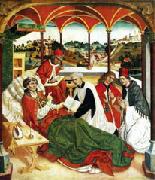 |
POLACK, Jan
|
|
Polish Northern Renaissance Painter, died 1519
|
|
|
|
|
|
|
|
|
|
|
|
 |
plato
|
|
Born: c. 428 B.C.
Birthplace: Athens, Greece
Died: 347 B.C.
Best Known As: The ancient philosopher who wrote The Republic
|
|
|
|
|
|
|
|
|
|
|
|
|
| Wholesale China Oil Painting Wholesale Oil Painting China Xiamen Portrait Reproduction on canvas Chinese Oil Painting Wholesale USA Oil Painting |
|
|
|
|
|